• Wyszukiwanie zaawansowane
  • Kategorie
  • Kategorie BISAC
  • Książki na zamówienie
  • Promocje
  • Granty
  • Książka na prezent
  • Opinie
  • Pomoc
  • Załóż konto
  • Zaloguj się

Illumination and Color in Computer Generated Imagery » książka


zaloguj się | załóż konto
Logo Krainaksiazek.pl

koszyk

konto

szukaj
topmenu
Księgarnia internetowa
Szukaj
Książki na zamówienie
Promocje
Granty
Książka na prezent
Moje konto
Pomoc
 
 
Wyszukiwanie zaawansowane
Pusty koszyk
Bezpłatna dostawa dla zamówień powyżej 20 złBezpłatna dostawa dla zamówień powyżej 20 zł

Kategorie główne

• Nauka
 [2946600]
• Literatura piękna
 [1856966]

  więcej...
• Turystyka
 [72221]
• Informatyka
 [151456]
• Komiksy
 [35826]
• Encyklopedie
 [23190]
• Dziecięca
 [619653]
• Hobby
 [140543]
• AudioBooki
 [1577]
• Literatura faktu
 [228355]
• Muzyka CD
 [410]
• Słowniki
 [2874]
• Inne
 [445822]
• Kalendarze
 [1744]
• Podręczniki
 [167141]
• Poradniki
 [482898]
• Religia
 [510455]
• Czasopisma
 [526]
• Sport
 [61590]
• Sztuka
 [243598]
• CD, DVD, Video
 [3423]
• Technologie
 [219201]
• Zdrowie
 [101638]
• Książkowe Klimaty
 [124]
• Zabawki
 [2473]
• Puzzle, gry
 [3898]
• Literatura w języku ukraińskim
 [254]
• Art. papiernicze i szkolne
 [8170]
Kategorie szczegółowe BISAC

Illumination and Color in Computer Generated Imagery

ISBN-13: 9781461281412 / Angielski / Miękka / 2011 / 282 str.
Roy Hall
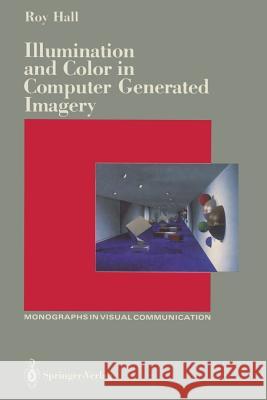
Illumination and Color in Computer Generated Imagery Roy Hall 9781461281412 Springer - książkaWidoczna okładka, to zdjęcie poglądowe, a rzeczywista szata graficzna może różnić się od prezentowanej.

Illumination and Color in Computer Generated Imagery

ISBN-13: 9781461281412 / Angielski / Miękka / 2011 / 282 str.

Roy Hall
cena 201,72 zł
(netto: 192,11 VAT:  5%)

Najniższa cena z 30 dni: 192,74 zł
Termin realizacji zamówienia:
ok. 22 dni roboczych
Bez gwarancji dostawy przed świętami

Darmowa dostawa!

In a very broad sense the historical development of computer graphics can be considered in three phases, each a giant step down the road towards "realistic" computer generated images. The first, during the late 1960's and early 1970's, can perhaps be characterized as the "wire frame" era. Basically pictures were composed of lines. Considerable em phasis was placed on "real time" interactive manipulation of the model. As models became more complex and as raster technology developed, eliminating the hidden lines or hidden surfaces from the image became critical for visual understanding. This requirement resulted in the second phase of computer graphics, the "hidden surface" era, that developed during the 1970's and early 1980's. The names associated with hidden surface algorithms read like a who's who of computer graphics. The cul mination of the hidden surface era and the beginning of the current and third era in computer graphics, the "rendering" era, was Turner Whitted's incorporation of a global illumination model into the ray trac ing algorithm. Now the goal was not just to generate an image, but to generate a realistic appearing image."


Kategorie:
Informatyka
Kategorie BISAC:
Computers > Software Development & Engineering - Computer Graphics
Computers > Artificial Intelligence - Computer Vision & Pattern Recognition
Wydawca:
Springer
Seria wydawnicza:
Monographs in Visual Communication
Język:
Angielski
ISBN-13:
9781461281412
Rok wydania:
2011
Wydanie:
Softcover Repri
Numer serii:
000015488
Ilość stron:
282
Waga:
0.46 kg
Wymiary:
23.5 x 15.5
Oprawa:
Miękka
Wolumenów:
01

1.0 Introduction.- 1.1 Intent and Overview.- 1.2 The Process of Creating Images.- 1.3 Representation or Simulation of Reality.- 2.0 The Illumination Process.- 2.1 Light and Materials.- 2.2 Background Optics and Physics.- 2.2.1 Vector Notation.- 2.2.2 The Wave Nature of Light.- 2.2.3 Illuminating Hemisphere and Solid Angle.- 2.2.4 Intensity and Energy.- 2.2.5 Reflection and Refraction.- 2.2.6 Geometry of a Surface.- 2.2.7 Geometric Attenuation.- 2.3 Surface Illumination.- 2.3.1 Coherent Illumination.- 2.3.2 Incoherent Illumination.- 2.3.2.1 Incoherent Mechanism.- 2.3.2.2 Microfacet Distribution.- 2.3.2.3 Computing Incoherent Illumination.- 2.3.2.4 Ideal Diffuse Illumination.- 2.3.3 Emissive Illumination.- 2.3.4 A Generalized Illumination Expression.- 3.0 Perceptual Response.- 3.1 Describing Color.- 3.2 Colorimetry.- 3.3 Colorimetry and the RGB Monitor.- 3.4 Alternate Color Representations.- 3.5 Color Spaces for Color Computation.- 3.5.1 Computation in RGB.- 3.5.2 Spectral Sampling Approaches.- 3.5.3 Sources of Confusion.- 4.0 Illumination Models.- 4.1 Shading and Illumination Basics.- 4.1.1 Starting from the Eye.- 4.1.2 Starting from the Light.- 4.1.3 Combined Techniques.- 4.2 Incremental Shading, Empirical Models.- 4.2.1 Diffuse Illumination.- 4.2.2 Atmospheric Attenuation.- 4.2.3 Specular Highlights.- 4.2.4 Geometric Smoothing.- 4.3 Ray Tracing, Transitional Models.- 4.3.1 Improved Specular Reflection.- 4.3.2 Macroscopic Surface Properties.- 4.3.3 Recursive Reflection and Refraction.- 4.3.4 Distributed Ray Tracing.- 4.4 Radiosity, Analytical Models.- 4.4.1 An Energy Equilibrium Illumination Model.- 4.4.2 Radiosity for Diffuse Environments.- 4.4.3 Radiosity for Specular Environments.- 4.5 Hybrid Techniques.- 4.5.1 View Independent Illumination.- 4.5.2 View Dependent Illumination.- 4.6 Visual Comparison.- 4.7 Summary.- 5.0 Image Display.- 5.1 Image File Considerations.- 5.1.1 Color Correction for Display.- 5.1.2 Gamma Correction for Display.- 5.1.3 Color Clipping and Compressing for Display.- 5.1.4 Image Dither and Patterning.- 5.2 NTSC and RGB Video.- 5.3 Video Setup for Image Display.- 5.4 Monitor Alignment and Calibration.- 5.5 NTSC Limitations.- 5.6 Black and White Display.- Appendix I Terminology.- Appendix II Controlling Appearance.- II.1 Surface Character.- II.1.1 Dielectric Materials.- II.1.2 Conductive Materials.- II.1.3 Composite Materials.- II.1.4 Using Published Spectral Data.- II.2 Surface Finish.- Appendix III Example Code.- III.1 Geometric Utilities.- III.1.1 Code Summary.- III.1.2 Code Source.- III.2 Hemispherical Integrator.- III.2.1 Code Summary.- III.2.2 Code Source.- III.3 Geometric Attenuation.- III.3.1 Code Summary.- III.3.2 Code Source.- III.4 Microfacet Distributions.- III.4.1 Code Summary.- III.4.2 Code Source.- III.5 Fresnel Approximation.- III.5.1 Approximation Methodology.- III.5.2 Code Summary.- III.5.3 Code Source.- III.6 Illumination Models.- III.6.1 Illuminated Surface Description.- III.6.2 Code Summary.- III.6.3 Code Source.- III.7 Color Transformation.- III.7.1 Material Data.- III.7.2 Code Summary.- III.7.3 Code Source.- III.8 Spectral Sampling.- III.8.1 Code Summary.- III.8.2 Code Source.- III.9 RGB Color Cupping.- III.9.1 Code Summary.- III.9.2 Code Source.- Appendix IV Radiosity Algorithms.- IV.1 Pseudocode Definition.- IV.2 Hemi-cube Form Factors.- IV.3 Specular Radiosity.- IV.4 Hybrid Form Factors.- Appendix V Equipment Sources.- References.


Udostępnij

Facebook - konto krainaksiazek.pl


Opinie o Krainaksiazek.pl na Opineo.pl

Partner Mybenefit

Krainaksiazek.pl w programie rzetelna firma Krainaksiaze.pl - płatności przez paypal

Czytaj nas na:

Facebook - krainaksiazek.pl
  • książki na zamówienie
  • granty
  • książka na prezent
  • kontakt
  • pomoc
  • opinie
  • regulamin
  • polityka prywatności

Zobacz:

  • Księgarnia czeska

  • Wydawnictwo Książkowe Klimaty

1997-2025 DolnySlask.com Agencja Internetowa

© 1997-2022 krainaksiazek.pl
     
KONTAKT | REGULAMIN | POLITYKA PRYWATNOŚCI | USTAWIENIA PRYWATNOŚCI
Zobacz: Księgarnia Czeska | Wydawnictwo Książkowe Klimaty | Mapa strony | Lista autorów
KrainaKsiazek.PL - Księgarnia Internetowa

Polityka prywatnosci - link
Krainaksiazek.pl - płatnośc Przelewy24
Przechowalnia Przechowalnia





