• Wyszukiwanie zaawansowane
  • Kategorie
  • Kategorie BISAC
  • Książki na zamówienie
  • Promocje
  • Granty
  • Książka na prezent
  • Opinie
  • Pomoc
  • Załóż konto
  • Zaloguj się

Identity, Language and Education of Sakhalin Japanese and Koreans: Continual Diaspora » książka

zaloguj się | załóż konto
Logo Krainaksiazek.pl

koszyk

konto

szukaj
topmenu
Księgarnia internetowa
Szukaj
Książki na zamówienie
Promocje
Granty
Książka na prezent
Moje konto
Pomoc
 
 
Wyszukiwanie zaawansowane
Pusty koszyk
Bezpłatna dostawa dla zamówień powyżej 20 złBezpłatna dostawa dla zamówień powyżej 20 zł

Kategorie główne

• Nauka
 [2946912]
• Literatura piękna
 [1852311]

  więcej...
• Turystyka
 [71421]
• Informatyka
 [150889]
• Komiksy
 [35717]
• Encyklopedie
 [23177]
• Dziecięca
 [617324]
• Hobby
 [138808]
• AudioBooki
 [1671]
• Literatura faktu
 [228371]
• Muzyka CD
 [400]
• Słowniki
 [2841]
• Inne
 [445428]
• Kalendarze
 [1545]
• Podręczniki
 [166819]
• Poradniki
 [480180]
• Religia
 [510412]
• Czasopisma
 [525]
• Sport
 [61271]
• Sztuka
 [242929]
• CD, DVD, Video
 [3371]
• Technologie
 [219258]
• Zdrowie
 [100961]
• Książkowe Klimaty
 [124]
• Zabawki
 [2341]
• Puzzle, gry
 [3766]
• Literatura w języku ukraińskim
 [255]
• Art. papiernicze i szkolne
 [7810]
Kategorie szczegółowe BISAC

Identity, Language and Education of Sakhalin Japanese and Koreans: Continual Diaspora

ISBN-13: 9783031137976 / Angielski / Twarda / 2022
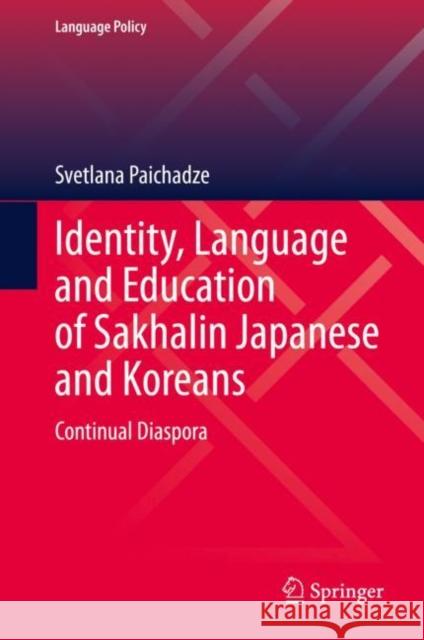
Svetlana Paichadze
Identity, Language and Education of Sakhalin Japanese and Koreans: Continual Diaspora Paichadze, Svetlana 9783031137976 Springer International Publishing - książkaWidoczna okładka, to zdjęcie poglądowe, a rzeczywista szata graficzna może różnić się od prezentowanej.

Identity, Language and Education of Sakhalin Japanese and Koreans: Continual Diaspora

ISBN-13: 9783031137976 / Angielski / Twarda / 2022

Svetlana Paichadze
cena 443,82
(netto: 422,69 VAT:  5%)

Najniższa cena z 30 dni: 385,52
Termin realizacji zamówienia:
ok. 22 dni roboczych
Bez gwarancji dostawy przed świętami

Darmowa dostawa!
inne wydania

This book explores the issues of education, the use of languages and the formation of self-identification of the Japanese and Korean diasporas of Sakhalin, over a hundred years period: from the time they moved to the island, until their “return” to historical homelands in Japan or South Korea. During this time, their language environment and language of education changed 4 times and Japanese and Korean of Sakhalin continued to be a linguistic and ethnic minority.


This book is of interest to researchers, students, NGO supporters and education policy makers. 

Kategorie:
Podręczniki
Kategorie BISAC:
Education > Language Experience Approach
Language Arts & Disciplines > Linguistics - Sociolinguistics
Social Science > Emigration & Immigration
Wydawca:
Springer International Publishing
Seria wydawnicza:
Language Policy
Język:
Angielski
ISBN-13:
9783031137976
Rok wydania:
2022
Waga:
0.46 kg
Wymiary:
23.5 x 15.5
Oprawa:
Twarda

Series editors' foreword​


Foreword 

Chapter 1. Introduction

1.1 Historical Context

1.2 Theoretical Context

 1.2.1 Immigration, Repatriation and Migration Studies

 1.2.2 Diaspora Studies

 1.2.3 Ethnic Identity

 1.2.4 Identity and Language

 1.2.5 School Education and Language

1.3 Methodology and Structure of the Book

Part I. From Joint Control to the Border on the Island

Chapter 2. Sakhalin under Control of the Russian Empire and Soviet Union

2.1 From Joint to Russian Control

2.2 From St. Petersburg Treaty to Russo-Japanese War

 2.2.1 Movement of the Population and Ethnic Composition of the Island.

 2.2.2 Policy for Migrants in the Russian Far East

 2.2.3 First Schools

2.3 After Russo-Japanese War

 2.3.1 Movement of the Population

 2.3.2 Schools Between 1906 and 1917

2.4 Sakhalin after the Russian Revolution

 2.4.1 New Wave of Colonisation and Migration of the Population

 2.4.2 Ethnic Policy in Soviet Sakhalin

 2.4.3 Schools in Soviet Sakhalin

2.5 Conclusion of the Chapter

Chapter 3. Sakhalin/Karafuto under Control of the Japanese Empire
3.1 Migration Policy and Movement of the Population to Karafuto

3.2 North Sakhalin under Japanese Control

 3.2.1 Schools in North Sakhalin

3.3 Forced Mobilisation of Koreans

3.4 Minority policy and Interaction between Different Groups of Population

 3.4.1 Pre-war Japanese Korean Families

 3.4.2 Schools and Minority Education in Karafuto

3.5 Conclusion of the Chapter

Part II. Postwar Population Movements

Chapter 4. Coexistence, Repatriation and Those Left Behind (1945-end of the 1950s)

4.1 Repatriation of the Japanese Population and the New Ethnic Composition of the Island

 4.1.1 Repatriation and People Left Behind

 4.1.2 Interethnic Marriage

4. 2 Ethnic Policy and Coexistence of Japanese, Korean and Russian schools

 4.2.1 Ethnic Policy

4.2.2 Japanese, Korean, and Russian Schools

4.3 Annual Reports on Schools - Sources that Reflect Social Processes Taking Place on Sakhalin

 4.3.1 Socio-economic Situation and Education

 4.3.2 Ethnic Composition of the Schools

 4.3.3 Repatriation

4.4 Interviews with the Post-war Young Generation about Their Life, Language Use and School

 4.4.1 Reasons to Sstay in Sakhalin

 4.4.2 Language in Family Interactions

 4.4.3 Socio-economic Situation, Education, and Language at school

4.5 Conclusion of the Chapter

Chapter 5. From the End of the 1950s to the end of the 1980s: New Wave of Migration of the Population and the Closure of Korean Schools in Sakhalin

5.1 The new Wave of Repatriation to Japan and Departure to the DPRK

5. 2 Position of Japanese Korean and Korean Schools in Japan

5. 3 Life after Return to Japan

5.4 The Closure of Korean Schools on Sakhalin and Russification of the Japanese and Korean Population

 5.4.1 Change of the Soviet Language Policy and Closure of the Korean Schools

 5.4.2 Language and Identity of Sakhalin Japanese and Koreans after 1963

5.5 Conclusion of the Chapter

Part III: Contemporary Repatriation

Chapter 6. Contemporary Repatriation to Japan and South Korea: Formation of new diasporas (New Life as Migrants)
6.1 Life after Returning to Japan and South Korea

6.2 Migration and Multicultural Policies in Japan and South Korea

6.2.1 Ethnic Return Migrants as Workers

 6.2.2 Multicultural Policy in Japan and South Korea

6.3 Policy for Returnees from Sakhalin

6.4 Life, Language Usage and Identity after Return to Japan and South Korea

 6.4.1 Language Usage and Identity after Return of First Generation

 6.4.2. Language Usage and Identity of Second and Third Generation Returnees

6.5 Conclusion of the Chapter

Chapter 7. Education, Language, and Identity of the Young Generation of Returnees

7.1 Russian Immigration to Japan and Russian Education

 7.1.1. History of Russian Immigration and Russian Education in Japan

 7.1.2. Russian Community, Russian School and NPOs support in Sapporo

 7.1.3. The Ethnic Background of Children at the Russian School in Sapporo

7.2. Russian Immigration to Korea and Russian Education

 7.2.1. History of Russian Immigration and Russian Education in Korea

 7.2.2. Russian Speaking Community and Russian Schools in Ansan

7.3 Identity and Language of Young Returnees

 7.3.1 Identity and Language of Young Returnees in Sapporo

 7.3.2 The Young Generation of Returnees in Ansan

7.4 In Their Own words

7.5 Conclusion of the Chapter

Chapter 8. Conclusions

8.1 History through the Lens of the Human Being, or Man in History

8.2 Identity

8.3 Education

8.4 The Limitation of the Study and Possibility for Further Research

8.5 Summary: some thoughts about Diversity, Identity and Multiculturalism

Appendices

Index

Svetlana Paichadze, PhD, is Associate Professor in the Research Faculty of Media and Communication at Hokkaido University. Her main research themes are the education, identity and language issues of Russian speaking diaspora. She is co-editor (with Philip Seaton) of Voices from the shifting Russo-Japanese border (Karafuto/Sakhalin, Routledge, 2015) and coauthor (with Mooam Hyun) of Left behind on Sakhalin: Japan, Korea and Russia. Story of 10 families (Kō bunken, 2016 for the Japanese version, translated and published in Korean Chaek kwa Hamkke 2019).

This book explores the issues of education, the use of languages and the formation of self-identification of the Japanese and Korean diasporas of Sakhalin, over a hundred years period: from the time they moved to the island, until their “return” to historical homelands in Japan or South Korea. During this time, their language environment and language of education changed 4 times and Japanese and Korean of Sakhalin continued to be a linguistic and ethnic minority.


This book is of interest to researchers, students, NGO supporters and education policy makers.



Udostępnij

Facebook - konto krainaksiazek.pl


Opinie o Krainaksiazek.pl na Opineo.pl

Partner Mybenefit

Krainaksiazek.pl w programie rzetelna firma Krainaksiaze.pl - płatności przez paypal

Czytaj nas na:

Facebook - krainaksiazek.pl
  • książki na zamówienie
  • granty
  • książka na prezent
  • kontakt
  • pomoc
  • opinie
  • regulamin
  • polityka prywatności

Zobacz:

  • Księgarnia czeska

  • Wydawnictwo Książkowe Klimaty

1997-2025 DolnySlask.com Agencja Internetowa

© 1997-2022 krainaksiazek.pl
     
KONTAKT | REGULAMIN | POLITYKA PRYWATNOŚCI | USTAWIENIA PRYWATNOŚCI
Zobacz: Księgarnia Czeska | Wydawnictwo Książkowe Klimaty | Mapa strony | Lista autorów
KrainaKsiazek.PL - Księgarnia Internetowa

Polityka prywatnosci - link
Krainaksiazek.pl - płatnośc Przelewy24
Przechowalnia Przechowalnia







