• Wyszukiwanie zaawansowane
  • Kategorie
  • Kategorie BISAC
  • Książki na zamówienie
  • Promocje
  • Granty
  • Książka na prezent
  • Opinie
  • Pomoc
  • Załóż konto
  • Zaloguj się

ICU Resource Allocation in the New Millennium: Will We Say No? » książka


zaloguj się | załóż konto
Logo Krainaksiazek.pl

koszyk

konto

szukaj
topmenu
Księgarnia internetowa
Szukaj
Książki na zamówienie
Promocje
Granty
Książka na prezent
Moje konto
Pomoc
 
 
Wyszukiwanie zaawansowane
Pusty koszyk
Bezpłatna dostawa dla zamówień powyżej 20 złBezpłatna dostawa dla zamówień powyżej 20 zł

Kategorie główne

• Nauka
 [2950560]
• Literatura piękna
 [1849509]

  więcej...
• Turystyka
 [71097]
• Informatyka
 [151150]
• Komiksy
 [35848]
• Encyklopedie
 [23178]
• Dziecięca
 [617388]
• Hobby
 [139064]
• AudioBooki
 [1657]
• Literatura faktu
 [228597]
• Muzyka CD
 [383]
• Słowniki
 [2855]
• Inne
 [445295]
• Kalendarze
 [1464]
• Podręczniki
 [167547]
• Poradniki
 [480102]
• Religia
 [510749]
• Czasopisma
 [516]
• Sport
 [61293]
• Sztuka
 [243352]
• CD, DVD, Video
 [3414]
• Technologie
 [219456]
• Zdrowie
 [101002]
• Książkowe Klimaty
 [124]
• Zabawki
 [2311]
• Puzzle, gry
 [3459]
• Literatura w języku ukraińskim
 [254]
• Art. papiernicze i szkolne
 [8079]
Kategorie szczegółowe BISAC

ICU Resource Allocation in the New Millennium: Will We Say No?

ISBN-13: 9781461438656 / Angielski / Miękka / 2012 / 351 str.
David W. Crippen
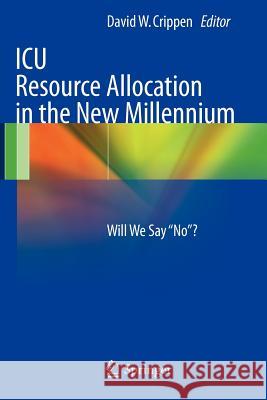
ICU Resource Allocation in the New Millennium: Will We Say No? Crippen, David 9781461438656 Springer - książkaWidoczna okładka, to zdjęcie poglądowe, a rzeczywista szata graficzna może różnić się od prezentowanej.

ICU Resource Allocation in the New Millennium: Will We Say No?

ISBN-13: 9781461438656 / Angielski / Miękka / 2012 / 351 str.

David W. Crippen
cena 200,77
(netto: 191,21 VAT:  5%)

Najniższa cena z 30 dni: 192,74
Termin realizacji zamówienia:
ok. 22 dni roboczych
Dostawa w 2026 r.

Darmowa dostawa!

Intensive care medicine is one of the fastest growing services provided by hospitals and perhaps one of the most expensive. Yet in response to the global financial crisis of the last few years, healthcare funding is slowing or decreasing throughout the world. How we manage health care resources in the intensive care unit (ICU) now and in a future that promises only greater cost constraints is the subject of this book, the third in an informal series of volumes providing a global perspective on difficult issues arising in the ICU. Taking 12 developed countries as their focus, leading experts provide a country-by-country analysis of current ICU resource allocation. A second group of experts use the chapters as a departure point to analyze current ICU resource allocation at the level of the global medical village. The process is repeated, but with an eye toward the future first country by country, then at the global level that takes into account initiatives and reforms now underway.A fictional healthcare plan, the Fair & Equitable Healthcare Plan, is put forth to address weaknesses in existing approaches, and healthcare experts and ethicists are invited to respond to its often provocative provisions.Itself structured as a dialogue, the book is an excellent way to start or to continue serious discussion about the allocation of ICU healthcare resources now and in the years ahead. "


Kategorie:
Nauka, Medycyna
Kategorie BISAC:
Medical > Critical Care
Medical > Etyka
Medical > Zdrowie publiczne
Wydawca:
Springer
Język:
Angielski
ISBN-13:
9781461438656
Rok wydania:
2012
Wydanie:
2013
Ilość stron:
351
Waga:
0.52 kg
Wymiary:
23.39 x 15.6 x 1.98
Oprawa:
Miękka
Wolumenów:
01
Dodatkowe informacje:
Bibliografia
Wydanie ilustrowane

From the reviews:

"This monograph challenges the critical care community to evaluate the technical, moral, and financial limits of critical care. ... Trainees, policy makers, and medical practitioners are an appropriate audience for this book, which features international perspectives on critical care resource utilization. ... This book effectively frames the question of resource limitation and offers a short list of strategies to address this concern in the future." (David J. Dries, Doody's Book Reviews, April, 2013)

"Simply compelling! ... dynamic, balanced, and stimulating ... challenges readers to question 'how things are done' and 'how things should be done' in the ever changing financial and ethical world of the ICU. ... not only a must read for ICU clinicians of all disciplines but also for health economists, health policy makers, ethicists and even the lay public." (Richard J. Brilli, Critical Care Medicine, Vol. 41 (4), April, 2013)

"It would appeal to individuals with an interest in the different systems of health care delivery, particularly from a global perspective. This book would also serve as an excellent foundation for anyone researching various care models throughout the globe. ... intensive care physicians who wrestle daily with questions on how to deliver care in a system with limited resources and ever expanding patient expectations will take great interest in this book." (Donald Griesdale, Canadian Journal of Anesthesia/Journal canadien d'anesthésie, Vol. 60, 2013)

Foreword

by Jean-Louis Vincent

Introduction

by David W. Crippen

Part I.  Contrasts in Global Health Care Resource Allocation                                

1. Australia:  Where Have We Been?     

by Ian Seppelt

2. Brazil:  Where Have We Been?         

by Frederico Bruzzi de Carvalho, Alvaro Réa-Neto, Rodrigo Ferreira Simões, and Monica Viegas Andrade

3. Canada:  Where Have We Been?     

by Christopher James Doig

4. Germany:  Where Have We Been?   

by Thomas Kerz

5. India:  Where Have We Been?           

by Farhad Kapadia, Atul P. Kulkarni, and J.V Divatia

6. Israel:  Where Have We Been?          

by Eran Segal

7. Italy:  Where Have We Been?

by Marco Luchetti and Giuseppe A. Marraro

8. The Netherlands:  Where Have We Been? 

by Frank Bosch

9. New Zealand:  Where Have We Been?       

by Stephen Streat

10. South Africa:  Where Have We Been?

by R. Eric Hodgson and Timothy C Hardcastle

11. United Kingdom:  Where Have We Been?  

by Anna M. Batchelor

12. United States, Private Practice:  Where Have We Been? 

by John W. Hoyt

13. United States, Academic Medicine:  Where Have We Been?      

by David W. Crippen

14. Australia:  Where Are We Going?      

by Ian Seppelt

15. Brazil:  Where Are We Going?           

by Rubens Carmo Costa Filho

16. Canada:  Where Are We Going?       

by Randy S. Wax

17. Germany:  Where Are We Going?     

by Thomas Kerz

18. India:  Where Are We Going? 

by Farhad Kapadia and J.V. Divatia

19. Italy:  Where Are We Going?  

by Marco Luchetti and Giuseppe A. Marraro

20. The Netherlands:  Where Are We Going?   

by David W. Crippen

21. New Zealand:  Where Are We Going?         

by Stephen Streat

22. South Africa:  Where Are We Going?           

by Ross Hofmeyr

23. United Kingdom:  Where Are We Going?    

by Andrew Thorniley

24. United States, Private Practice:  Where Are We Going?   

by John W. Hoyt

25. United States, Academic Medicine:  Where Are We Going?        

by Mark Mazer

26. Analysis of the Demand for Health Care in the Global Medical Village              

by Timothy G. Buchman and  Donald W. Chalfin

27. First Critique of Buchman and Chalfin's Conclusions      

by Leslie P. Scheunemann and Douglas B. White

28. Second Critique of Buchman and Chalfin's Conclusions           

by Lynn Barkley Burnett

29. Third Critique of Buchman and Chalfin's Conclusions    

by Charles L. Sprung

30. Fourth Critique of Buchman and Chalfin's Conclusions 

by Richard Burrows

Part II. The Fair and Equitable Health Care Act                                  

31. The Fair and Equitable Health Care Act (FEHCA)

by David W. Crippen

32. First Critique of the Fair and Equitable Health Care Act (FEHCA)                            

by Michael A. Rie and  W. Andrew Kofke

33. Fixing the Foundation of Critical Care at the End-stage of Life                            

by Jack K. Kilcullen

34. Third Critique of the Fair and Equitable Health Care Act (FEHCA)                            

by Leslie M. Whetstine

Part III. Legal and Nursing Viewpoints                          

35. Medical Judgment Versus Capitulation       

by Gilbert Ross

36. Nursing Aspects of Inappropriate Patient Care       

by Melanie S. Smith

Part IV. Conclusions                                   

37. Where Is “Universal” Health Care Headed in the Global Village?           

by M. A. Kuiper and  Steven M. Hollenberg

38. The New Shape Of Intensive Care In The United States  

by Derek C. Angus

39. Health Care in the Year 2050 

by Brian Wowk

Afterword

by David W. Crippen

David W. Crippen, MD, FCCM is Professor of Critical Care Medicine at the University of Pittsburgh School of Medicine and Co-Director, Neurovascular ICU at the University of Pittsburgh Medical Center. He also holds secondary appointments as Professor in the Department of Emergency Medicine and in the Department of Neurologic Surgery. 


Dr. Crippen trained in general surgery, emergency medicine, and critical care medicine. He is a member of the Society for Critical Care Medicine, the European Society for Intensive Care Medicine, and the American College of Emergency Physicians. He is a Fellow of the American College of Critical Care Medicine, has been a Diplomate of the American Board of Emergency Medicine for 20 years, and received the European Diploma in Intensive Care Medicine.


Dr. Crippen is a prolific writer in the medical and popular literature and a frequent speaker at international medical meetings. He moderates the Critical Care Medicine Internet Group (CCM-L) with more than 800 members around the world. Dr. Crippen plays lead and rhythm guitar for the rock group The CODES, has raced motorcycles on off-road and road racing circuits, and collects and tours the world on vintage motorcycles.

Intensive care medicine is one of the fastest growing services provided by hospitals and perhaps one of the most expensive.  Yet in response to the global financial crisis of the last few years, healthcare funding is slowing or decreasing throughout the world. 


How we manage health care resources in the intensive care unit (ICU) now and in a future that promises only greater cost constraints is the subject of this book, the third in an informal series of volumes providing a global perspective on difficult issues arising in the ICU. 


Leading healthcare experts, including critical care physicians, critical care nurses, ethicists, and attorneys, provide snapshots of current ICU resource allocation in 12 developed countries on which other experts then draw to analyze resource allocation and consumer demand at the level of the global medical village.  The process is repeated with an eye toward the future that takes into account initiatives and reforms now underway.


A fictional healthcare plan, the “Fair & Equitable Healthcare Plan,” is put forth to address weaknesses in existing approaches, and healthcare experts and ethicists are invited to respond to its often provocative provisions.  Structured as a dialogue, the book is a great starting point for serious discussion about the looming issue of ICU healthcare resource allocation.


Udostępnij

Facebook - konto krainaksiazek.pl


Opinie o Krainaksiazek.pl na Opineo.pl

Partner Mybenefit

Krainaksiazek.pl w programie rzetelna firma Krainaksiaze.pl - płatności przez paypal

Czytaj nas na:

Facebook - krainaksiazek.pl
  • książki na zamówienie
  • granty
  • książka na prezent
  • kontakt
  • pomoc
  • opinie
  • regulamin
  • polityka prywatności

Zobacz:

  • Księgarnia czeska

  • Wydawnictwo Książkowe Klimaty

1997-2025 DolnySlask.com Agencja Internetowa

© 1997-2022 krainaksiazek.pl
     
KONTAKT | REGULAMIN | POLITYKA PRYWATNOŚCI | USTAWIENIA PRYWATNOŚCI
Zobacz: Księgarnia Czeska | Wydawnictwo Książkowe Klimaty | Mapa strony | Lista autorów
KrainaKsiazek.PL - Księgarnia Internetowa

Polityka prywatnosci - link
Krainaksiazek.pl - płatnośc Przelewy24
Przechowalnia Przechowalnia






