• Wyszukiwanie zaawansowane
  • Kategorie
  • Kategorie BISAC
  • Książki na zamówienie
  • Promocje
  • Granty
  • Książka na prezent
  • Opinie
  • Pomoc
  • Załóż konto
  • Zaloguj się

Hydraulic Servo-systems: Modelling, Identification and Control » książka


zaloguj się | załóż konto
Logo Krainaksiazek.pl

koszyk

konto

szukaj
topmenu
Księgarnia internetowa
Szukaj
Książki na zamówienie
Promocje
Granty
Książka na prezent
Moje konto
Pomoc
 
 
Wyszukiwanie zaawansowane
Pusty koszyk
Bezpłatna dostawa dla zamówień powyżej 20 złBezpłatna dostawa dla zamówień powyżej 20 zł

Kategorie główne

• Nauka
 [2949965]
• Literatura piękna
 [1857847]

  więcej...
• Turystyka
 [70818]
• Informatyka
 [151303]
• Komiksy
 [35733]
• Encyklopedie
 [23180]
• Dziecięca
 [617748]
• Hobby
 [139972]
• AudioBooki
 [1650]
• Literatura faktu
 [228361]
• Muzyka CD
 [398]
• Słowniki
 [2862]
• Inne
 [444732]
• Kalendarze
 [1620]
• Podręczniki
 [167233]
• Poradniki
 [482388]
• Religia
 [509867]
• Czasopisma
 [533]
• Sport
 [61361]
• Sztuka
 [243125]
• CD, DVD, Video
 [3451]
• Technologie
 [219309]
• Zdrowie
 [101347]
• Książkowe Klimaty
 [123]
• Zabawki
 [2362]
• Puzzle, gry
 [3791]
• Literatura w języku ukraińskim
 [253]
• Art. papiernicze i szkolne
 [7933]
Kategorie szczegółowe BISAC

Hydraulic Servo-systems: Modelling, Identification and Control

ISBN-13: 9781852336929 / Angielski / Twarda / 2002 / 355 str.
Mohieddine Jelali;Andreas Kroll
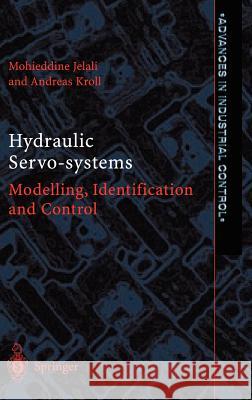
Hydraulic Servo-systems: Modelling, Identification and Control Mohieddine Jelali, Andreas Kroll 9781852336929 Springer London Ltd - książkaWidoczna okładka, to zdjęcie poglądowe, a rzeczywista szata graficzna może różnić się od prezentowanej.

Hydraulic Servo-systems: Modelling, Identification and Control

ISBN-13: 9781852336929 / Angielski / Twarda / 2002 / 355 str.

Mohieddine Jelali;Andreas Kroll
cena 806,99
(netto: 768,56 VAT:  5%)

Najniższa cena z 30 dni: 771,08
Termin realizacji zamówienia:
ok. 22 dni roboczych
Bez gwarancji dostawy przed świętami

Darmowa dostawa!
inne wydania

Hydraulic Servo-systems details the basic concepts of many recent developments of nonlinear identification and nonlinear control and their application to hydraulic servo-systems: developments such as feedback linearisation and fuzzy control. The principles, benefits and limitations associated with standard control design approaches such as linear state feedback control, feedforward control and compensation for static nonlinearities are also reviewed, because of their continued practical importance. Featuring: - theoretical (physically based) modelling of hydraulic servo-systems; - experimental modelling (system identification); - control strategies for hydraulic servo-systems; - case studies and experimental results. Appendices outline the most important fundamentals of (nonlinear) differential geometry and fuzzy control. The book is very application-oriented and provides the reader with detailed working procedures and hints for implementation routines and software tools. Hydraulic Servo-systems will interest scientists and qualified engineers involved in the analysis and design of hydraulic control systems, especially in advanced hydraulic industries, the aeronautical and space, and automotive industries.


Kategorie:
Technologie
Kategorie BISAC:
Technology & Engineering > Automation
Mathematics > Matematyka stosowana
Technology & Engineering > Industrial Engineering
Wydawca:
Springer London Ltd
Seria wydawnicza:
Advances in Industrial Control
Język:
Angielski
ISBN-13:
9781852336929
Rok wydania:
2002
Dostępne języki:
Angielski
Wydanie:
2003
Numer serii:
000000291
Ilość stron:
355
Waga:
1.61 kg
Wymiary:
23.523.5 x 15.5
Oprawa:
Twarda
Wolumenów:
01
Dodatkowe informacje:
Bibliografia
Wydanie ilustrowane

From the reviews:

Altogether the book gives a comprehensive survey of physical modelling, conventional and modern control stategies for hydraulic drives and can be recommended to engineers and scientists who are working in this field.

Simulation News Europe 38/39 (2003) 61 - 62 (Reviewer: Peter Beater)

1 Introduction.- 1.1 Historical View and Motivation for Hydraulic Systems.- 1.2 Aims and Focus of the Book.- 1.3 Outline of the Chapters.- 1.4 Background of the Work and Bibliographical Notes.- 2 General Description of Hydraulic Servo-systems.- 2.1 Basic Structure of Hydraulic Servo-systems.- 2.2 Description of the Components.- 2.2.1 Valves.- 2.2.2 Pumps and Actuators.- 2.2.3 Power Supplies.- 2.3 Classification of Hydraulic Servo-systems.- 2.4 Measurement and Control Devices.- 2.4.1 Control Loops.- 2.4.2 Sensors/Transducers.- 2.5 Application Examples.- 2.5.1 Hydraulically Actuated Manipulators.- 2.5.2 Hydraulic Automatic Gauge Control for Rolling Mills.- 3 Physical Fundamentals of Hydraulics.- 3.1 Physical Properties of Fluids.- 3.1.1 Viscosity and Related Quantities.- 3.1.2 Mass Density, Bulk Modulus and Related Quantities.- 3.1.3 Effective Bulk Modulus.- 3.1.4 Section Summary.- 3.2 General Equations of Fluid Motion.- 3.2.1 Continuity Equation and Pressure Transients.- 3.2.2 Navier-Stokes Equation.- 3.2.3 Bernoulli’s Theorem.- 3.2.4 Section Summary.- 3.3 Flow Through Passages.- 3.3.1 Flow Establishment in Pipelines.- 3.3.2 Flow Through Orifices.- 3.3.3 Flow Through Valves.- 3.3.4 Section Summary.- 3.4 Spool Port Forces.- 3.5 Electro-hydraulic Analogy.- 3.5.1 Hydraulic Capacitance.- 3.5.2 Hydraulic Resistance.- 3.5.3 Hydraulic Inductance.- 4 Physically Based Modelling.- 4.1 Introduction.- 4.1.1 Characterisation of Subsystems.- 4.1.2 Model Complexity and Applications.- 4.2 Elementary Models.- 4.2.1 Valves.- 4.2.2 Hydraulic Cylinders.- 4.2.3 Hydraulic Pumps and Motors.- 4.2.4 Power Supplies.- 4.2.5 Pipelines.- 4.3 Typical Non-linear State-space Models.- 4.4 Structured and Simplified Models of Valve-controlled Systems.- 4.4.1 Relevance of Valve and Pipeline Dynamics.- 4.4.2 Approximation of Pressure Dynamics.- 4.4.3 Introduction of Load Pressure.- 4.4.4 Linearised Models.- 4.5 Determination of Specific Model Parameters.- 4.5.1 Static Valve Characteristics.- 4.5.2 Dynamic Valve Characteristics.- 4.5.3 Actuator Dimensions and Mass.- 4.5.4 Friction Forces.- 4.5.5 Leakage Coefficients and Valve Underlap.- 4.6 Implementation and Software Tools.- 4.6.1 Simulation of Frietion Forces.- 4.6.2 Simulation of Mechanical Saturations.- 4.6.3 Simulation Packages.- 4.7 Section Summary.- 5 Experimental Modelling (Identification).- 5.1 Introduction.- 5.1.1 Generic Identification Procedure.- 5.1.2 Linear vs. Non-linear Identification.- 5.1.3 Online vs. Offline Identification.- 5.2 Pre-identification Process.- 5.2.1 Design of Input Signals.- 5.2.2 Pre-computations.- 5.3 Overview of Model Structures.- 5.3.1 Introductory Remarks and Definitions.- 5.3.2 Review of Linear Model Structures.- 5.3.3 Non-linear Input-output Models.- 5.3.4 Non-linear State-space Models.- 5.4 Description of Selected Non-linear Model Structures.- 5.4.1 Continuous-time Special (Canonical) Models.- 5.4.2 Fuzzy Models.- 5.4.3 Artificial Neural Networks.- 5.5 Parameter Estimation Methods.- 5.5.1 Prediction Error Methods.- 5.5.2 Classical Least-squares Analysis.- 5.5.3 Orthogonal Least-squares Estimator.- 5.5.4 Maximum Likelihood Method.- 5.5.5 Bias/Nariance Dilemma and Regularisation Concepts.- 5.6 Optimisation Algorithms.- 5.6.1 Newton’s Method.- 5.6.2 Damped Gauss-Newton Method.- 5.6.3 Levenberg-Marquardt Algorithrn.- 5.6.4 Computational Aspects.- 5.7 Grey-box Identification ofNon-linear Hydraulic Servo-system Models.- 5.7.1 Identification of Pressure Dynamics Model.- 5.7.2 Identification of Load Dynamics Model.- 5.7.3 Online Identification for Adaptive Control.- 5.7.4 Identification of General Models.- 5.8 Fuzzy Identification.- 5.8.1 Introduction and Model Parameter Overview.- 5.8.2 Structure Identification.- 5.8.3 Parameter Identification (Premise).- 5.8.4 Parameter Identification (Conclusion).- 5.8.5 Optimisation.- 5.9 Identification with Artificial Neural Networks.- 5.9.1 Selection of Artificial Neural Network Architectures.- 5.9.2 Estimation of Weights.- 5.9.3 Optimisation of Network Architecture (Growing/Pruning).- 5.10 Model Validation and Comparison of Model Structures.- 5.10.1 Prediction, Simulation and Cross-validation.- 5.10.2 Residual Tests.- 5.10.3 Model Structure Test Criteria.- 5.11 Implementation and Software Tools.- 5.12 Section Summary.- 6 Hydraulic Control Systems Design.- 6.1 Introduction.- 6.1.1 General Approaches.- 6.1.2 Literature Scan and Classification.- 6.2 Classical Feedback Control Design.- 6.2.1 Pressure Feedback.- 6.2.2 Acceleration Feedback.- 6.2.3 Position Feedback.- 6.2.4 Summary.- 6.3 Estimator-based State Feedback Control.- 6.3.1 Computation of the State Control Law.- 6.3.2 Selection of Pole Locations.- 6.3.3 Elimination of Steady-state Errors.- 6.3.4 Application to Hydraulic Servo-system Linear Models.- 6.4 Extensions to Linear Feedback Control.- 6.4.1 Combined Feedback and Feedforward Control.- 6.4.2 Adaptive Control.- 6.4.3 Compensation of Special (Static) Non-linearities.- 6.4.4 Conclusions and Drawbacks of Classical Approaches.- 6.5 Feedback Linearising Control.- 6.5.1 Feedback Linearisation and the Companion Form.- 6.5.2 Intuitive Concept of Input-Output Linearisation.- 6.5.3 Formalised Theory of Feedback Linearisation.- 6.5.4 Application to Hydraulic Servo-system Models.- 6.5.5 Feedback Linearisation Based on Bilinear Models.- 6.6 Approaches Similar to Feedback Linearisation.- 6.6.1 Direct Inverse Control.- 6.6.2 Cascade Load Pressure (Load Force) Control.- 6.7 Fuzzy Control.- 6.7.1 Fuzzy State Control.- 6.7.2 Fuzzy Model Predictive Control.- 6.8 Neural-network-based Control.- 6.8.1 Neural-network-based Feedback Linearisation.- 6.8.2 Control Based on Instantaneous Linearisation.- 6.9 Vibration Damping Control.- 6.9.1 Introduction.- 6.9.2 Vibration Damping Concept.- 6.9.3 Integrated Velocity Control.- 6.10 State Estimation.- 6.10.1 Velocity Estimation.- 6.10.2 Estimation of Acceleration and Friction Forces.- 6.10.3 Estimation of Extemal Forces.- 6.11 Implementation and Software Tools.- 6.12 Rapid Prototyping Tools for Control.- 6.13 Section Summary.- 7 Case Studies and Experimental Results.- 7.1 Identification and Control of a Synchronising Cylinder.- 7.1.1 System Description.- 7.1.2 Continuous-time Model in Canonical Form.- 7.1.3 Fuzzy Model Identification.- 7.1.4 Fuzzy Model Predictive Controller and Fuzzy State Feedback Controller.- 7.1.5 Neural Network (Multi-layer Perceptron) Identification.- 7.1.6 Section Summary.- 7.2 Modelling and Control of a Small Differential Cylinder.- 7.2.1 System Description.- 7.2.2 Physically Based Mode1.- 7.2.3 Linear vs. Non-linear Control.- 7.3 Control of a Big Differential Cylinder.- 7.3.1 System Description.- 7.3.2 Linear vs. Non-linear Control.- 7.4 Vibration Damping Control for a Flexible Robot.- 7.5 Vibration Damping Control for a Concrete Pump.- Appendix A Fluid Power Symbols.- Appendix B Data and Catalogue Sheets.- Appendix C Non-linear Control Background.- References.

Mohieddine Jelali received the Dipl.-Ing. and Dr.-Ing. degrees from the University of Duisberg, Germany in 1993 and 1997 respectively, both in mechanical engineering. From 1993 to 1996, he was research assistant with the Department of Measurement and Control.

From 1996 to 1999, he worked as a research-and-development engineer with Mannesmann Demag Metallurgy in Ratingen, BU Cold Rolling and Processing. In September 1999, he joined the Betriebsforchungsinstitut - VDEh-Institut für angewandte Forschung GmbH in Düsseldorf as a project manager and co-ordinator of multinational research projects in the steel industry. His main fields of interest include: modelling, dynamic simulation, development of advanced controls and control prototyping for rolling mills and supervisory control of steel processes.

Since October he has been a lecturer in control systems at the University of Duisberg. He has written/co-written 14 research publications.

Andreas Kroll obtained his Dr.-Ing. in mechanical engineering at the University of Duisberg in 1996. From 1993 to 1996, he was also a research assistant with the Department of Measurement and Control.

In 1996 Doctor Kroll joined the ABB Research Centre in Heidelberg as a research-and-development engineer. Since 1998, he has been International R&D manager and since 2000, the group leader for Applied Control and Optimisation. His current research interests include: methods of computational intelligence, advanced process control and applications, dynamic simulation and optimisation of processes, international project management and personal and technological strategies of the line unit.

He has written or co-written 16 publications.

Hydraulic Servo-systems details the basic concepts of many recent developments of nonlinear identification and nonlinear control and their application to hydraulic servo-systems: developments such as feedback linearisation and fuzzy control. The principles, benefits and limitations associated with standard control design approaches such as linear state feedback control, feedforward control and compensation for static nonlinearities are also reviewed, because of their continued practical importance.

Featuring:

• theoretical (physically based) modelling of hydraulic servo-systems;

• experimental modelling (system identification);

• control strategies for hydraulic servo-systems;

• case studies and experimental results.

Appendices outline the most important fundamentals of (nonlinear) differential geometry and fuzzy control. The book is very application-oriented and provides the reader with detailed working procedures and hints for implementation routines and software tools.

Hydraulic Servo-systems will interest scientists and qualified engineers involved in the analysis and design of hydraulic control systems, especially in advanced hydraulic industries, the aeronautical and space, and automotive industries.

 

Advances in Industrial Control aims to report and encourage the transfer of technology in control engineering. The rapid development of control technology has an impact on all areas of the control discipline. The series offers an opportunity for researchers to present an extended exposition of new work in all aspects of industrial control.


Udostępnij

Facebook - konto krainaksiazek.pl


Opinie o Krainaksiazek.pl na Opineo.pl

Partner Mybenefit

Krainaksiazek.pl w programie rzetelna firma Krainaksiaze.pl - płatności przez paypal

Czytaj nas na:

Facebook - krainaksiazek.pl
  • książki na zamówienie
  • granty
  • książka na prezent
  • kontakt
  • pomoc
  • opinie
  • regulamin
  • polityka prywatności

Zobacz:

  • Księgarnia czeska

  • Wydawnictwo Książkowe Klimaty

1997-2025 DolnySlask.com Agencja Internetowa

© 1997-2022 krainaksiazek.pl
     
KONTAKT | REGULAMIN | POLITYKA PRYWATNOŚCI | USTAWIENIA PRYWATNOŚCI
Zobacz: Księgarnia Czeska | Wydawnictwo Książkowe Klimaty | Mapa strony | Lista autorów
KrainaKsiazek.PL - Księgarnia Internetowa

Polityka prywatnosci - link
Krainaksiazek.pl - płatnośc Przelewy24
Przechowalnia Przechowalnia




