• Wyszukiwanie zaawansowane
  • Kategorie
  • Kategorie BISAC
  • Książki na zamówienie
  • Promocje
  • Granty
  • Książka na prezent
  • Opinie
  • Pomoc
  • Załóż konto
  • Zaloguj się

Human Factors Issues in Combat Identification » książka


zaloguj się | załóż konto
Logo Krainaksiazek.pl

koszyk

konto

szukaj
topmenu
Księgarnia internetowa
Szukaj
Książki na zamówienie
Promocje
Granty
Książka na prezent
Moje konto
Pomoc
 
 
Wyszukiwanie zaawansowane
Pusty koszyk
Bezpłatna dostawa dla zamówień powyżej 20 złBezpłatna dostawa dla zamówień powyżej 20 zł

Kategorie główne

• Nauka
 [2949965]
• Literatura piękna
 [1857847]

  więcej...
• Turystyka
 [70818]
• Informatyka
 [151303]
• Komiksy
 [35733]
• Encyklopedie
 [23180]
• Dziecięca
 [617748]
• Hobby
 [139972]
• AudioBooki
 [1650]
• Literatura faktu
 [228361]
• Muzyka CD
 [398]
• Słowniki
 [2862]
• Inne
 [444732]
• Kalendarze
 [1620]
• Podręczniki
 [167233]
• Poradniki
 [482388]
• Religia
 [509867]
• Czasopisma
 [533]
• Sport
 [61361]
• Sztuka
 [243125]
• CD, DVD, Video
 [3451]
• Technologie
 [219309]
• Zdrowie
 [101347]
• Książkowe Klimaty
 [123]
• Zabawki
 [2362]
• Puzzle, gry
 [3791]
• Literatura w języku ukraińskim
 [253]
• Art. papiernicze i szkolne
 [7933]
Kategorie szczegółowe BISAC

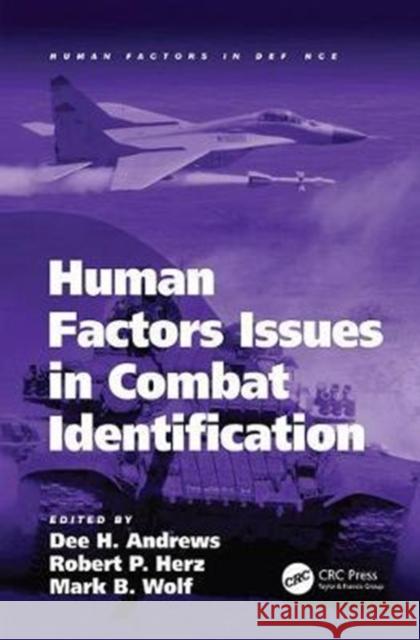
Human Factors Issues in Combat Identification

ISBN-13: 9781138071674 / Angielski / Miękka / 2017 / 398 str.
Robert P. Herz
Human Factors Issues in Combat Identification Robert P. Herz 9781138071674 Taylor and Francis - książkaWidoczna okładka, to zdjęcie poglądowe, a rzeczywista szata graficzna może różnić się od prezentowanej.

Human Factors Issues in Combat Identification

ISBN-13: 9781138071674 / Angielski / Miękka / 2017 / 398 str.

Robert P. Herz
cena 307,25
(netto: 292,62 VAT:  5%)

Najniższa cena z 30 dni: 287,08
Termin realizacji zamówienia:
ok. 22 dni roboczych
Bez gwarancji dostawy przed świętami

Darmowa dostawa!
inne wydania

This edited book presents an array of approaches on how human factors theory and research addresses the challenges associated with combat identification. Special emphasis is placed on reducing human error that leads to fratricide, which is the unintentional death or injury of friendly personnel by friendly weapons during an enemy engagement. Although fratricide has been a concern since humans first engaged in combat operations, it gained prominence during the Persian Gulf War. To reduce fratricide, advances in technological approaches to enhance combat identification (e.g., Blue Force Tracker) should be coupled with the application of human factors principles to reduce human error. The book brings together a diverse group of authors from academic and military researchers to government contractors and commercial developers to provide a single volume with broad appeal. Human Factors Issues in Combat Identification is intended for the larger human factors community within academia, the military and other organizations that work with the military such as government contractors and commercial developers as well as others interested in combat identification issues including military personnel and policy makers.


Kategorie:
Technologie
Kategorie BISAC:
History > Military - Strategy
Technology & Engineering > Military Science
Technology & Engineering > Industrial Health & Safety
Wydawca:
Taylor and Francis
Seria wydawnicza:
Human Factors in Defence
Język:
Angielski
ISBN-13:
9781138071674
Rok wydania:
2017
Ilość stron:
398
Oprawa:
Miękka
Wolumenów:
01

'The book leverages the best current science to provide the military with a concrete agenda and set of principles to use in mitigating fratricide, in all possible avenues of approach to the problem. One can easily imagine the Department of Defense going from this book to a specific program of research with the potential for many near-term applications. Military organizations can take this book and run with it.' Robert Hoffman, Institute for Human and Machine Cognition, USA 'Tragedies caused by combat misidentification have existed since the beginning of combat. Other texts have reviewed the history of fratricide, but Human Factors Issues in Combat Identification sets a new standard for comprehensiveness in exploring the psychological underpinnings of combat identification. Leading experts provide state-of-the-art reviews explaining how perception, cognition, situation awareness, team processes, and training all play a role and interact in understanding, and hopefully alleviating, combat misidentification.' Michael A. Vidulich, Air Force Research Laboratory, USA 'With the lethality of today¹s weaponry and increasing requirements for coalition and asymmetric operations, it has become strategically as well as tactically critical to distinguish friend from foe. As long as humans make these decisions, the issue must be informed by behavioral technology and science. In covering areas ranging from human cognition, decision-making, and perception to team processes and interactions between humans and technologies, this book is a uniquely comprehensive, authoritative, and practical resource specifically focused on the essential and inescapable "people" issues in combat identification.' J. D. Fletcher, Institute for Defense Analyses, USA 'This book should be read by warfighters and capability developers across Australian Defence.' Australian Defence Force Journal, September 2010

Contents: Foreword; Preface; Introduction, Katherine A. Wilson, Eduardo Salas and Dee H. Andrews. Section 1 Cognitive Processes: Factors affecting speed and accuracy of response selection in operational environments, Robert W. Proctor and Motonori Yamaguchi; Measuring vigilance abilities to enhance combat identification performance, Clark Shingledecker, David E. Weldon, Kyle Behymer, Benjamin Simpkins, Elizabeth Lerner, Joel Warm, Gerald Matthews, Victore Finomore, Tyler Shaw and Jennifer S. Murphy; Dimensions of spatial ability and their influence on performance with unmanned systems, Thomas Fincannon, A. William Evans III, Florian Jentsch and Joseph Keebler. Section 2 Visual Discrimination: The effects of conjunctive search and response mappings on automatic performance in a complex visual task, Cleotilde Gonzalez, Rick P. Thomas and Poornima Madhavan; What visual discrimination of fractal textures can tell us about discrimination of camouflaged targets, Vincent A. Billock, Douglas W. Cunningham and Brian H. Tsou; A cognitive basis for friend-foe misidentification of vehicles in combat, Joseph R. Keebler, Lee W. Sciarini, Florian Jentsch, Denise Nicholson and Thomas Fincannon; Preattentive attributes in visualization design: enhancing combat identification, Scott H. Summers. Section 3 Situation Awareness: Team coordination and shared situation awareness in combat identification, Cheryl A. Bolstad, Mica R. Endsley and Haydee M. Cuevas; The use of soft sensors and I-space for improved combat ID, David L. Hall and Stan Aungst. Section 4 Teams: Training strategies to mitigate expectancy-induced response bias in combat identification: a research agenda, Frank L. Greitzer and Dee H. Andrews; Comparing individual and team judgment accuracy for target identification under heavy cognitive demand, Verlin B. Hinsz and Dana M. Wallace; A team training paradigm for better combat identification, Wayne Shebilske, Georgiy Levchuk, Jared Freeman and Kevin Gildea; Analysis of the tasks conducted by forward air controllers and pilots during simulated close air support missions: supporting the development of the INCIDER model, Beejal Mistry, Gareth Croft, David Dean, Julie Gadsden, Gareth Conway and Katherine Cornes; Team cognition during a simulated close air support exercise: results from a new behavioral rating instrument, Jerzy Jarmasz, Richard Zobarich, Lora Bruyn-Martin and Tab Lamoureux. Section 5 Automation: Evaluating reliance on combat identification systems: the role of reliability feedback, Heather F. Neyedli, Lu Wang, Greg A. Jamieson and Justin G. Hollands; The effects of automation bias on operator compliance and reliance, Stephen Rice, Krisstal Clayton and Jason McCarley; An examination of the social, cognitive, and motivational factors that affect automation reliance, Mary T. Dzindolet, Linda G. Pierce and Hall P. Beck; On fratricide and the operational reliability of target identification decision aids in combat identification, John K. Hawley, Anna L. Mares and Jessica L. Marcon; The case for active fratricide avoidance in Net-Centric C2 systems, John Barnett; Mitigating friendly fire casualties through enhanced battle command capabilities, Jean W. Pharaon; Index.

Dee H. Andrews is the Directorate Senior Scientist (ST) for the Human Effectiveness Directorate, 711th Human Performance Wing of the Air Force Research Laboratory (AFRL). AFRL is an organization within the United States Air Force that is dedicated to leading the discovery, development, and integration of warfighting technologies for the United States’ air, space and cyberspace forces. As a Senior Scientist (ST), Dr. Andrews is the AFRL's principal scientific authority for training research. Dr. Andrews' responsibilities include sustaining technological superiority for training by planning and conducting theoretical and experimental studies. He is also responsible for mentoring and developing dedicated technical staff to assure quality in training research, and represents AFRL in training research matters to the external scientific and technical community. Lt Col Robert P. Herz is a research scientist with the Mesa Research Site, Air Force Research Laboratory. He has considerable human factors experience with operational test and evaluation of space systems, modeling, simulation, distributed mission operations, C4ISR, training, and has integrated numerous tools into the AOC baseline. He is currently the Director of Operations of the Warfighter Readiness Research Division and has both military and civilian flight experience. He earned a B.S. from Wright State University specializing in Human Factors, an M.S. from Embry-Riddle Aeronautical University in Aerospace Operations and a Ph.D. through Northcentral University specializing in Aerospace Operations Management. Mark B. Wolf is a Research Fellow with the Oak Ridge Institute for Science and Education (ORISE), and works at the Air Force Research Laboratory in Mesa, AZ. He earned a PH.D. in Industrial-Organizational Psychology from the Georgia Institute of Technology.


Udostępnij

Facebook - konto krainaksiazek.pl


Opinie o Krainaksiazek.pl na Opineo.pl

Partner Mybenefit

Krainaksiazek.pl w programie rzetelna firma Krainaksiaze.pl - płatności przez paypal

Czytaj nas na:

Facebook - krainaksiazek.pl
  • książki na zamówienie
  • granty
  • książka na prezent
  • kontakt
  • pomoc
  • opinie
  • regulamin
  • polityka prywatności

Zobacz:

  • Księgarnia czeska

  • Wydawnictwo Książkowe Klimaty

1997-2025 DolnySlask.com Agencja Internetowa

© 1997-2022 krainaksiazek.pl
     
KONTAKT | REGULAMIN | POLITYKA PRYWATNOŚCI | USTAWIENIA PRYWATNOŚCI
Zobacz: Księgarnia Czeska | Wydawnictwo Książkowe Klimaty | Mapa strony | Lista autorów
KrainaKsiazek.PL - Księgarnia Internetowa

Polityka prywatnosci - link
Krainaksiazek.pl - płatnośc Przelewy24
Przechowalnia Przechowalnia






