• Wyszukiwanie zaawansowane
  • Kategorie
  • Kategorie BISAC
  • Książki na zamówienie
  • Promocje
  • Granty
  • Książka na prezent
  • Opinie
  • Pomoc
  • Załóż konto
  • Zaloguj się

How Glass Changed the World: The History and Chemistry of Glass from Antiquity to the 13th Century » książka

zaloguj się | załóż konto
Logo Krainaksiazek.pl

koszyk

konto

szukaj
topmenu
Księgarnia internetowa
Szukaj
Książki na zamówienie
Promocje
Granty
Książka na prezent
Moje konto
Pomoc
 
 
Wyszukiwanie zaawansowane
Pusty koszyk
Bezpłatna dostawa dla zamówień powyżej 20 złBezpłatna dostawa dla zamówień powyżej 20 zł

Kategorie główne

• Nauka
 [2950560]
• Literatura piękna
 [1849509]

  więcej...
• Turystyka
 [71097]
• Informatyka
 [151150]
• Komiksy
 [35848]
• Encyklopedie
 [23178]
• Dziecięca
 [617388]
• Hobby
 [139064]
• AudioBooki
 [1657]
• Literatura faktu
 [228597]
• Muzyka CD
 [383]
• Słowniki
 [2855]
• Inne
 [445295]
• Kalendarze
 [1464]
• Podręczniki
 [167547]
• Poradniki
 [480102]
• Religia
 [510749]
• Czasopisma
 [516]
• Sport
 [61293]
• Sztuka
 [243352]
• CD, DVD, Video
 [3414]
• Technologie
 [219456]
• Zdrowie
 [101002]
• Książkowe Klimaty
 [124]
• Zabawki
 [2311]
• Puzzle, gry
 [3459]
• Literatura w języku ukraińskim
 [254]
• Art. papiernicze i szkolne
 [8079]
Kategorie szczegółowe BISAC

How Glass Changed the World: The History and Chemistry of Glass from Antiquity to the 13th Century

ISBN-13: 9783642281822 / Angielski / Miękka / 2012 / 85 str.
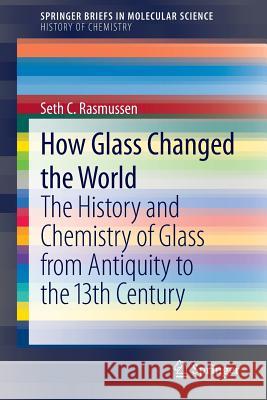
Seth C. Rasmussen
How Glass Changed the World: The History and Chemistry of Glass from Antiquity to the 13th Century Seth C. Rasmussen 9783642281822 Springer-Verlag Berlin and Heidelberg GmbH &  - książkaWidoczna okładka, to zdjęcie poglądowe, a rzeczywista szata graficzna może różnić się od prezentowanej.

How Glass Changed the World: The History and Chemistry of Glass from Antiquity to the 13th Century

ISBN-13: 9783642281822 / Angielski / Miękka / 2012 / 85 str.

Seth C. Rasmussen
cena 281,10
(netto: 267,71 VAT:  5%)

Najniższa cena z 30 dni: 250,57
Termin realizacji zamówienia:
ok. 22 dni roboczych
Dostawa w 2026 r.

Darmowa dostawa!

Glass production is thought to date to 2500 BC and had found numerous uses by the height of the Roman Empire. Yet the modern view of glass-based chemical apparatus (beakers, flasks, stills, etc.) was quite limited due to a lack of glass durability under rapid temperature changes and chemical attack. This "brief" gives an overview of the history and chemistry of glass technology from its origins in antiquity to its dramatic expansion in the 13th century, concluding with its impact on society in general, particularly its effect on chemical practices.


Kategorie:
Technologie
Kategorie BISAC:
Science > Chemia - Fizyczna
Technology & Engineering > Materials Science - Ceramics
Science > History
Wydawca:
Springer-Verlag Berlin and Heidelberg GmbH &
Seria wydawnicza:
History of Chemistry
Język:
Angielski
ISBN-13:
9783642281822
Rok wydania:
2012
Dostępne języki:
Angielski
Wydanie:
2012
Numer serii:
000435162
Ilość stron:
85
Waga:
0.16 kg
Wymiary:
23.523.5 x 15.5
Oprawa:
Miękka
Wolumenów:
01
Dodatkowe informacje:
Wydanie ilustrowane

"This book is exciting and enjoyable to read, especially for anyone who is interested in glass. The book provides a dynamic introduction to glass via the history of glassmaking ... . this book is highly recommended, whether you are a novice or an expert in glass research or you are just interested in glass and glassmaking. It is easy to read and understand, even for those individuals with minimal background knowledge in science and chemistry. This is a must read!" (Michael B. Jacobs, Journal of Chemical Education, Vol. 92 (3), 2015)

Origins of glass: Myth and known history.- Development and growth of glass through the Roman period.- Reinventing an old material: Venice and the new glass.- Applications to chemical apparatus.- Impact on society and its effect on chemical progress.

Seth C. Rasmussen is an Associate Professor of Chemistry at North Dakota State University (NDSU) in Fargo (seth.rasmussen@ndsu.edu). He received his B.S in Chemistry from
Washington State University in 1990 and his Ph.D. in Inorganic Chemistry from Clemson University in 1994, under the guidance of Prof. John D. Peterson. As a postdoctoral associate at
the University of Oregon, he then studied conjugated organic polymers under Prof. James E. Hutchison. In 1997, he accepted a teaching position at the University of Oregon, before moving
to join the faculty at NDSU in 1999. Active in the fields of materials chemistry and the history of chemistry, his research interests
include the design and synthesis of conjugated materials, photovoltaics (solar cells), organic light emitting diodes, the application of history to chemical education, the history of materials, and chemical technology in antiquity. As both author and editor, Prof. Rasmussen has contributed to books in both materials and history and has published more than 50 research papers. He is a
member of various international professional societies including the American Chemical Society, Materials Research Society, Alpha Chi Sigma, Society for the History of Alchemy and Chemistry, and the International History, Philosophy & Science Teaching Group.
Prof. Rasmussen currently serves as the Program Chair for the History of Chemistry division of the American Chemical Society and as Series Editor for Springer Briefs in Molecular Science: History of Chemistry.

Glass production is thought to date to ~2500 BC and had found numerous uses by the height of the Roman Empire. The modern view of glass-based chemical apparatus (beakers, flasks, stills, etc.) was quite limited, however, due to a lack of glass durability under rapid temperature changes and chemical attack. In the mid 1200s, this began to change as the glassmakers of Venice and Murano began blending previous Roman methods with raw materials from the Levant, as well as developing pretreatment and purification methods of the raw materials used. The combination of these practices resulted in a new glass with a strength and high melting point suitable for use in chemical apparatus. The ability to produce vessels from glass allowed much greater freedom and versatility in the design of chemical apparatus. In addition, the resulting improved glass technology lead to the invention of eyeglasses and a vast improvement in still design, which in turn allowed the isolation of important materials such as alcohol and the mineral acids. This text will give an overview of the history and chemistry of glass technology from its origins in antiquity to its dramatic expansion in the 13th century, concluding with its impact on society in general, particularly its affect on chemical practices.


Udostępnij

Facebook - konto krainaksiazek.pl


Opinie o Krainaksiazek.pl na Opineo.pl

Partner Mybenefit

Krainaksiazek.pl w programie rzetelna firma Krainaksiaze.pl - płatności przez paypal

Czytaj nas na:

Facebook - krainaksiazek.pl
  • książki na zamówienie
  • granty
  • książka na prezent
  • kontakt
  • pomoc
  • opinie
  • regulamin
  • polityka prywatności

Zobacz:

  • Księgarnia czeska

  • Wydawnictwo Książkowe Klimaty

1997-2025 DolnySlask.com Agencja Internetowa

© 1997-2022 krainaksiazek.pl
     
KONTAKT | REGULAMIN | POLITYKA PRYWATNOŚCI | USTAWIENIA PRYWATNOŚCI
Zobacz: Księgarnia Czeska | Wydawnictwo Książkowe Klimaty | Mapa strony | Lista autorów
KrainaKsiazek.PL - Księgarnia Internetowa

Polityka prywatnosci - link
Krainaksiazek.pl - płatnośc Przelewy24
Przechowalnia Przechowalnia







