• Wyszukiwanie zaawansowane
  • Kategorie
  • Kategorie BISAC
  • Książki na zamówienie
  • Promocje
  • Granty
  • Książka na prezent
  • Opinie
  • Pomoc
  • Załóż konto
  • Zaloguj się

How Brain-Like Is the Spinal Cord?: Interacting Cell Assemblies in the Nervous System » książka


zaloguj się | załóż konto
Logo Krainaksiazek.pl

koszyk

konto

szukaj
topmenu
Księgarnia internetowa
Szukaj
Książki na zamówienie
Promocje
Granty
Książka na prezent
Moje konto
Pomoc
 
 
Wyszukiwanie zaawansowane
Pusty koszyk
Bezpłatna dostawa dla zamówień powyżej 20 złBezpłatna dostawa dla zamówień powyżej 20 zł

Kategorie główne

• Nauka
 [2946912]
• Literatura piękna
 [1852311]

  więcej...
• Turystyka
 [71421]
• Informatyka
 [150889]
• Komiksy
 [35717]
• Encyklopedie
 [23177]
• Dziecięca
 [617324]
• Hobby
 [138808]
• AudioBooki
 [1671]
• Literatura faktu
 [228371]
• Muzyka CD
 [400]
• Słowniki
 [2841]
• Inne
 [445428]
• Kalendarze
 [1545]
• Podręczniki
 [166819]
• Poradniki
 [480180]
• Religia
 [510412]
• Czasopisma
 [525]
• Sport
 [61271]
• Sztuka
 [242929]
• CD, DVD, Video
 [3371]
• Technologie
 [219258]
• Zdrowie
 [100961]
• Książkowe Klimaty
 [124]
• Zabawki
 [2341]
• Puzzle, gry
 [3766]
• Literatura w języku ukraińskim
 [255]
• Art. papiernicze i szkolne
 [7810]
Kategorie szczegółowe BISAC

How Brain-Like Is the Spinal Cord?: Interacting Cell Assemblies in the Nervous System

ISBN-13: 9783642511226 / Angielski / Miękka / 2012 / 334 str.
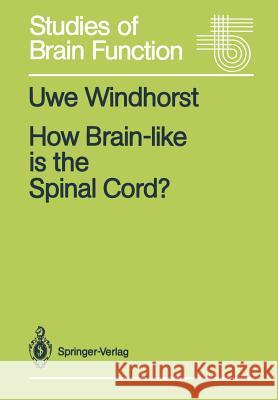
Uwe Windhorst
How Brain-Like Is the Spinal Cord?: Interacting Cell Assemblies in the Nervous System Windhorst, Uwe 9783642511226 Springer - książkaWidoczna okładka, to zdjęcie poglądowe, a rzeczywista szata graficzna może różnić się od prezentowanej.

How Brain-Like Is the Spinal Cord?: Interacting Cell Assemblies in the Nervous System

ISBN-13: 9783642511226 / Angielski / Miękka / 2012 / 334 str.

Uwe Windhorst
cena 201,24
(netto: 191,66 VAT:  5%)

Najniższa cena z 30 dni: 192,74
Termin realizacji zamówienia:
ok. 22 dni roboczych
Bez gwarancji dostawy przed świętami

Darmowa dostawa!

"Theorizing about brain functions is often considered slightly disreputable and anyhow a waste of time -perhaps even 'philoso- ical'" 1 P. S. CHURCHLAND At present there are no unanimously accepted general con cepts of brain operation and function. This is especially the case with regard to so-called "higher" functions such as per ception, memory or the coupling between sensory input and motor output. There are a number of different reasons for this. Some may be related to experimental limitations allowing the simultaneous recording of the activities of only a restricted number of neurones. But there are also conceptual difficulties hindering the transition from "single-neurone" schemes, in which neurones are assigned relatively specific tasks (such as feature detection), to more complex schemes of nerve cell as semblies (for a discussion of some of the difficulties see Abeles 1982; von der Malsburg 1981; Kriiger 1983). Whilst much is known about the basic properties and functions of single neu rones, whose operations we hope to understand in the foresee able future, this does not hold true in the same way for the working of large assemblies of neurones."


Kategorie:
Nauka, Biologia i przyroda
Kategorie BISAC:
Nature > Animals - Mammals
Medical > Neuroscience
Science > Cytologia
Wydawca:
Springer
Seria wydawnicza:
Studies of Brain Function
Język:
Angielski
ISBN-13:
9783642511226
Rok wydania:
2012
Wydanie:
Softcover Repri
Numer serii:
000221560
Ilość stron:
334
Waga:
0.61 kg
Wymiary:
24.4 x 17.0
Oprawa:
Miękka
Wolumenów:
01
Dodatkowe informacje:
Wydanie ilustrowane

1 Correlations Between Spike Trains of Supraspinal Neurones.- 1.1 Correlations Between Discharge Patterns of Cortical Neurones.- 1.2 The Basic Method of Cross-Correlating Spike Trains.- 1.3 Correlations Between Discharge Patterns of Cortical Neurones and Their Role in Some Recent Models of Brain function.- 1.3.1 Synfire Chains.- 1.3.2 A Correlation Theory of Brain Function: Synaptic Modulation.- 1.3.3 Synaptic Plasticity.- 1.3.4 Summary.- 1.4 Brainstem.- 1.4.1 A Spatio-Temporal Cross-Correlation Model for Acoustic Pitch Detection.- 1.4.2 Activity Patterns in the Reticular Formation.- 1.4.3 Summary.- 2 Correlations Between Spinal Neurones.- 2.1 Correlations Between ?-Motoneurone Discharges.- 2.1.1 Types of Correlation Between ?-Motoneurone Discharges.- 2.1.2 Causes of ?-Motoneurone Correlations.- 2.2 Correlations Between ?-Motoneurone Discharges.- 2.3 Correlations Between ?-Motoneurone Discharges.- 2.3.1 Types of Correlation Between ?-Motoneurone Discharges.- 2.3.2 Causes of ?-Motoneurone Correlations.- 2.3.3 Correlations Between ?- and ?-Motoneurone Discharges.- 2.4 Summary.- 2.5 Correlations Between Muscle Afferent Discharges.- 2.5.1 Correlations Between Ia Afferent Discharges in Decerebrate Cats.- 2.5.2 Correlations Between Spindle Afferent Discharges Time-Related to Motor Unit Twitches.- 2.6 The Effect of Fusimotor Input on Spindle Afferent Correlations.- 2.7 Summary.- 2.8 Effects of Correlations Between Presynaptic Fibres on Spinal Neurones.- 2.8.1 An Introductory Model.- 2.8.2 Effects of Muscle Afferent Correlations on ?-Motoneurones: Monosynaptic Connexions.- 2.8.3 Summary.- 2.9 Interneuronal Circuits.- 2.9.1 Signal Transmission to Motoneurones Through Interneuronal Systems.- 2.9.2 Some Spinal Interneuronal Circuits Influencing Correlations.- 2.9.3 Summary.- 3 Tremor States.- 3.1 Frequency-Displacement Amplitude Relations for Normal Hand Tremor.- 3.2 Muscle Contraction as a Stochastic Process.- 3.2.1 The Basic Mechanism of Small-Amplitude Physiological Tremor.- 3.2.2 Nonlinearities of Motor Unit Behaviour.- 3.2.3 Effects of Motor Unit Contractions on Spindle Afferent Discharge.- 3.3 Localised Stretch Reflexes Acting as a Tremor-Suppressive Mechanism?.- 3.3.1 Muscles with “In-parallel” Structure and Their Monosynaptic Reflex Organisation.- 3.3.2 Muscles with “In-series” Structure and Their Monosynaptic Reflex Organisation.- 3.3.3 Summary and Limitations.- 3.4 Further Feedback Systems.- 3.4.1 Involvement of the Renshaw Cell System in Tremor.- 3.4.2 Multiple Meshed Feedback Loops.- 3.4.3 Remarks on the Possible Significance of Physiological Tremor.- 3.5 Plasticity in the Spinal Cord.- 3.6 Summary.- 4 Recurrent Inhibition and Proprioceptive Feedback.- 4.1 Fundamental Functions of the Spinal Cord.- 4.2 Specific Functions of Recurrent Inhibition and the Stretch Reflex.- 4.2.1 Functional Models of Renshaw Cell Inhibition.- 4.2.2 Functional Models of the Stretch Reflex.- 4.2.3 Summary.- 4.3 Structural and Functional Analogies Between Spinal Recurrent Inhibition and Proprioceptive Feedback.- 4.3.1 Spatial Organisation of Recurrent and Proprioceptive Feedback.- 4.3.2 Feedback of Different Functional Types of ?-Motoneurones.- 4.3.3 Static Input-Output Relations in the Pathways from Motor Axons to Renshaw Cells or Spindle Afferents.- 4.3.4 Dynamics of Signal Transmission from Motor Axons to Renshaw Cells or Spindle Afferents.- 4.3.5 Responses of ?-Motoneurones to Activation of Single Homonymous Motor Axons Mediated Through Renshaw Cells or Motor Units and Muscle Afferents.- 4.3.6 Differentiated Feedback?.- 4.3.7 Presynaptic Inhibition.- 4.3.8 Recurrent Inhibitory vs Proprioceptive Feedback on ?-Motoneurones.- 4.3.9 Recurrent Inhibition vs Ia Excitation of Reciprocal Ia Inhibitory Interneurones.- 4.3.10 Mutual Inhibition Between Renshaw Cells vs Reciprocal Inhibition.- 4.3.11 Supraspinal Inputs to ?-Motoneurones and Renshaw Cells.- 4.3.12 A Phylogenetic Comparison.- 4.3.13 Summary.- 4.4 The Reafference Principle.- 4.5 The Renshaw Cell System as an Efference Copy?.- 4.6 Model-Reference Control Systems.- 4.6.1 Basic Notions.- 4.6.2 Hypothetical Motor Control Schemes.- 4.7 Adaptive Control Systems.- 4.7.1 Basic Notions.- 4.7.2 Interpretations.- 4.8 An Integrated Model Including Proprioceptive Feedback and Recurrent Inhibition.- 4.9 Remarks on the Function of the Integrated System.- 4.10 Are the Inputs to ?-Motoneurones and Renshaw Cells Matched to Each Other?.- 4.11 Relation of Fusi- and Skeletomotor Activation Patterns: Task Dependence.- 4.12 ?-Motoneurones and Renshaw Cells as Integrative Centres.- 4.13 Suggestions for Further Research.- 4.14 Summary.- 5 Problems in Motor Control.- 5.1 On the Modules of Motor Control.- 5.1.1 Differential Activation of Muscle Compartments.- 5.1.2 Nonlinear Mechanical Interaction Between Muscle Compartments.- 5.1.3 Different Mechanical Output Actions of Muscle Compartments.- 5.1.4 Spatial Density Gradients for Different Types of Muscle Fibre.- 5.1.5 Muscle Fibre Architecture.- 5.1.6 Ontogeny.- 5.1.7 The Task Group Notion.- 5.2 The Problem of the Variable(s) Controlled in Motor Acts.- 5.3 Which Are the Measured Variables?.- 5.4 Spatial Transformations.- 5.5 Temporal Aspects.- 5.6 Multimodal Organisation of Spinal Neural Assemblies.- 5.7 Summary.- 5.8 Concluding Remarks.- Appendix A Auto- and Cross-Correlations.- Appendix B Cross-Correlations Between Three Spike Trains.- Appendix C Event-Related Cross-Correlations.- Appendix D Statistical Analysis of Nonlinear Physiological Systems.- Appendix E On Spurious Synchronisation of Two Semiregularly Firing Neurones.- Appendix F Spectral Analysis.- Appendix G A Remark on Correlation Patterns.- References.


Udostępnij

Facebook - konto krainaksiazek.pl


Opinie o Krainaksiazek.pl na Opineo.pl

Partner Mybenefit

Krainaksiazek.pl w programie rzetelna firma Krainaksiaze.pl - płatności przez paypal

Czytaj nas na:

Facebook - krainaksiazek.pl
  • książki na zamówienie
  • granty
  • książka na prezent
  • kontakt
  • pomoc
  • opinie
  • regulamin
  • polityka prywatności

Zobacz:

  • Księgarnia czeska

  • Wydawnictwo Książkowe Klimaty

1997-2025 DolnySlask.com Agencja Internetowa

© 1997-2022 krainaksiazek.pl
     
KONTAKT | REGULAMIN | POLITYKA PRYWATNOŚCI | USTAWIENIA PRYWATNOŚCI
Zobacz: Księgarnia Czeska | Wydawnictwo Książkowe Klimaty | Mapa strony | Lista autorów
KrainaKsiazek.PL - Księgarnia Internetowa

Polityka prywatnosci - link
Krainaksiazek.pl - płatnośc Przelewy24
Przechowalnia Przechowalnia





