Host-Fungus Interactions: Methods and Protocols » książka





Host-Fungus Interactions: Methods and Protocols
ISBN-13: 9781493959044 / Angielski / Miękka / 2016 / 597 str.
Host-Fungus Interactions: Methods and Protocols
ISBN-13: 9781493959044 / Angielski / Miękka / 2016 / 597 str.
(netto: 632,57 VAT: 5%)
Najniższa cena z 30 dni: 636,13
ok. 22 dni roboczych.
Darmowa dostawa!
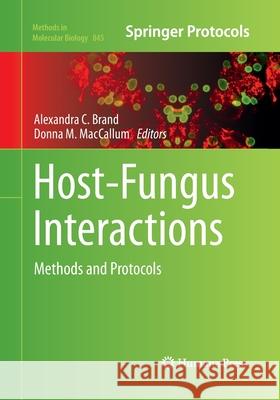
This exploration of the culture and genetic manipulation of primary fungal pathogens, as well as interactions in model systems, includes detailed, lab-ready techniques as well as the key tips and implementation advice necessary to achieve successful results.
From the book reviews:
"The book 'Host-fungus Interactions' assembles methods and protocols for studying gene disruption, modulation of gene expression, host and fungal responses to infection and several model systems to analyze the host-fungus interactions. The book comprises of 8 parts with 42 chapters and an index at the end of the book. ... A useful tool for medical microbiologists, immunologists, geneticists, biotechnologists and students studying pharmacology and pathogenicity testing." (Melvina D'souza and Kevin D. Hyde, Fungal Diversity, December, 2014)Part I: Gene Disruption
1. Gene Deletion in Candida albicans Wild-Type Strains Using the SAT1-Flipping Strategy
Christoph Sasse and Joachim Morschhäuser
2. Mini-Blaster-Mediated Targeted Gene Disruption and Marker Complementation in Candida albicans
Shantanu Ganguly and Aaron P. Mitchell
3. Rapid Detection of Aneuploidy Following the Generation of Mutants in Candida albicans
Megan D. Lenardon and André Nantel
4. Agrobacterium-Mediated Insertional Mutagenesis in Histoplasma capsulatumi
Olga Zemska and Chad A. Rappleye
5. Targeted Gene Disruption in Cryptococcus neoformans Using Double Joint PCR with Split Dominant Selectable Markers
Min Su Kim, Seo-Young Kim, Kwang-Woo Jung, and Yong-Sun Bahn
6. Multiple Gene Deletion in Cryptococcus neoformans Using the Cre--lox System
Lorina G. Bakerand and Jennifer K. Lodge
7. Gene Disruption in Aspergillus fumigatus Using a PCR-Based Strategy and In Vivo Recombination in Yeast
Iran Malavazi and Gustavo Henrique Goldman
8. Targeted Gene Deletion in Aspergillus fumigatus Using the Hygromycin-Resistance Split-Marker Approach
Fabrice N. Gravelat, David S. Askew, and Donald C. Sheppard
9. Gene Disruption in Coccidioides Using Hygromycin or Phleomycin Resistance Markers
Chiung-Yu Hung, Hua Zhang Wise, and Garry T. Cole
Part II: Modulation of Gene Expression: RNAi Gene Knockdown
10. RNAi-Based Gene Silencing Using a GFP Sentinel System in Histoplasma capsulatum
Brian H. Youseff and Chad A. Rappleye
11. RNA Interference in Cryptococcus neoformans
Michael L. Skowyra and Tamara L. Doering
12. Gene Knock-Down in Paracoccidioides brasiliensis Using Antisense RNA
João F. Menino, Agostinho J. Almeida, and Fernando Rodrigues
Part III: Modulation of Gene Expression: Regulatable Promoters
13. Tetracycline-Inducible Gene Expression in Candida albicans
Michael Weyler and Joachim Morschhäuser
14. Galactose-Inducible Promoters in Cryptococcus neoformans var. grubii
Lorina G. Baker and Jennifer K. Lodge
15. Modular Gene Over-Expression Strategies for Candida albicans
Vitor Cabral, Murielle Chauvel, Arnaud Firon, Mélanie Legrand, Audrey Nesseir, Sophie Bachellier-Bassi, Yogesh Chaudhari, Carol Munro, and Christophe d’Enfert
Part IV: Responses to Infection In Vivo
16. Interactions Between Macrophages and Cell-Wall Oligosaccharides of Candida albicans
Héctor M. Mora-Montes, Christopher McKenzie, Judith M. Bain, Leanne E. Lewis, Lars P. Erwig, and Neil A.R. Gow
17. Murine Bone Marrow-Derived Dendritic Cells and T Cell Activation by Candida albicans
Joanne Gibson, Neil A.R. Gow, and Simon Y.C. Wong
18. Phagocytosis and Intracellular Killing of Candida albicans by Murine Polymorphonuclear Neutrophils
Alieke G. Vonk, Mihai G. Netea, and Bart Jan Kullberg
19. Human Oral Keratinocytes: A Model System to Analyze Host-Pathogen Interactions
Torsten Wöllert, Christiane Rollenhagen, George M. Langford, and Paula Sundstrom
20. Simple Assays for Measuring Innate Interactions with Fungi
Ann M. Kerrigan, Maria da Glória Teixeira de Sousa, and Gordon D. Brown
21. Binding and Uptake of Candida albicans by Human Monocyte-Derived Dendritic Cells
Annemiek B. van Spriel and Alessandra Cambi
22. Immune Responses to Candida albicans in Models of In Vitro Reconstituted Human Oral Epithelium
Jeanette Wagener, Daniela Mailänder-Sanchez, and Martin Schaller
23. Analysis of Host-Cell Responses by Immunoblotting, ELISA, and Real-Time PCR
David L. Moyes and Julian R. Naglik
24. In Vitro Model of Invasive Pulmonary Aspergillosis in the Human Alveolus
Lea Gregson, William W. Hope, and Susan J. Howard
25. Biofilm Formation Studies in Microtiter Plate Format
Marta Riera, Emilia Moreno-Ruiz, Sophie Goyard, Christophe d’Enfert, and Guilhem Janbon
Part V: Responses to Infection In Vivo: Fungal Response
26. Transcript Profiling Using ESTs from Paracoccidioides brasiliensis in Models of
Infection
Alexandre Melo Bailão, Maristela Pereira, Silvia Maria Salem-Izacc, Clayton Luiz Borges, and Célia Maria de Almeida Soares
27. Laser Capture Microdissection of Candida albicans from Host Tissue
Caroline Westwater and David A. Schofield
28. Isolation and Amplification of Fungal RNA for Microarray Analysis from Host Samples
Anja Lüttich, Sascha Brunke, and Bernhard Hube
Part VI: Responses to Infection In Vivo: Host Response
29. Cytokine Measurement Using Cytometric Bead Arrays (CBA)
Luis Castillo and Donna M. MacCallum
30. Transcript Profiling of the Murine Immune Response to Invasive Aspergillosis
Zaneeta Dhesi, Susanne Herbst, and Darius Armstrong-James
Part VII: Responses to Infection In Vivo: Model Systems for Host-Fungal Interactions
31. Caenorhabditis elegans: A Nematode Infection Model for Pathogenic Fungi
Maged Muhammed, Jeffrey J. Coleman, and Eleftherios Mylonakis
32. Drosophila melanogaster as a Model Organism for Invasive Aspergillosis
Michail S. Lionakis and Dimitrios P. Kontoyiannis
33. Galleria mellonella as a Model for Fungal Pathogenicity Testing
John Fallon, Judy Kelly, and Kevin Kavanagh
34. Embryonated Chicken Eggs as Alternative Infection Model for Pathogenic Fungi
Ilse D. Jacobsen, Katharina Große, and Bernhard Hube
Part VIII: Responses to Infection In Vivo: Mammalian Hosts
35. Mouse Intravenous Challenge Models and Applications
Donna M. MacCallum
36. A Nebulized Intra-Tracheal Rat Model of Invasive Pulmonary Aspergillosis
Guillaume Desoubeaux and Jacques Chandenier
37. Invasive Models of Histoplasmosis
A. George Smulian
38. Murine Model of Concurrent Oral and Vaginal Candida albicans Colonization
Durdana Rahman, Mukesh Mistry, Selvam Thavaraj, Julian R. Naglik, and Stephen J. Challacombe
39. A Luciferase Reporter for Gene Expression Studies and Dynamic Imaging of Superficial Candida albicans Infections
Donatella Pietrella, Brice Enjalbert, Ute Zeidler, Sadri Znaidi, Anna Rachini, Anna Vecchiarelli, and Christophe d’Enfert
40. Modeling of Fungal Biofilms Using a Rat Central-Vein Catheter
Jeniel E. Nett, Karen Marchillo, and David R. Andes
41. Orogastrointestinal Model of Mucosal and Disseminated Candidiasis
Karl V. Clemons and David A. Stevens
42. A Non-Lethal Murine Cutaneous Model of Invasive Aspergillosis
Ronen Ben-Ami and Dimitrios Kontoyiannis
Microbiologists, medical mycologists, immunologists, and biochemists are increasingly working together to focus on the processes involved in the progression and treatment of fungal disease. Host-Fungus Interactions: Methods and Protocols is designed for research scientists who are involved in this work and interested in undertaking new or comparative studies of interactions between the mammalian host and clinically important fungal pathogens. Aiming to combine approaches for reverse genetics in pathogenic fungi with methods for their application in in vitro and in vivo models of disease, the book includes methods for the culture and genetic manipulation of the primary fungal pathogens and the opportunistic pathogens, as well as methods for investigating host-fungus interactions in model systems. Written in the highly successful Methods in Molecular Biology™ series format, chapters include introductions to their respective topics, lists of the necessary materials and reagents, step-by-step, readily reproducible laboratory protocols, and tips on troubleshooting and avoiding known pitfalls.
Comprehensive and practical, Host-Fungus Interactions: Methods and Protocols describes available molecular methods and fungal infection models in great detail in order to encourage researchers to try new approaches to investigating host-fungus interactions with added levels of confidence.




Czytaj nas na:
1997-2026 DolnySlask.com Agencja Internetowa
KrainaKsiazek.PL - Księgarnia Internetowa


