• Wyszukiwanie zaawansowane
  • Kategorie
  • Kategorie BISAC
  • Książki na zamówienie
  • Promocje
  • Granty
  • Książka na prezent
  • Opinie
  • Pomoc
  • Załóż konto
  • Zaloguj się

History of the Principle of Interference of Light » książka


zaloguj się | załóż konto
Logo Krainaksiazek.pl

koszyk

konto

szukaj
topmenu
Księgarnia internetowa
Szukaj
Książki na zamówienie
Promocje
Granty
Książka na prezent
Moje konto
Pomoc
 
 
Wyszukiwanie zaawansowane
Pusty koszyk
Bezpłatna dostawa dla zamówień powyżej 20 złBezpłatna dostawa dla zamówień powyżej 20 zł

Kategorie główne

• Nauka
 [2949965]
• Literatura piękna
 [1857847]

  więcej...
• Turystyka
 [70818]
• Informatyka
 [151303]
• Komiksy
 [35733]
• Encyklopedie
 [23180]
• Dziecięca
 [617748]
• Hobby
 [139972]
• AudioBooki
 [1650]
• Literatura faktu
 [228361]
• Muzyka CD
 [398]
• Słowniki
 [2862]
• Inne
 [444732]
• Kalendarze
 [1620]
• Podręczniki
 [167233]
• Poradniki
 [482388]
• Religia
 [509867]
• Czasopisma
 [533]
• Sport
 [61361]
• Sztuka
 [243125]
• CD, DVD, Video
 [3451]
• Technologie
 [219309]
• Zdrowie
 [101347]
• Książkowe Klimaty
 [123]
• Zabawki
 [2362]
• Puzzle, gry
 [3791]
• Literatura w języku ukraińskim
 [253]
• Art. papiernicze i szkolne
 [7933]
Kategorie szczegółowe BISAC

History of the Principle of Interference of Light

ISBN-13: 9783034897174 / Angielski / Miękka / 2012 / 271 str.
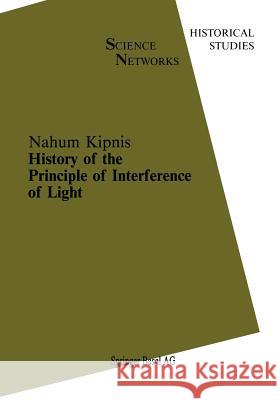
N. Kipnis
History of the Principle of Interference of Light N. Kipnis 9783034897174 Birkhauser Verlag AG - książkaWidoczna okładka, to zdjęcie poglądowe, a rzeczywista szata graficzna może różnić się od prezentowanej.

History of the Principle of Interference of Light

ISBN-13: 9783034897174 / Angielski / Miękka / 2012 / 271 str.

N. Kipnis
cena 181,38
(netto: 172,74 VAT:  5%)

Najniższa cena z 30 dni: 173,31
Termin realizacji zamówienia:
ok. 22 dni roboczych
Bez gwarancji dostawy przed świętami

Darmowa dostawa!

The controversy between the wave theory and the emission theory of light early in the nineteenth century has been a subject of numerous studies. Yet many is- sues remain unclear, in particular, the reasons for rejecting Young's theory of light. It appears that further progress in the field requires a better grasp of the overall situation in optics and related subjects at the time and a more thorough study of every factor suggested to be of importance for the dispute. This book is intended to be a step in this direction. It examines the impact of the concept of interference of light on the development of the early nineteenth- century optics in general, and the theory of light, in particular. This is not a his- tory of the wave theory of light, nor is it a history of the debate on the nature of light in general: it covers only that part of the controversy which involved the concept of interference. Although the book deals with a number of scientists, scientific institutions, and journals, its main character is a scientific concept, the principle of interference. While discussing the reasons for accepting or rejecting this concept I have primarily focused on scientific factors, although in some cases the human factor is examined as well. The book is a revised Ph. D. dissertation (University of Minnesota, 1984) writ- ten under Alan E. Shapiro.


Kategorie:
Nauka
Kategorie BISAC:
Science > Optyka
Mathematics > Filozofia i historia matematyki
Non-Classifiable > Non-Classifiable
Wydawca:
Birkhauser Verlag AG
Seria wydawnicza:
Science Networks. Historical Studies
Język:
Angielski
ISBN-13:
9783034897174
Rok wydania:
2012
Dostępne języki:
Angielski
Wydanie:
Softcover Repri
Numer serii:
000394104
Ilość stron:
271
Waga:
0.53 kg
Wymiary:
25.425.4 x 17.8
Oprawa:
Miękka
Wolumenów:
01
Dodatkowe informacje:
Wydanie ilustrowane

I Interference historiography and physics.- I.1 The “mystery” of Young’s theory.- I.2 New approach.- I.3 What is “Young’s wave theory”?.- I.4 “Interference” or “superposition”?.- I.5 What is the “acceptance of a theory”?.- II Thomas Young and the problem of intersecting sounds.- Section I: Young.- II. 1 What did Young discover about interference?.- II.2 Young on interference of sound.- Section II: Young’s predecessors.- II.3 Reinforcement of sound.- II.4 Destruction of sound.- II.5 Do intersecting sound waves interact?.- II.6 Mathematical approach to independence of sound.- II.7 Harmonics.- II.8 The third sound.- II.9 Summary.- III Young on interference of mechanical waves.- III.1 Standing waves.- III.2 Tides.- III.3 Coherence of mechanical waves.- III.4 Response to the concept of interference of sound.- a) Robison.- b) Gough.- c) Later response.- III.5 Summary.- IV Discovery of the principle of interference of light.- IV.1 Optical background.- IV.2 Transition from acoustics to optics.- IV.3 The problem of mathematical representation of light.- IV.4 What is the “law of interference”?.- IV.5 The principle of interference and the theory of interference.- V Young’s theory of interference and its application.- Section I: Interference of reflected and refracted light.- V.1 The colors of thin films.- V.2 The colors of the “thick plates”.- V.3 The colors of the “mixed plates”.- V.4 The colors of supernumerary rainbows.- Section II: Interference of diffracted light.- V.5 The colors of striated surfaces.- V.6 Diffraction of light by a narrow body: internal fringes.- V.7 Diffraction of light by a narrow body: external fringes.- V.8 The two-slit experiment.- Section III: Young on coherence of light.- V.9 The condition of frequency.- V.10 The condition of direction.- V.11 The condition of path difference.- V.12 The condition of a common origin.- V.13 The condition of the size of a light source.- V.14 Summary.- VI Response to the principle of interference (1801–1815).- VI.1 Early comments(1801–1805):generalsurvey.- VI.2 British reviews of Young’s theory(1801–1805).- a) “Non-experts”.- b) The Critical Review.- c) The Monthly Review.- d) The Edinburgh Magazine.- e) The Edinburgh Review.- VI.3 Later response (1807–1815).- VI.4 Summary.- VII Fresnel and the principle of interference.- VII.1 First period(1815–1816).- a) Rediscovery of the principle of interference of light.- b) Diffraction by a narrow body.- c) Reflection and refraction of light.- d) Other applications.- e) Early definitions of the principle of interference and conditions of coherence.- VII.2 Second period (1816–1818).- VII.3 Third period (1819–1822).- VII.4 Summary.- VIII Response to Fresnel’s principle of interference.- VIII.1 Arago.- VIII.2 Reception of Fresnel’s first paper.- VIII.3 Contest on diffraction.- VIII.4 Response to Fresnel’s prize-winning memoir.- VIII.5 Principle of interference and the wave theory.- VIII.6 Principle of interference and the emission theory.- VIII.7 Understanding of coherence after Fresnel.- VIII.8 Young’s role after 1815.- VIII.9 Summary.- Conclusions.


Udostępnij

Facebook - konto krainaksiazek.pl


Opinie o Krainaksiazek.pl na Opineo.pl

Partner Mybenefit

Krainaksiazek.pl w programie rzetelna firma Krainaksiaze.pl - płatności przez paypal

Czytaj nas na:

Facebook - krainaksiazek.pl
  • książki na zamówienie
  • granty
  • książka na prezent
  • kontakt
  • pomoc
  • opinie
  • regulamin
  • polityka prywatności

Zobacz:

  • Księgarnia czeska

  • Wydawnictwo Książkowe Klimaty

1997-2025 DolnySlask.com Agencja Internetowa

© 1997-2022 krainaksiazek.pl
     
KONTAKT | REGULAMIN | POLITYKA PRYWATNOŚCI | USTAWIENIA PRYWATNOŚCI
Zobacz: Księgarnia Czeska | Wydawnictwo Książkowe Klimaty | Mapa strony | Lista autorów
KrainaKsiazek.PL - Księgarnia Internetowa

Polityka prywatnosci - link
Krainaksiazek.pl - płatnośc Przelewy24
Przechowalnia Przechowalnia






