• Wyszukiwanie zaawansowane
  • Kategorie
  • Kategorie BISAC
  • Książki na zamówienie
  • Promocje
  • Granty
  • Książka na prezent
  • Opinie
  • Pomoc
  • Załóż konto
  • Zaloguj się

History of Mathematics: A Supplement » książka


zaloguj się | załóż konto
Logo Krainaksiazek.pl

koszyk

konto

szukaj
topmenu
Księgarnia internetowa
Szukaj
Książki na zamówienie
Promocje
Granty
Książka na prezent
Moje konto
Pomoc
 
 
Wyszukiwanie zaawansowane
Pusty koszyk
Bezpłatna dostawa dla zamówień powyżej 20 złBezpłatna dostawa dla zamówień powyżej 20 zł

Kategorie główne

• Nauka
 [2946912]
• Literatura piękna
 [1852311]

  więcej...
• Turystyka
 [71421]
• Informatyka
 [150889]
• Komiksy
 [35717]
• Encyklopedie
 [23177]
• Dziecięca
 [617324]
• Hobby
 [138808]
• AudioBooki
 [1671]
• Literatura faktu
 [228371]
• Muzyka CD
 [400]
• Słowniki
 [2841]
• Inne
 [445428]
• Kalendarze
 [1545]
• Podręczniki
 [166819]
• Poradniki
 [480180]
• Religia
 [510412]
• Czasopisma
 [525]
• Sport
 [61271]
• Sztuka
 [242929]
• CD, DVD, Video
 [3371]
• Technologie
 [219258]
• Zdrowie
 [100961]
• Książkowe Klimaty
 [124]
• Zabawki
 [2341]
• Puzzle, gry
 [3766]
• Literatura w języku ukraińskim
 [255]
• Art. papiernicze i szkolne
 [7810]
Kategorie szczegółowe BISAC

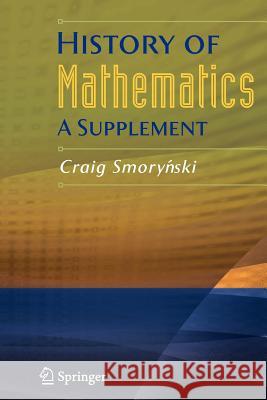
History of Mathematics: A Supplement

ISBN-13: 9781441925930 / Angielski / Miękka / 2010 / 274 str.
Craig Smorynski
History of Mathematics: A Supplement Smorynski, Craig 9781441925930 Springer - książkaWidoczna okładka, to zdjęcie poglądowe, a rzeczywista szata graficzna może różnić się od prezentowanej.

History of Mathematics: A Supplement

ISBN-13: 9781441925930 / Angielski / Miękka / 2010 / 274 str.

Craig Smorynski
cena 164,85
(netto: 157,00 VAT:  5%)

Najniższa cena z 30 dni: 157,89
Termin realizacji zamówienia:
ok. 22 dni roboczych
Bez gwarancji dostawy przed świętami

Darmowa dostawa!

1 An Initial Assignment I haven t taught the history of mathematics that often, but I do rather like the course. The chief drawbacks to teaching it are that i. it is a lot more work than teaching a regular mathematics course, and ii. in American colleges at least, the students taking the course are not mathematics majors but e- cation majors and and in the past I had found education majors to be somewhat weak and unmotivated. The last time I taught the course, however, themajorityofthestudentsweregraduateeducationstudentsworkingtoward their master s degrees. I decided to challenge them right from the start: 1 Assignment. In An Outline of Set Theory, James Henle wrote about mat- matics: Every now and then it must pause to organize and re?ect on what it is and where it comes from. This happened in the sixth century B. C. when Euclid thought he had derived most of the mathematical results known at the time from ?ve postulates. Do a little research to ?nd as many errors as possible in the second sentence and write a short essay on them. Theresponsesfarexceededmyexpectations. Tobesure, someoftheund- graduates found the assignment unclear: I did not say how many errors they 2 were supposed to ?nd. But many of the students put their hearts and souls 1 MyapologiestoProf. Henle, atwhoseexpenseIpreviouslyhadalittlefunonthis matter. I used it again not because of any animosity I hold for him, but because I was familiar with it and, dealing with Euclid, it seemed appropriate for the start of my course."


Kategorie:
Nauka, Matematyka
Kategorie BISAC:
Mathematics > Filozofia i historia matematyki
Mathematics > Algebra - General
Mathematics > Geometria
Wydawca:
Springer
Język:
Angielski
ISBN-13:
9781441925930
Rok wydania:
2010
Ilość stron:
274
Waga:
0.39 kg
Wymiary:
23.39 x 15.6 x 1.47
Oprawa:
Miękka
Wolumenów:
01
Dodatkowe informacje:
Komentarz
Bibliografia

From the reviews:

"This is very personal book, full of personal asides and footnotes that reveal the author's thought process. It's also an argumentative book ... which made me want to argue back. I kept reading. ... this is an interesting book. ... I do think anyone who teaches history of mathematics can find useful things here." (Fernando Q. Gouvêa, MathDL, December, 2007)

"This volume ... aims to discuss just a few topics from pre-20th-century mathematics, but to address them in some mathematical and historical detail. ... The book includes an appendix offering a dozen historical/mathematical projects. Overall, an interesting volume. Summing Up: Recommended. Upper-division undergraduates through researchers/faculty." (S. J. Colley, CHOICE, Vol. 45 (11), August, 2008)

Annotated Bibliography.- Foundations of Geometry.- The Construction Problems of Antiquity.- A Chinese Problem.- The Cubic Equation.- Horner's Method.- Some Lighter Material.

This book attempts to fill two gaps which exist in the standard textbooks on the History of Mathematics. One is to provide students with material that could encourage more critical thinking. General textbooks, attempting to cover three thousand years of mathematical history, must necessarily oversimplify almost everything, the practice of which can scarcely promote a critical approach to the subject. For this reason, Craig Smorynski chooses a more narrow but deeper coverage of a few select topics.

The second aim of this book is to include the proofs of important results which are typically neglected in the modern history of mathematics curriculum. The most obvious of these is the oft-cited necessity of introducing complex numbers in applying the algebraic solution of cubic equations. This solution, though it is now relegated to courses in the History of Mathematics, was a major occurrence in the history of mathematics. It was the first substantial piece of mathematics in Europe that was not a mere extension of what the Greeks had done and thus signified the coming of age of European mathematics. The fact that the solution, in the case of three distinct real roots to a cubic, necessarily involved complex numbers both made inevitable the acceptance and study of these numbers and provided a stimulus for the development of numerical approximation methods.

Other unique features include:

* a prefatory essay on the ways in which sources may be unreliable, followed by an annotated bibliography;

* a modern recounting of a Chinese word problem from the 13th century, illustrating the need for consulting multiple sources when the primary source is unavailable;

* the solution of the cubic equation, including multiple proofs that the algebraic solution uses complex numbers whenever the cubic equation has three distinct real solutions;

* a critical reappraisal of Horner's Method;

The final chapter contains lighter material, including a critical look at North Korea's stamps commemorating the 350th birthday of Newton, historically interesting (and hard to find) poems, and drinking songs or limericks with mathematical themes. The appendix outlines a few, small projects which could serve as replacements for the usual term papers.

Craig Smorynski is also the author of "Self-Reference and Modal Logic" and "Logical Number Theory I".


Udostępnij

Facebook - konto krainaksiazek.pl


Opinie o Krainaksiazek.pl na Opineo.pl

Partner Mybenefit

Krainaksiazek.pl w programie rzetelna firma Krainaksiaze.pl - płatności przez paypal

Czytaj nas na:

Facebook - krainaksiazek.pl
  • książki na zamówienie
  • granty
  • książka na prezent
  • kontakt
  • pomoc
  • opinie
  • regulamin
  • polityka prywatności

Zobacz:

  • Księgarnia czeska

  • Wydawnictwo Książkowe Klimaty

1997-2025 DolnySlask.com Agencja Internetowa

© 1997-2022 krainaksiazek.pl
     
KONTAKT | REGULAMIN | POLITYKA PRYWATNOŚCI | USTAWIENIA PRYWATNOŚCI
Zobacz: Księgarnia Czeska | Wydawnictwo Książkowe Klimaty | Mapa strony | Lista autorów
KrainaKsiazek.PL - Księgarnia Internetowa

Polityka prywatnosci - link
Krainaksiazek.pl - płatnośc Przelewy24
Przechowalnia Przechowalnia





