• Wyszukiwanie zaawansowane
  • Kategorie
  • Kategorie BISAC
  • Książki na zamówienie
  • Promocje
  • Granty
  • Książka na prezent
  • Opinie
  • Pomoc
  • Załóż konto
  • Zaloguj się

Histories Written by International Criminal Courts and Tribunals: Developing a Responsible History Framework » książka


zaloguj się | załóż konto
Logo Krainaksiazek.pl

koszyk

konto

szukaj
topmenu
Księgarnia internetowa
Szukaj
Książki na zamówienie
Promocje
Granty
Książka na prezent
Moje konto
Pomoc
 
 
Wyszukiwanie zaawansowane
Pusty koszyk
Bezpłatna dostawa dla zamówień powyżej 20 złBezpłatna dostawa dla zamówień powyżej 20 zł

Kategorie główne

• Nauka
 [2946350]
• Literatura piękna
 [1816154]

  więcej...
• Turystyka
 [70666]
• Informatyka
 [151172]
• Komiksy
 [35576]
• Encyklopedie
 [23172]
• Dziecięca
 [611458]
• Hobby
 [135995]
• AudioBooki
 [1726]
• Literatura faktu
 [225763]
• Muzyka CD
 [378]
• Słowniki
 [2917]
• Inne
 [444280]
• Kalendarze
 [1179]
• Podręczniki
 [166508]
• Poradniki
 [469467]
• Religia
 [507199]
• Czasopisma
 [496]
• Sport
 [61352]
• Sztuka
 [242330]
• CD, DVD, Video
 [3348]
• Technologie
 [219391]
• Zdrowie
 [98638]
• Książkowe Klimaty
 [124]
• Zabawki
 [2382]
• Puzzle, gry
 [3525]
• Literatura w języku ukraińskim
 [259]
• Art. papiernicze i szkolne
 [7107]
Kategorie szczegółowe BISAC

Histories Written by International Criminal Courts and Tribunals: Developing a Responsible History Framework

ISBN-13: 9789462654297 / Angielski / Miękka / 2021 / 284 str.
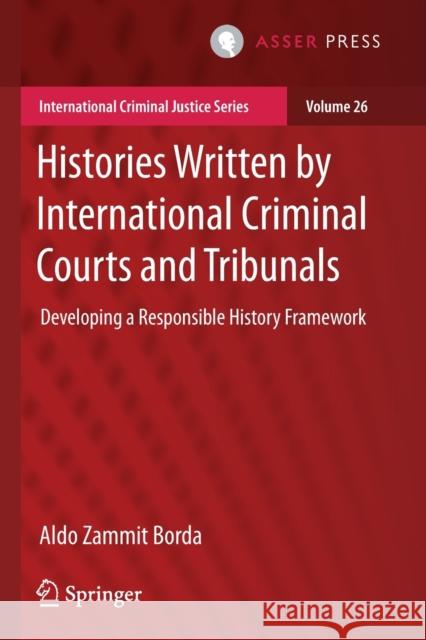
Aldo Zammit Borda
Histories Written by International Criminal Courts and Tribunals: Developing a Responsible History Framework Zammit Borda, Aldo 9789462654297 T.M.C. Asser Press - książkaWidoczna okładka, to zdjęcie poglądowe, a rzeczywista szata graficzna może różnić się od prezentowanej.

Histories Written by International Criminal Courts and Tribunals: Developing a Responsible History Framework

ISBN-13: 9789462654297 / Angielski / Miękka / 2021 / 284 str.

Aldo Zammit Borda
cena 342,14
(netto: 325,85 VAT:  5%)

Najniższa cena z 30 dni: 327,68
Termin realizacji zamówienia:
ok. 16-18 dni roboczych.

Darmowa dostawa!
inne wydania

This book argues for a more moderate approach to history-writing in international criminal adjudication by articulating the elements of a “responsible history” normative framework. The question of whether international criminal courts and tribunals (ICTs) ought to write historical narratives has gained renewed relevance in the context of the recent turn to history in international criminal law, the growing attention to the historical legacies of the ad hoc Tribunals and the minimal attention paid to historical context in the first judgment of the International Criminal Court.The starting point for this discussion is that, in cases of mass atrocities, prosecutors and judges are inevitably understood to be engaged in writing history and influencing collective memory, whether or not they so intend. Therefore, while writing history is an inescapable feature of ICTs, there is still today a significant lack of consensus over the proper place of this function. Since Hannah Arendt articulated her doctrine of strict legality, in response to the prosecutor’s expansive didactic approach in Eichmann, the legal debate on the subject has been largely polarised between restrictive and expansive approaches to history-writing in mass atrocity trials. What has been noticeably missing from this debate is the middle ground. The contribution this book seeks to make is precisely to articulate a framework that occupies that ground. The book asks: what are the lenses through which judges of ICTs interpret historical events, what kind of histories do ICTs write? and what kinds of histories should ICTs produce? Its arguments for a more moderate approach to history-writing are based on three distinct, but interrelated grounds: (1) Truth and Justice; (2) Right to Truth; and (3) Legal Epistemology.
Different target audiences may benefit from this book. Court officials and legal practitioners may find the normative framework developed herein useful in addressing the tensions between the competing objectives of ICTs and, in particular, in assessing the value of the history-writing function. Lawyers, historians and other academics may also find the analysis of the strengths, constraints and blind spots of the historical narratives written by ICTs interesting. This issue is particularly timely in view of current debates on the legacies of ICTs.
Aldo Zammit Borda is Director of the Centre for Access to Justice and Inclusion at Anglia Ruskin University, Cambridge, UK.



Kategorie:
Nauka, Prawo i administracja
Kategorie BISAC:
Law > International
Law > Criminal Law - General
Wydawca:
T.M.C. Asser Press
Seria wydawnicza:
International Criminal Justice Series
Język:
Angielski
ISBN-13:
9789462654297
Rok wydania:
2021
Ilość stron:
284
Waga:
0.40 kg
Wymiary:
23.39 x 15.6 x 1.52
Oprawa:
Miękka
Wolumenów:
01
Dodatkowe informacje:
Wydanie ilustrowane

Chapter 1. Introduction.- Chapter 2. Approaches to the History-Writing Function in International Criminal Adjudication.- Chapter 3.  The Individual-Centred Lens.- Chapter 4.  The Crime-Driven Lens.- Chapter 5.  The Law-Affirming Lens.- Chapter 6.  The Distinctive Approaches Of History And Law.- Chapter 7.  Aiming Towards Responsible History in International Criminal Adjudication.- Chapter 8. Conclusion.

This book argues for a more moderate approach to history-writing in international criminal adjudication by articulating the elements of a “responsible history” normative framework. The question of whether international criminal courts and tribunals (ICTs) ought to write historical narratives has gained renewed relevance in the context of the recent turn to history in international criminal law, the growing attention to the historical legacies of the ad hoc Tribunals and the minimal attention paid to historical context in the first judgment of the International Criminal Court. 

The starting point for this discussion is that, in cases of mass atrocities, prosecutors and judges are inevitably understood to be engaged in writing history and influencing collective memory, whether or not they so intend. Therefore, while writing history is an inescapable feature of ICTs, there is still today significant lack of consensus over the proper place of this function. Since Hannah Arendt articulated her doctrine of strict legality, in response to the prosecutor’s expansive didactic approach in Eichmann, the legal debate on the subject has been largely polarised between restrictive and expansive approaches to history-writing in mass atrocity trials. What has been noticeably missing from this debate is the middle ground. The contribution this book seeks to make is precisely to articulate a framework that occupies that ground. The book asks: what are the lenses through which judges of ICTs interpret historical events and what kind of histories do ICTs write? and what kinds of histories should ICTs produce? Its arguments for a more moderate approach to history-writing are based on three distinct, but interrelated reasons: (1) Truth and Justice; (2) Right to Truth; and (3) Legal Epistemology. 

Different target audiences may benefit from this book. Court officials and legal practitioners may find the normative framework developed herein useful in addressing the tensions between the competing objectives of ICTs and, in particular, in assessing the value of the history-writing function. Lawyers, historians and other academics may also find the analysis of the strengths, constraints and blind spots of the historical narratives written by ICTs interesting. This issue is particularly timely in view of current debates on the legacies of ICTs. 

Aldo Zammit Borda is Director of the Centre for Access to Justice and Inclusion at Anglia Ruskin University, Cambridge, UK. 



Udostępnij

Facebook - konto krainaksiazek.pl


Opinie o Krainaksiazek.pl na Opineo.pl

Partner Mybenefit

Krainaksiazek.pl w programie rzetelna firma Krainaksiaze.pl - płatności przez paypal

Czytaj nas na:

Facebook - krainaksiazek.pl
  • książki na zamówienie
  • granty
  • książka na prezent
  • kontakt
  • pomoc
  • opinie
  • regulamin
  • polityka prywatności

Zobacz:

  • Księgarnia czeska

  • Wydawnictwo Książkowe Klimaty

1997-2026 DolnySlask.com Agencja Internetowa

© 1997-2022 krainaksiazek.pl
     
KONTAKT | REGULAMIN | POLITYKA PRYWATNOŚCI | USTAWIENIA PRYWATNOŚCI
Zobacz: Księgarnia Czeska | Wydawnictwo Książkowe Klimaty | Mapa strony | Lista autorów
KrainaKsiazek.PL - Księgarnia Internetowa

Polityka prywatnosci - link
Krainaksiazek.pl - płatnośc Przelewy24
Przechowalnia Przechowalnia




