• Wyszukiwanie zaawansowane
  • Kategorie
  • Kategorie BISAC
  • Książki na zamówienie
  • Promocje
  • Granty
  • Książka na prezent
  • Opinie
  • Pomoc
  • Załóż konto
  • Zaloguj się

Hilbert Transform Applications in Mechanical Vibration » książka


zaloguj się | załóż konto
Logo Krainaksiazek.pl

koszyk

konto

szukaj
topmenu
Księgarnia internetowa
Szukaj
Książki na zamówienie
Promocje
Granty
Książka na prezent
Moje konto
Pomoc
 
 
Wyszukiwanie zaawansowane
Pusty koszyk
Bezpłatna dostawa dla zamówień powyżej 20 złBezpłatna dostawa dla zamówień powyżej 20 zł

Kategorie główne

• Nauka
 [2946912]
• Literatura piękna
 [1852311]

  więcej...
• Turystyka
 [71421]
• Informatyka
 [150889]
• Komiksy
 [35717]
• Encyklopedie
 [23177]
• Dziecięca
 [617324]
• Hobby
 [138808]
• AudioBooki
 [1671]
• Literatura faktu
 [228371]
• Muzyka CD
 [400]
• Słowniki
 [2841]
• Inne
 [445428]
• Kalendarze
 [1545]
• Podręczniki
 [166819]
• Poradniki
 [480180]
• Religia
 [510412]
• Czasopisma
 [525]
• Sport
 [61271]
• Sztuka
 [242929]
• CD, DVD, Video
 [3371]
• Technologie
 [219258]
• Zdrowie
 [100961]
• Książkowe Klimaty
 [124]
• Zabawki
 [2341]
• Puzzle, gry
 [3766]
• Literatura w języku ukraińskim
 [255]
• Art. papiernicze i szkolne
 [7810]
Kategorie szczegółowe BISAC

Hilbert Transform Applications in Mechanical Vibration

ISBN-13: 9780470978276 / Angielski / Twarda / 2011 / 320 str.
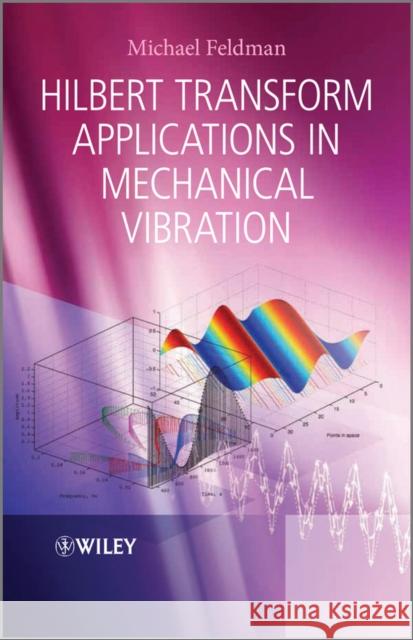
Dr. Michael Feldman;¬Abar;¬Abar
Hilbert Transform Applications in Mechanical Vibration Dr. Michael Feldman   9780470978276  - książkaWidoczna okładka, to zdjęcie poglądowe, a rzeczywista szata graficzna może różnić się od prezentowanej.

Hilbert Transform Applications in Mechanical Vibration

ISBN-13: 9780470978276 / Angielski / Twarda / 2011 / 320 str.

Dr. Michael Feldman;¬Abar;¬Abar
cena 571,28
(netto: 544,08 VAT:  5%)

Najniższa cena z 30 dni: 568,93
Termin realizacji zamówienia:
ok. 30 dni roboczych
Bez gwarancji dostawy przed świętami

Darmowa dostawa!

Hilbert Transform Applications in Mechanical Vibration addresses recent advances in theory and applications of the Hilbert transform to vibration engineering, enabling laboratory dynamic tests to be performed more rapidly and accurately. The author integrates important pioneering developments in signal processing and mathematical models with typical properties of mechanical dynamic constructions such as resonance, nonlinear stiffness and damping. A comprehensive account of the main applications is provided, covering dynamic testing and the extraction of the modal parameters of nonlinear vibration systems, including the initial elastic and damping force characteristics. This unique merger of technical properties and digital signal processing allows the instant solution of a variety of engineering problems and the in-depth exploration of the physics of vibration by analysis, identification and simulation. This book will appeal to both professionals and students working in mechanical, aerospace, and civil engineering, as well as naval architecture, biomechanics, robotics, and mechatronics. Hilbert Transform Applications in Mechanical Vibration employs modern applications of the Hilbert transform time domain methods including:

  • The Hilbert Vibration Decomposition method for adaptive separation of a multi-component non-stationary vibration signal into simple quasi-harmonic components; this method is characterized by high frequency resolution, which provides a comprehensive account of the case of amplitude and frequency modulated vibration analysis.
  • The FREEVIB and FORCEVIB main applications, covering dynamic testing and extraction of the modal parameters of nonlinear vibration systems including the initial elastic and damping force characteristics under free and forced vibration regimes. Identification methods contribute to efficient and accurate testing of vibration systems, avoiding effort-consuming measurement and analysis.
  • Precise identification of nonlinear and asymmetric systems considering high frequency harmonics on the base of the congruent envelope and congruent frequency.
  • Accompanied by a website at www.wiley.com/go/feldman, housing MATLAB(R)/ SIMULINK codes.

Kategorie:
Nauka, Fizyka
Kategorie BISAC:
Science > Mechanics - General
Technology & Engineering > Engineering (General)
Język:
Angielski
ISBN-13:
9780470978276
Rok wydania:
2011
Ilość stron:
320
Waga:
0.63 kg
Wymiary:
23.62 x 15.75 x 2.54
Oprawa:
Twarda
Wolumenów:
01
Dodatkowe informacje:
Bibliografia
Wydanie ilustrowane

List of Figures.

List of Tables.

Preface.

1 INTRODUCTION.

1.1 Brief History of the Hilbert Transform.

1.2 Hilbert Transform in Vibration Analysis.

1.3 Organization of the Book.

PART I. HILBERT TRANSFORM AND ANALYTIC SIGNAL.

2 ANALYTIC SIGNAL REPRESENTATION.

2.1 Local Versus Global Estimations.

2.2 The Hilbert Transform Notation.

2.3 Main Properties of the Hilbert Transform.

2.4 The Hilbert Transform of Multiplication.

2.5 Analytic Signal Representation.

2.6 Polar Notation.

2.7 Angular Position and Speed.

2.8 Signal Waveform and Envelope.

2.9 Instantaneous Phase.

2.10 Instantaneous Frequency.

2.11 Envelope vs. Instantaneous Frequency Plot.

2.12 Distribution Functions of the Instantaneous Characteristics.

2.13 Signal Bandwidth.

2.14 Instantaneous Frequency Distribution and Negative Values.

2.15 Conclusions.

3 SIGNAL DEMODULATION.

3.1 Envelope and Instantaneous Frequency Extraction.

3.2 Hilbert Transform and Synchronous Detection.

3.3 Digital Hilbert Transformers.

3.4 Instantaneous Characteristics Distortions.

3.5 Conclusions.

Part II. HILBERT TRANSFORM AND VIBRATION SIGNALS.

4 TYPICAL EXAMPLES AND DESCRIPTION OF VIBRATION DATA.

4.1 Random Signal.

4.2 Decay Vibration Waveform.

4.3 Slow Linear Sweeping Frequency Signal.

4.4 Harmonic Frequency Modulation.

4.5 Harmonic Amplitude Modulation.

4.6 Product of Two Harmonics.

4.7 Single Harmonic with DC Offset.

4.8 Composition of Two Harmonics.

4.9 Derivative and Integral of the Analytic Signal.

4.10 Signal Level.

4.11 Frequency Contents.

4.12 Narrowband and Wideband Signal.

4.13 Conclusions.

5 ACTUAL SIGNAL CONTENTS.

5.1 Monocomponent Signal.

5.2 Multicomponent Signal.

5.3 Types of multicomponent signals.

5.4 Averaging Envelope and Instantaneous Frequency.

5.5 Smoothing and Approximation of the Instantaneous Frequency.

5.6 Congruent Envelope.

5.7 Congruent Instantaneous Frequency.

5.8 Conclusions.

6 LOCAL AND GLOBAL VIBRATION DECOMPOSITIONS.

6.1 Empirical Mode Decomposition.

6.2 Analytical Basics of the EMD.

6.3 Global Hilbert Vibration Decomposition.

6.4 Instantaneous Frequency of the Largest Energy Component.

6.5 Envelope of the Largest Energy Component.

6.6 Subtraction of the Synchronous Largest Component.

6.7 Hilbert Vibration Decomposition Scheme.

6.8 Examples of Hilbert Vibration Decomposition.

6.9 Comparison of the Hilbert Transform Decomposition Methods.

6.10 Common Properties of the Hilbert Transform Decompositions.

6.11 The Differences between the Hilbert Transform Decompositions.

6.12 Amplitude–Frequency Resolution of HT Decompositions.

6.13 Limiting Number of Valued Oscillating Components.

6.14 Decompositions of Typical Non–stationary Vibration Signals.

6.15 Main Results and Recommendations.

6.16 Conclusions.

7 SIGNAL ANALYSIS PRACTICE EXPERIENCE AND INDUSTRIAL APPLICATION.

7.1 Structural Health Monitoring.

7.2 Standing and Traveling Wave Separation.

7.3 Echo Signal Estimation.

7.4 Synchronization Description.

7.5 Fatigue Estimation.

7.6 Multichannel Vibration Generation.

7.7 Conclusions.

Part III. HILBERT TRANSFORM AND VIBRATION SYSTEMS

8 VIBRATION SYSTEM CHARACTERISTICS.

8.1 Kramers–Kronig Relations.

8.2 Detection of Nonlinearities in Frequency Domain.

8.3 Typical Nonlinear Elasticity Characteristics.

8.4 Phase Plane Representation of Elastic Nonlinearities in Vibration Systems.

8.5 Complex Plane Representation.

8.6 Approximate Primary Solution of a Conservative Nonlinear System.

8.7 Hilbert Transform and Hysteretic Damping.

8.8 Nonlinear Damping Characteristics in SDOF Vibration System.

8.9 Typical Nonlinear Damping in Vibration System.

8.10 Velocity–Dependent Nonlinear Damping.

8.11 Velocity–Independent Damping.

8.12 Combination of Different Damping Elements.

8.13 Conclusions.

9 IDENTIFICATION OF THE PRIMARY SOLUTION.

9.1 Theoretical Bases of the Hilbert Transform System Identification.

9.2 Free Vibration Modal Characteristics.

9.3 Forced Vibration Modal Characteristics.

9.4 BackBone (Skeleton Curve).

9.5 Damping Curve.

9.6 Frequency Response.

9.7 Force Static Characteristics.

9.8 Conclusions.

10 THE FREEVIB and FORCEVIB METHODS.

10.1 FREEVIB Identification Examples.

10.2 FORCEVIB Identification Examples.

10.3 System Identification with Biharmonic Excitation.

10.4 Identification of Nonlinear Time–Varying System.

10.5 Experimental Identification of Nonlinear Vibration System.

10.6 Conclusions.

11 CONSIDERING HIGH ORDER SUPERHARMONICS. IDENTIFICATION OF ASYMMETRIC AND MDOF SYSTEMS.

11.1 Description of the Precise Method Scheme.

11.2 Identification of the Instantaneous Modal Parameters.

11.3 Congruent Modal Parameters.

11.4 Congruent Nonlinear Elastic and Damping Forces.

11.5 Examples of Precise Free Vibration Identification.

11.6 Forced Vibration Identification Considering High–Order Superharmonics.

11.7 Identification of Asymmetric Nonlinear System.

11.8 Experimental Identification of a Crack.

11.9 Identification of MDOF Vibration System.

11.10 Identification of Weakly Nonlinear Coupled Oscillators.

11.11 Conclusions.

12 SYSTEM ANALYSIS PRACTICE EXPERIENCE AND INDUSTRIAL APPLICATION.

12.1 Non–parametric Identification of Nonlinear Mechanical Vibration Systems.

12.2 Parametric Identification of Nonlinear Mechanical Vibrating Systems.

12.3 Structural Health Monitoring and Damage Detection.

12.4 Conclusions.

References.

Index.

Hilbert Transform Applications in Mechanical Vibration
Michael Feldman, Technion – Israel Institute of Technology

Hilbert Transform Applications in Mechanical Vibration addresses recent advances in theory and applications of the Hilbert transform to vibration engineering, enabling laboratory dynamic tests to be performed more rapidly and accurately. The author integrates important pioneering developments in signal processing and mathematical models with typical properties of mechanical dynamic constructions such as resonance, nonlinear stiffness and damping. A comprehensive account of the main applications is provided, covering dynamic testing and the extraction of the modal parameters of nonlinear vibration systems, including the initial elastic and damping force characteristics. This unique merger of technical properties and digital signal processing allows the instant solution of a variety of engineering problems and the in–depth exploration of the physics of vibration by analysis, identification and simulation.

This book will appeal to both professionals and students working in mechanical, aerospace, and civil engineering, as well as naval architecture, biomechanics, robotics, and mechatronics.

Hilbert Transform Applications in Mechanical Vibration employs modern applications of the Hilbert transform time domain methods including:

  • The Hilbert Vibration Decomposition method for adaptive separation of a multi–component non–stationary vibration signal into simple quasi–harmonic components; this method is characterized by high frequency resolution, which provides a comprehensive account of the case of amplitude and frequency modulated vibration analysis.
  • The FREEVIB and FORCEVIB main applications, covering dynamic testing and extraction of the modal parameters of nonlinear vibration systems including the initial elastic and damping force characteristics under free and forced vibration regimes. Identification methods contribute to efficient and accurate testing of vibration systems, avoiding effort–consuming measurement and analysis.
  • Precise identification of nonlinear and asymmetric systems considering high frequency harmonics on the base of the congruent envelope and congruent frequency.
  • Companion website houses MATLAB®/ SIMULINK codes.


Udostępnij

Facebook - konto krainaksiazek.pl


Opinie o Krainaksiazek.pl na Opineo.pl

Partner Mybenefit

Krainaksiazek.pl w programie rzetelna firma Krainaksiaze.pl - płatności przez paypal

Czytaj nas na:

Facebook - krainaksiazek.pl
  • książki na zamówienie
  • granty
  • książka na prezent
  • kontakt
  • pomoc
  • opinie
  • regulamin
  • polityka prywatności

Zobacz:

  • Księgarnia czeska

  • Wydawnictwo Książkowe Klimaty

1997-2025 DolnySlask.com Agencja Internetowa

© 1997-2022 krainaksiazek.pl
     
KONTAKT | REGULAMIN | POLITYKA PRYWATNOŚCI | USTAWIENIA PRYWATNOŚCI
Zobacz: Księgarnia Czeska | Wydawnictwo Książkowe Klimaty | Mapa strony | Lista autorów
KrainaKsiazek.PL - Księgarnia Internetowa

Polityka prywatnosci - link
Krainaksiazek.pl - płatnośc Przelewy24
Przechowalnia Przechowalnia







