• Wyszukiwanie zaawansowane
  • Kategorie
  • Kategorie BISAC
  • Książki na zamówienie
  • Promocje
  • Granty
  • Książka na prezent
  • Opinie
  • Pomoc
  • Załóż konto
  • Zaloguj się

Heuristics and Biases: The Psychology of Intuitive Judgment » książka

zaloguj się | załóż konto
Logo Krainaksiazek.pl

koszyk

konto

szukaj
topmenu
Księgarnia internetowa
Szukaj
Książki na zamówienie
Promocje
Granty
Książka na prezent
Moje konto
Pomoc
 
 
Wyszukiwanie zaawansowane
Pusty koszyk
Bezpłatna dostawa dla zamówień powyżej 20 złBezpłatna dostawa dla zamówień powyżej 20 zł

Kategorie główne

• Nauka
 [2949965]
• Literatura piękna
 [1857847]

  więcej...
• Turystyka
 [70818]
• Informatyka
 [151303]
• Komiksy
 [35733]
• Encyklopedie
 [23180]
• Dziecięca
 [617748]
• Hobby
 [139972]
• AudioBooki
 [1650]
• Literatura faktu
 [228361]
• Muzyka CD
 [398]
• Słowniki
 [2862]
• Inne
 [444732]
• Kalendarze
 [1620]
• Podręczniki
 [167233]
• Poradniki
 [482388]
• Religia
 [509867]
• Czasopisma
 [533]
• Sport
 [61361]
• Sztuka
 [243125]
• CD, DVD, Video
 [3451]
• Technologie
 [219309]
• Zdrowie
 [101347]
• Książkowe Klimaty
 [123]
• Zabawki
 [2362]
• Puzzle, gry
 [3791]
• Literatura w języku ukraińskim
 [253]
• Art. papiernicze i szkolne
 [7933]
Kategorie szczegółowe BISAC

Heuristics and Biases: The Psychology of Intuitive Judgment

ISBN-13: 9780521792608 / Angielski / Twarda / 2002 / 880 str.
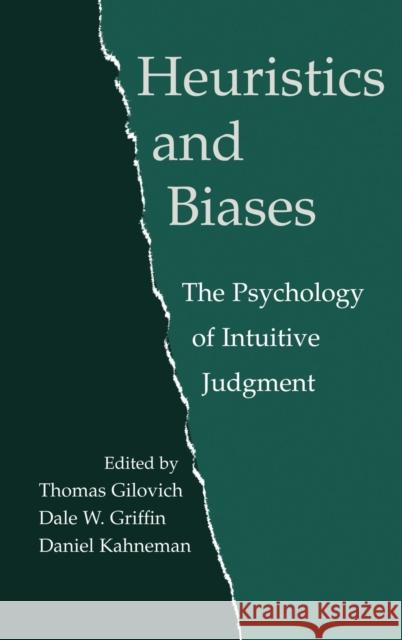
Thomas Gilovich; Dale W. Griffin; Daniel Kahneman
Heuristics and Biases: The Psychology of Intuitive Judgment Gilovich, Thomas 9780521792608 Cambridge University Press - książkaWidoczna okładka, to zdjęcie poglądowe, a rzeczywista szata graficzna może różnić się od prezentowanej.

Heuristics and Biases: The Psychology of Intuitive Judgment

ISBN-13: 9780521792608 / Angielski / Twarda / 2002 / 880 str.

Thomas Gilovich; Dale W. Griffin; Daniel Kahneman
cena 741,05
(netto: 705,76 VAT:  5%)

Najniższa cena z 30 dni: 733,53
Termin realizacji zamówienia:
ok. 22 dni roboczych
Bez gwarancji dostawy przed świętami

Darmowa dostawa!
inne wydania

Judgment pervades human experience. Do I have a strong enough case to go to trial? Will the Fed change interest rates? Can I trust this person? This book examines how people answer such questions. How do people cope with the complexities of the world economy, the uncertain behavior of friends and adversaries, or their own changing tastes and personalities? When are people's judgments prone to bias, and what is responsible for their biases? This book compiles psychologists' best attempts to answer these important questions.


Kategorie:
Nauka, Psychologia
Kategorie BISAC:
Psychology > Cognitive Psychology & Cognition
Wydawca:
Cambridge University Press
Język:
Angielski
ISBN-13:
9780521792608
Rok wydania:
2002
Ilość stron:
880
Waga:
1.20 kg
Wymiary:
24.31 x 16.38 x 3.56
Oprawa:
Twarda
Wolumenów:
01
Dodatkowe informacje:
Bibliografia
Wydanie ilustrowane

"Heuristics and Biases: The Psychology of Intuitive Judgment is a scholarly treat, one that is sure to shape the perspectives of another generation of researchers, teachers, and graduate students. The book will serve as a welcome refresher course for some readers and a strong introduction to an important research perspective for others." Journal of Social and Clinical Psychology

Introduction: heuristics and biases then and now; Part I. Theoretical and Empirical Extensions: 1. Extensional versus intuitive reasoning: the conjunction fallacy in probability judgment; 2. Representativeness revisited: attribute substitution in intuitive judgment; 3. How alike is it versus how likely it is: a disjunction fallacy in probability judgments; 4. Imagining can heighten or lower the perceived likelihood of contracting a disease: the mediating effect of ease of imagery; 5. The availability heuristic revisited: ease of recall and content of recall as distinct sources of information; 6. Incorporating the irrelevant: anchors in judgments of belief and value; 7. Putting adjustment back in the anchoring and adjustment heuristic: differential processing of self-generate and experimenter-provided anchors; 8. Self anchoring in conversation: why language users don't do what they 'should'; 9. Inferential correction; 10. Mental contamination and the debiasing problem; 11. Sympathetic magical thinking: the contagion and similarity 'heuristics'; 12. Compatibility effects in judgment and choice; 13. The weighing of evidence and the determinants of confidence; 14. Inside the planning fallacy: the causes and consequences of optimistic time predictions; 15. Probability judgment across cultures; 16. Durability bias in affective forecasting; 17. Resistance of personal risk perceptions to debiasing interventions; 18. Ambiguity and self-evaluation: the role of idiosyncratic trait definitions in self-serving assessments of ability; 19. When predictions fail: the dilemma of unrealistic optimism; 20. Norm theory: comparing reality to its alternatives; 21. Counterfactual thought, regret, and superstition: how to avoid kicking yourself; Part II. New Theoretical Directions: 22. Two systems of reasoning; 23. The affect heuristic; 24. Individual differences in reasoning: implications for the rationality debate?; 25. Support theory: a nonextensional representation of subjective probability; 26. Unpacking, repacking, and anchoring: advances in support theory; 27. Remarks on support theory: recent advances and future directions; 28. The use of statistical heuristics in everyday inductive reasoning; 29. Feelings as information: moods influence judgments and processing strategies; 30. Automated choice heuristics; 31. How good are fast and frugal heuristics?; 32. Intuitive politicians, theologians, and prosecutors: exploring the empirical implications of deviant functionalist metaphors; Part III. Real World Applications: 33. The hot hand in basketball: on the misperception of random sequences; 34. Like goes with like: the role of representativeness in erroneous and pseudoscientific beliefs; 35. When less is more: counterfactual thinking and satisfaction among Olympic medalists; 36. Understanding misunderstanding: social psychological perspectives; 37. Assessing uncertainty in physical constants; 38. Do analysts overreact?; 39. The calibration of expert judgment: Heuristics and biases beyond the laboratory; 40. Clinical versus actuarial judgment; 41. Heuristics and biases in application; 42. Theory driven reasoning about plausible pasts and probable futures in world politics.

Gilovich, Thomas Thomas Gilovich is a professor of psychology at Co... więcej >


Udostępnij

Facebook - konto krainaksiazek.pl


Opinie o Krainaksiazek.pl na Opineo.pl

Partner Mybenefit

Krainaksiazek.pl w programie rzetelna firma Krainaksiaze.pl - płatności przez paypal

Czytaj nas na:

Facebook - krainaksiazek.pl
  • książki na zamówienie
  • granty
  • książka na prezent
  • kontakt
  • pomoc
  • opinie
  • regulamin
  • polityka prywatności

Zobacz:

  • Księgarnia czeska

  • Wydawnictwo Książkowe Klimaty

1997-2025 DolnySlask.com Agencja Internetowa

© 1997-2022 krainaksiazek.pl
     
KONTAKT | REGULAMIN | POLITYKA PRYWATNOŚCI | USTAWIENIA PRYWATNOŚCI
Zobacz: Księgarnia Czeska | Wydawnictwo Książkowe Klimaty | Mapa strony | Lista autorów
KrainaKsiazek.PL - Księgarnia Internetowa

Polityka prywatnosci - link
Krainaksiazek.pl - płatnośc Przelewy24
Przechowalnia Przechowalnia






