• Wyszukiwanie zaawansowane
  • Kategorie
  • Kategorie BISAC
  • Książki na zamówienie
  • Promocje
  • Granty
  • Książka na prezent
  • Opinie
  • Pomoc
  • Załóż konto
  • Zaloguj się

Health Policy and Systems Responses to Forced Migration » książka


zaloguj się | załóż konto
Logo Krainaksiazek.pl

koszyk

konto

szukaj
topmenu
Księgarnia internetowa
Szukaj
Książki na zamówienie
Promocje
Granty
Książka na prezent
Moje konto
Pomoc
 
 
Wyszukiwanie zaawansowane
Pusty koszyk
Bezpłatna dostawa dla zamówień powyżej 20 złBezpłatna dostawa dla zamówień powyżej 20 zł

Kategorie główne

• Nauka
 [2946912]
• Literatura piękna
 [1852311]

  więcej...
• Turystyka
 [71421]
• Informatyka
 [150889]
• Komiksy
 [35717]
• Encyklopedie
 [23177]
• Dziecięca
 [617324]
• Hobby
 [138808]
• AudioBooki
 [1671]
• Literatura faktu
 [228371]
• Muzyka CD
 [400]
• Słowniki
 [2841]
• Inne
 [445428]
• Kalendarze
 [1545]
• Podręczniki
 [166819]
• Poradniki
 [480180]
• Religia
 [510412]
• Czasopisma
 [525]
• Sport
 [61271]
• Sztuka
 [242929]
• CD, DVD, Video
 [3371]
• Technologie
 [219258]
• Zdrowie
 [100961]
• Książkowe Klimaty
 [124]
• Zabawki
 [2341]
• Puzzle, gry
 [3766]
• Literatura w języku ukraińskim
 [255]
• Art. papiernicze i szkolne
 [7810]
Kategorie szczegółowe BISAC

Health Policy and Systems Responses to Forced Migration

ISBN-13: 9783030338145 / Angielski / Miękka / 2021 / 249 str.
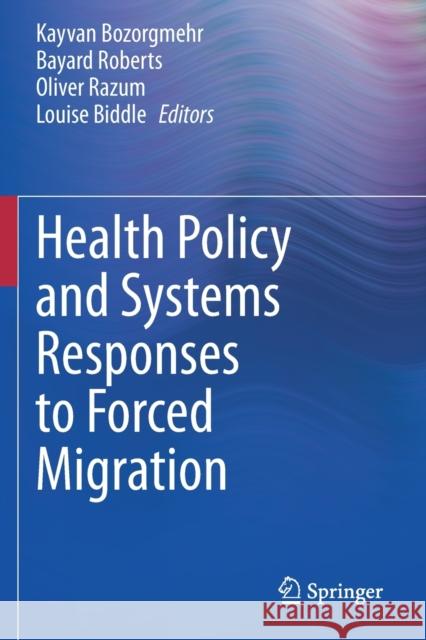
Kayvan Bozorgmehr; Bayard Roberts; Oliver Razum
Health Policy and Systems Responses to Forced Migration Kayvan Bozorgmehr Bayard Roberts Oliver Razum 9783030338145 Springer - książkaWidoczna okładka, to zdjęcie poglądowe, a rzeczywista szata graficzna może różnić się od prezentowanej.

Health Policy and Systems Responses to Forced Migration

ISBN-13: 9783030338145 / Angielski / Miękka / 2021 / 249 str.

Kayvan Bozorgmehr; Bayard Roberts; Oliver Razum
cena 200,77
(netto: 191,21 VAT:  5%)

Najniższa cena z 30 dni: 192,74
Termin realizacji zamówienia:
ok. 22 dni roboczych
Dostawa w 2026 r.

Darmowa dostawa!
inne wydania
Kategorie:
Nauka, Medycyna
Kategorie BISAC:
Medical > Health Policy
Social Science > Emigration & Immigration
Medical > Allied Health Services - General
Wydawca:
Springer
Język:
Angielski
ISBN-13:
9783030338145
Rok wydania:
2021
Wydanie:
2020
Ilość stron:
249
Waga:
0.38 kg
Wymiary:
23.39 x 15.6 x 1.42
Oprawa:
Miękka
Wolumenów:
01
Dodatkowe informacje:
Wydanie ilustrowane


Editorial
The editorial summarises the rationale of the book, provides background information on the book project as well as an overview of each chapter. It summarises the essentials of each chapter, shows their interrelation, and highlights specific contributions.


Introduction: Why a health policy and systems approach to forced migration?
The introduction defines health policy and health system, including the elements and building blocks of health systems as well as their interrelation. It outlines main concepts in the area of health policy and systems research, provides insights into systems perspectives and approaches, and clarifies why such an approach is needed to better understand and respond to challenges of forced migration. It builds the basis for readers not familiar with the field or from different disciplines and
epistemological backgrounds to understand and contextualize the specific contributions of the subsequent chapters outlined below.


Chapters 1 – 10: (Preliminary structure: The 10 main areas will be further detailed out in light of specific contributions of authors)

1. Health policy and systems reforms: political economy of responses to forced migration 
Health policy and systems reforms are embedded in social structures, norms, and values. This chapter delineates the contemporary political economy in which policy and systems reforms with respect to forced migration are made. Applying a European perspective, this chapter shows how health policy and systems reforms interrelate, conflict, or concur with other policy areas. It takes a broader
international perspective as far as necessary to understand the (global) linkages between local or national policy and systems reforms and broader socio‐political or economic contexts and determinants. This includes issues of policy space but also normative and legal architecture surrounding aspects of forced migration.

2. Health financing: challenges, solutions, or innovations of systems to address health and health care of forced migrants
Health financing systems are an essential component of every health system. This chapter outlines the challenges health financing systems face in the area of forced migration. Using a case‐studies approach, it provides examples of potential solutions and innovations practiced in local or national realities that have the potential to be up‐scaled or transferred to other contexts. The chapter also seeks to theoretically and normatively discuss the potential of innovative financing approaches proposed in other areas (such as the global fund for health, ILO social protection floor, or transaction‐based taxes) to overcome health financing challenges related to cross‐border migration.

3. Health system resilience: Approaches, strategies, and interventions to improve resilience
This chapter applies the concept of health system resilience ‐ understood as absorptive, adaptive, and transformative capacity of systems ‐ to the area of forced migration. Contributions in this area present how health systems have reacted to forced migration with respect to the three capacity areas that define resilience, in order to draw lessons for the future or for other countries.

4. Health security and universality: Tensions and synergies
This chapter closely interrelates with Chapter 1 with respect to the political economy of health systems and policy reforms. The contributions in the chapter define and compare the two prominent concepts of global health policy (health security and universal health coverage) applied to the area of forced migration. The chapter scrutinises essential and fundamental tensions between the two concepts, but also identifies synergies that may be used to maximize the health gain for the
population of forced migrants.

5. Influencing policy: experiences, factors, and strategies
This chapter outlines characteristics of the policy-making process as a practical and political field, and highlights areas in the context of forced migration where policy making and science (sometimes blatantly) diverge. Using examples from countries or local realities where scientific evidence effectively informed policy making, the chapter seeks to provide scientists and practitioners insights into experiences, factors, and strategies to influence the policy-making process in the context of forced migration.

6. Health information systems: gaps, challenges, and responses to forced migration
Health information systems are an essential but often neglected component of health systems. Data are essential for healthcare planning, monitoring, and evaluation, but also for social epidemiological enquiries into health inequalities within and between population groups. This chapter provides an overview of gaps in health information systems in selected European health systems, illustrates the challenges of collecting disaggregated data by migration status, and
highlights recent initiatives of health systems to respond to forced migration by strengthening their health information systems.

7. Health services organization: screening and identification of vulnerable refugees
The organization and delivery of health services in the context of forced migration is (compared to other health system elements) well-researched. There is, however, a gap in overviews on how health services (re‐)organized to respond to recent EU directives of identifying vulnerable refugees. While there is ample literature on infectious disease screening, there are few insights into screening for other conditions such as mental health. This chapter uses country examples to provide an overview of approaches, experiences, and lessons learnt in the area of screening and identification of vulnerable
refugees.

8. Health workforce mobilization, development, and strategies
This chapter interrelates with the chapter on health system resilience and provides experiences, evidence and knowledge on mobilising and developing a qualified health workforce to respond to the challenges of forced migration. It highlights system-level strategies, and local good practice with potentials for up‐scaling.

9. Cross‐border health governance: status quo, prospects, and strategies
This chapter takes a supra‐national European perspective to shed light on the challenge of cross-border health governance. As forced migrants cross national borders to reach their destination, transition countries and receiving countries need to collaborate to effectively provide the health and humanitarian needs along the migrant trajectory. This chapter analyses the
status quo of cross‐border governance that is often entrapped in national silos, discusses the prospects of cross‐border governance in selected health areas, and delineates potential strategies to enhance cross‐border health governance in the future.

10. Social policy, governance for health, and health governance
Health systems interrelate with other systems, such as trade, development, or the education system. Building on Ilona Kickbusch’s definition of the governance spaces for health, this chapter shows the interrelations between global health governance (i.e., dedicated health organisations) and governance in global organisations outside the health sector with relevance for health in the area of forced migration. These interrelations become important in light of the Sustainable Development Goals, which reach out beyond the health sector. This chapter analyses the status quo of current
governance systems with respect to forced migration and discusses the challenges and prospects of stronger inclusion of health and health systems perspectives into other sectors.

Kayvan Bozorgmehr, MD, MSc, is full professor and head of the Department of Population Medicine and Health Services Research at Bielefeld University School of Public Health in Germany. Dr. Bozorgmehr also is research group leader of "Social Determinants, Equity & Migration" in the Department of General Practice and Health Services Research at Heidelberg University Hospital in Germany.


Bayard Roberts, PhD, MPH, is professor in Health Systems and Policy with the Faculty of Public Health and Policy at the London School of Hygiene and Tropical Medicine in London, United Kingdom. Dr. Roberts also is head of the Department for Health Services Research and Policy as well as co-director for the Centre for Global Chronic Conditions. He has been co-editor-in-chief of the BMC journal Conflict and Health since 2012, and an honorary member of the Faculty of Public Health in the United Kingdom since 2015.

Oliver Razum, MD, MSc, is full professor and dean as well as head of the Department of Epidemiology and International Public Health at Bielefeld University School of Public Health in Germany.

Louise Biddle, MSc, is study coordinator for the research project RESPOND in the Department of General Practice and Health Services Research at University Hospital Heidelberg in Germany. Ms. Biddle also is a PhD candidate at Heidelberg University.


Forced migration has yet to be sufficiently addressed from the perspective of health policy and systems research, resulting in limited knowledge on system‐level interventions and policies to improve the health of forced migrants. The contributions within this edited volume seek to rectify this gap in the literature by compiling the existing knowledge on health systems and health policy responses to forced migration with a focus on asylum seekers, refugees, and internally displaced people. It also brings together the work of research communities from the fields of political science, epidemiology, health sciences, economics, psychology, and sociology to push the knowledge frontier of health research in the area of forced migration towards health policy and systems-level interventions, while also framing potential routes for further research in this area.

Among the analyses within the chapters:

  • The political economy of health and forced migration in Europe
  • Innovative humanitarian health financing for refugees
  • Understanding the resilience of health systems
  • Health security in the context of forced migration
  • Discrimination as a health systems response to forced migration

Health Policy and Systems Responses to Forced Migration offers unique and interdisciplinary theoretical, empirical, and literature-based perspectives that apply a health policy and systems approach to health and healthcare challenges among forced migrants. It will find an engaged audience among policy makers and analysts, international organizations, scholars in academia, think tanks, and students in undergraduate programs or at the graduate level, for policy, practice, and educational purposes.




Udostępnij

Facebook - konto krainaksiazek.pl


Opinie o Krainaksiazek.pl na Opineo.pl

Partner Mybenefit

Krainaksiazek.pl w programie rzetelna firma Krainaksiaze.pl - płatności przez paypal

Czytaj nas na:

Facebook - krainaksiazek.pl
  • książki na zamówienie
  • granty
  • książka na prezent
  • kontakt
  • pomoc
  • opinie
  • regulamin
  • polityka prywatności

Zobacz:

  • Księgarnia czeska

  • Wydawnictwo Książkowe Klimaty

1997-2025 DolnySlask.com Agencja Internetowa

© 1997-2022 krainaksiazek.pl
     
KONTAKT | REGULAMIN | POLITYKA PRYWATNOŚCI | USTAWIENIA PRYWATNOŚCI
Zobacz: Księgarnia Czeska | Wydawnictwo Książkowe Klimaty | Mapa strony | Lista autorów
KrainaKsiazek.PL - Księgarnia Internetowa

Polityka prywatnosci - link
Krainaksiazek.pl - płatnośc Przelewy24
Przechowalnia Przechowalnia



