• Wyszukiwanie zaawansowane
  • Kategorie
  • Kategorie BISAC
  • Książki na zamówienie
  • Promocje
  • Granty
  • Książka na prezent
  • Opinie
  • Pomoc
  • Załóż konto
  • Zaloguj się

Haptic Rendering: Foundations, Algorithms, and Applications » książka

zaloguj się | załóż konto
Logo Krainaksiazek.pl

koszyk

konto

szukaj
topmenu
Księgarnia internetowa
Szukaj
Książki na zamówienie
Promocje
Granty
Książka na prezent
Moje konto
Pomoc
 
 
Wyszukiwanie zaawansowane
Pusty koszyk
Bezpłatna dostawa dla zamówień powyżej 20 złBezpłatna dostawa dla zamówień powyżej 20 zł

Kategorie główne

• Nauka
 [2949965]
• Literatura piękna
 [1857847]

  więcej...
• Turystyka
 [70818]
• Informatyka
 [151303]
• Komiksy
 [35733]
• Encyklopedie
 [23180]
• Dziecięca
 [617748]
• Hobby
 [139972]
• AudioBooki
 [1650]
• Literatura faktu
 [228361]
• Muzyka CD
 [398]
• Słowniki
 [2862]
• Inne
 [444732]
• Kalendarze
 [1620]
• Podręczniki
 [167233]
• Poradniki
 [482388]
• Religia
 [509867]
• Czasopisma
 [533]
• Sport
 [61361]
• Sztuka
 [243125]
• CD, DVD, Video
 [3451]
• Technologie
 [219309]
• Zdrowie
 [101347]
• Książkowe Klimaty
 [123]
• Zabawki
 [2362]
• Puzzle, gry
 [3791]
• Literatura w języku ukraińskim
 [253]
• Art. papiernicze i szkolne
 [7933]
Kategorie szczegółowe BISAC

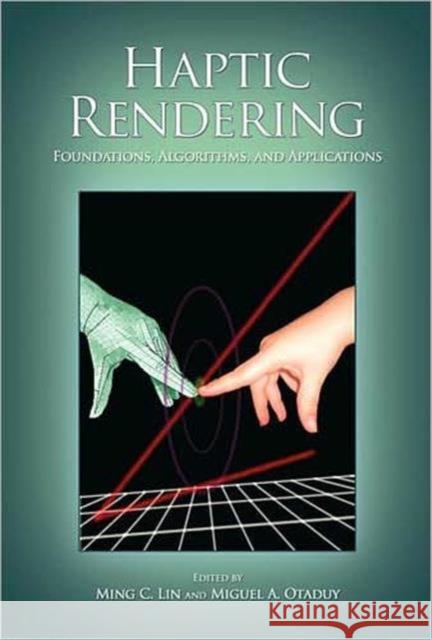
Haptic Rendering: Foundations, Algorithms, and Applications

ISBN-13: 9781568813325 / Angielski / Twarda / 2008 / 623 str.
Ming C. Lin; Miguel Otaduy
Haptic Rendering: Foundations, Algorithms, and Applications Lin, Ming C. 9781568813325 AK Peters - książkaWidoczna okładka, to zdjęcie poglądowe, a rzeczywista szata graficzna może różnić się od prezentowanej.

Haptic Rendering: Foundations, Algorithms, and Applications

ISBN-13: 9781568813325 / Angielski / Twarda / 2008 / 623 str.

Ming C. Lin; Miguel Otaduy
cena 658,50
(netto: 627,14 VAT:  5%)

Najniższa cena z 30 dni: 651,77
Termin realizacji zamówienia:
ok. 22 dni roboczych
Bez gwarancji dostawy przed świętami

Darmowa dostawa!

For a long time, human beings have dreamed of a virtual world where it is possible to interact with synthetic entities as if they were real. It has been shown that the ability to touch virtual objects increases the sense of presence in virtual environments. This book provides an authoritative overview of state-of-theart haptic rendering algorithms and their applications. The authors examine various approaches and techniques for designing touch-enabled interfaces for a number of applications, including medical training, model design, and maintainability analysis for virtual prototyping, scientific visualization, and creative processes.


Kategorie:
Informatyka
Kategorie BISAC:
Computers > Interactive & Multimedia
Computers > Software Development & Engineering - Computer Graphics
Computers > Human-Computer Interaction (HCI)
Wydawca:
AK Peters
Język:
Angielski
ISBN-13:
9781568813325
Rok wydania:
2008
Ilość stron:
623
Waga:
0.88 kg
Wymiary:
23.62 x 15.75 x 3.56
Oprawa:
Twarda
Wolumenów:
01
Dodatkowe informacje:
Bibliografia
Wydanie ilustrowane

Preface -- Introduction -- I Fundamentals and Devices -- 1 Perceiving Object Properties through a Rigid Link -- 1.1 Surface Roughness: Direct vs. Indirect Exploration -- 1.2 Effects of a Rigid Link on Other Object Properties -- 1.3 Object Identification: Direct vs. Indirect Exploration -- 1.4 Intersensory Influences via Indirect Touch -- 1.5 Rendered Textures -- 1.6 Implications for Virtual Objects -- 2 Multi-Sensory Interactions -- 2.1 Introduction to Crossmodal Congruency -- 2.2 The CrossmodalCongruency Task -- 2.3 Using the Crossmodal Congruency Task -- 2.4 Using the Crossmodal Congruency Task -- 2.5 Conclusion -- 3 Design Issues in Haptic Devices -- 3.1 Towards Full-Body Virtual Touch -- 3.2 SensoryModes and Interface Devices -- 3.3 Locomotion Interfaces -- 3.4 Desktop Displays -- 3.5 Flexible Surface Displays -- 3.6 Summary -- 4 Rendering for Multifinger Haptic Devices -- 4.1 Literature Review -- 4.2 Multifinger Haptic Perception -- 4.3 Design of a Multifinger Haptic Device -- 4.4 Multifinger Rendering Method -- 4.5 FutureWork -- 5 Locomotion Interfaces and Rendering -- 5.1 Locomotion InterfaceDesigns -- 5.2 Locomotion Rendering -- 5.3 Discussion -- 6 Variable Friction Haptic Displays -- 6.1 Human Perception of Friction -- 6.2 Friction Reduction Theory -- 6.3 Variable Friction Devices -- 6.4 Friction Reduction Measurements -- 6.5 Friction Patterns toMimic Textures -- 6.6 Multidimensional Scaling -- 6.7 Summary -- 7 Stability of Haptic Displays -- 7.1 Definitions -- 7.2 Designing for Passivity -- 7.3 PassiveRendering of a VirtualWall -- 7.4 Extensions to the Passivity Framework -- 7.5 ControlMethods -- 7.6 Extending Z-Width -- 7.7 Summary -- II Rendering Techniques -- 8 Introduction to Haptic Rendering Algorithms -- 8.1 Definition of the Rendering Problem -- 8.2 Components of a Rendering Algorithm -- 8.3 Direct Rendering vs. Virtual Coupling -- 8.4 Modeling the Tool and the Environment -- 8.5 Multirate Algorithm -- 9 Overview on Collision and Proximity Queries -- 9.1 ProblemDefinitions -- 9.2 Convex Polytopes -- 9.3 General PolygonalModels -- 9.4 Penetration Depth Computation -- 9.5 Volumetric Representations -- 9.6 Spline and Algebraic Objects -- 9.7 DeformableModels -- 9.8 Dynamic Queries -- 9.9 Multiresolution Techniques -- 9.10 Large Environments -- 9.11 Proximity Query Packages -- 10 Collision Detection for Three-DOF Rendering -- 10.1 RelatedWork -- 10.2 A Fast Proximity Query Algorithm for 3-DOF Haptic Interaction -- 10.3 Implementation Issues -- 10.4 System Performance -- 10.5 Conclusion -- 10.6 Acknowledgments -- 11 Voxel-Based Collision Detection for Six-DOF Rendering -- 11.1 AlgorithmOverview -- 11.2 Voxel Data Structures -- 11.3 Geometrical Awareness -- 11.4 Temporal Coherence -- 11.5 Rendering with Virtual Coupling -- 11.6 Applications and Experiments -- 11.7 Discussion -- 12 Continuous Collision Detection -- 12.1 Why Continuous Collision Detection? -- 12.2 Arbitrary In-BetweenMotions -- 12.3 Interval Arithmetic -- 12.4 Elementary Continuous Collision Detection -- 12.5 Continuous Overlap Tests for Bounding Volumes -- 12.6 Conclusion -- 13 Contact Levels of Detail -- 13.1 Psychophysical Foundations -- 13.2 Approaches to Multiresolution Collision Detection -- 13.3 Data Structure of CLODs -- 13.4 Sensation-Preserving Simplification -- 13.5 Multiresolution Contact Queries -- 13.6 Experiments -- 13.7 Discussion -- 14 Physically Based Haptic Synthesis -- 14.1 Haptic Synthesis as a Means for Passivity -- 14.2 Friction -- 14.3 Damage -- 14.4 Elastic Deformation -- 14.5 Texture -- 14.6 Shocks -- 14.7 Conclusion -- 15 Three-Degree-of-Freedom Rendering -- 15.1 Human-Machine Coupling -- 15.2 Single-Point Rendering of 3D Rigid Objects -- 15.3 Surface Details: Smoothing, Friction, and Texture -- 15.4 Summary and Future -- 16 Six-Degree-of-Freedom Rendering of Rigid Environments -- 16.1 Overview -- 16.2 Six-Degree-of-Freedom God-Object Simulation -- 16.3 Constraint-Based Force Computation -- 16.4 Haptic Surface Properties -- 16.5 Results and Discussion -- 16.6 Summary -- 17 Rendering of Spline Models -- 17.1 The Spline Representation -- 17.2 Distance and Orthogonal Projection -- 17.3 Local Minima in Distance versus the Virtual Proxy -- 17.4 3-DOF Haptic Rendering of Spline Models -- 17.5 Direct ParametricTracing -- 17.6 Stability of Numerical Closest Point Methods -- 17.7 6-DOF Haptic Rendering of Spline Models -- 17.8 Conclusion -- 18 Rendering of Textured Objects -- 18.1 PerceptualMotivations -- 18.2 Three-DOF Haptic Texture Rendering -- 18.3 Texture ForceModel -- 18.4 Penetration Depth between TexturedModels -- 18.5 Experiments -- 18.6 Discussion -- 19 Modeling Deformation of Linear Elastostatic Objects -- 19.1 Motivations for Linear Elastostatic Models -- 19.2 Linear Elastostatic Boundary Model Preliminaries -- 19.3 Fast Global Deformation Using Capacitance Matrix Algorithms (CMAs) -- 19.4 Capacitance Matrices as Local Buffer Models -- 19.5 Surface Stiffness Models for Point-Like Contact -- 19.6 Results -- 19.7 Summary -- 20 Rendering of Frictional Contact with Deformable Environments -- 20.1 Contact and Friction Models -- 20.2 Non-Smooth Dynamics for Deformable Objects -- 20.3 Integration Schemes -- 20.4 Building Contact Space -- 20.5 Solving Strategy -- 20.6 Haptic Rendering -- 20.7 Examples -- 20.8 Conclusion -- 21 Measurement-Based Modeling for Haptic Rendering -- 21.1 Literature Review -- 21.2 Developing and Rendering a Measurement-Based Model -- 21.3 Example Application: Tapping on Rigid Surfaces -- 21.4 Example Application: Cutting Deformable Surfaces -- 21.5 Summary -- III Applications -- 22 Virtual Prototyping -- 22.1 Brief State of the Art -- 22.2 Overview -- 22.3 The Stringed Haptic Workbench -- 22.4 TheMixed-Prop -- 22.5 Putty Application—An Automotive Virtual Prototyping Application -- 22.6 Conclusion -- 23 Haptics for Scientific Visualization -- 23.1 Lessons from Haptic-Enabled Visualization Applications -- 23.2 Useful Techniques for Haptic Display in Scientific Visualization -- 23.3 Summary -- 24 Haptics in Medical Applications -- 24.1 Overview -- 24.2 Visuo-Haptic Segmentation of Radiological Data -- 24.3 Immersive Virtual-Reality-Based Hysteroscopy Training -- 24.4 Multimodal Augmented Reality for Open Surgery Training -- 25 The Role of Haptics in Physical Rehabilitation -- 25.1 Robotic Systems for Physical Rehabilitation -- 25.2 Specifics of Haptic Feedback for the Disabled -- 25.3 Safety Issues in Haptics for Rehabilitation -- 25.4 Looking at the Future -- 26 Modeling and Creative Processes -- 26.1 Case Studies of Existing Systems -- 26.2 Haptic-Enhanced Painting with 3D Deformable Brushes -- 26.3 Haptic Modeling and 3D Painting -- 26.4 Discussion -- 26.5 FutureWork -- Bibliography -- Index.

Lin\, Ming C.; Otaduy\, Miguel

Lin, Ming C. University of North Carolina, Chapel Hill... więcej >


Udostępnij

Facebook - konto krainaksiazek.pl


Opinie o Krainaksiazek.pl na Opineo.pl

Partner Mybenefit

Krainaksiazek.pl w programie rzetelna firma Krainaksiaze.pl - płatności przez paypal

Czytaj nas na:

Facebook - krainaksiazek.pl
  • książki na zamówienie
  • granty
  • książka na prezent
  • kontakt
  • pomoc
  • opinie
  • regulamin
  • polityka prywatności

Zobacz:

  • Księgarnia czeska

  • Wydawnictwo Książkowe Klimaty

1997-2025 DolnySlask.com Agencja Internetowa

© 1997-2022 krainaksiazek.pl
     
KONTAKT | REGULAMIN | POLITYKA PRYWATNOŚCI | USTAWIENIA PRYWATNOŚCI
Zobacz: Księgarnia Czeska | Wydawnictwo Książkowe Klimaty | Mapa strony | Lista autorów
KrainaKsiazek.PL - Księgarnia Internetowa

Polityka prywatnosci - link
Krainaksiazek.pl - płatnośc Przelewy24
Przechowalnia Przechowalnia






