• Wyszukiwanie zaawansowane
  • Kategorie
  • Kategorie BISAC
  • Książki na zamówienie
  • Promocje
  • Granty
  • Książka na prezent
  • Opinie
  • Pomoc
  • Załóż konto
  • Zaloguj się

Handbook on Enterprise Architecture » książka


zaloguj się | załóż konto
Logo Krainaksiazek.pl

koszyk

konto

szukaj
topmenu
Księgarnia internetowa
Szukaj
Książki na zamówienie
Promocje
Granty
Książka na prezent
Moje konto
Pomoc
 
 
Wyszukiwanie zaawansowane
Pusty koszyk
Bezpłatna dostawa dla zamówień powyżej 20 złBezpłatna dostawa dla zamówień powyżej 20 zł

Kategorie główne

• Nauka
 [2949965]
• Literatura piękna
 [1857847]

  więcej...
• Turystyka
 [70818]
• Informatyka
 [151303]
• Komiksy
 [35733]
• Encyklopedie
 [23180]
• Dziecięca
 [617748]
• Hobby
 [139972]
• AudioBooki
 [1650]
• Literatura faktu
 [228361]
• Muzyka CD
 [398]
• Słowniki
 [2862]
• Inne
 [444732]
• Kalendarze
 [1620]
• Podręczniki
 [167233]
• Poradniki
 [482388]
• Religia
 [509867]
• Czasopisma
 [533]
• Sport
 [61361]
• Sztuka
 [243125]
• CD, DVD, Video
 [3451]
• Technologie
 [219309]
• Zdrowie
 [101347]
• Książkowe Klimaty
 [123]
• Zabawki
 [2362]
• Puzzle, gry
 [3791]
• Literatura w języku ukraińskim
 [253]
• Art. papiernicze i szkolne
 [7933]
Kategorie szczegółowe BISAC

Handbook on Enterprise Architecture

ISBN-13: 9783540003434 / Angielski / Twarda / 2003 / 788 str.
Peter Bernus;Laszlo Nemes;Günter Schmidt
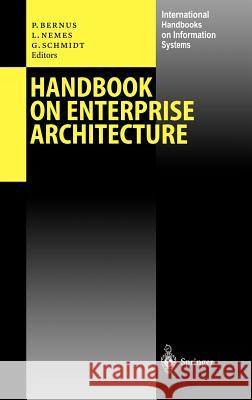
Handbook on Enterprise Architecture Peter Bernus, Laszlo Nemes, Günter Schmidt 9783540003434 Springer-Verlag Berlin and Heidelberg GmbH &  - książkaWidoczna okładka, to zdjęcie poglądowe, a rzeczywista szata graficzna może różnić się od prezentowanej.

Handbook on Enterprise Architecture

ISBN-13: 9783540003434 / Angielski / Twarda / 2003 / 788 str.

Peter Bernus;Laszlo Nemes;Günter Schmidt
cena 1210,50 zł
(netto: 1152,86 VAT:  5%)

Najniższa cena z 30 dni: 1156,64 zł
Termin realizacji zamówienia:
ok. 22 dni roboczych
Bez gwarancji dostawy przed świętami

Darmowa dostawa!

This Handbook is about methods, tools and examples of how to architect an enterprise through considering all life cycle aspects of Enterprise Entities (such as individual enterprises, enterprise networks, virtual enterprises, projects and other complex systems including a mixture of automated and human processes). The book is based on ISO15704:2000, or the GERAM Framework (Generalised Enterprise Reference Architecture and Methodology) that generalises the requirements of Enterprise Reference Architectures. Various Architecture Frameworks (PERA, CIMOSA, Grai-GIM, Zachman, C4ISR/DoDAF) are shown in light of GERAM to allow a deeper understanding of their contributions and therefore their correct and knowledgeable use. The handbook addresses a wide variety of audience, and covers methods and tools necessary to design or redesign enterprises, as well as to structure the implementation into manageable projects.


Kategorie:
Nauka, Ekonomia i biznes
Kategorie BISAC:
Business & Economics > Information Management
Computers > Information Technology
Business & Economics > Zarządzenie i techniki zarządzania
Wydawca:
Springer-Verlag Berlin and Heidelberg GmbH &
Seria wydawnicza:
International Handbooks on Information Systems
Język:
Angielski
ISBN-13:
9783540003434
Rok wydania:
2003
Dostępne języki:
Angielski
Wydanie:
2003
Numer serii:
000110700
Ilość stron:
788
Waga:
2.90 kg
Wymiary:
23.523.5 x 15.5
Oprawa:
Twarda
Wolumenów:
01
Dodatkowe informacje:
Glosariusz/słownik
Wydanie ilustrowane

1 Introduction.- 1.1 Enterprise Architecture.- 1.2 The Business Process Perspective.- 1.3 Extended, Virtual Enterprises.- 1.4 Enterprise Integration Methods.- 1.5 The Generalised Enterprise Reference Architecture And Methodology (The GERAM Enterprise Architecture Framework).- References.- I Architecture Frameworks — Organising Enterprise Architecture Knowledge.- 2 GERAM — The Generalised Enterprise Reference Architecture and Methodology.- 2.1 Introduction.- 2.2 The Framework for Enterprise Engineering and Enterprise Integration.- 2.3 Description of GERAM Framework Components.- 2.4 Historical Note.- References.- 3 A Mapping of Individual Architecture Frameworks (GRAI, PERA, C4ISR, CIMOSA, ZACHMAN, ARIS) onto GERAM.- 3.1 Introduction.- 3.2 Life Cycle Phases.- 3.3 Life History: The Timeline Aspect in Methodologies.- 3.4 The Modelling Frameworks of Reference Architectures.- 3.5 Modelling Languages.- 3.6 Methodologies.- 3.7 Reference Models.- 3.8 Other Relevant Constructs.- 3.9 Enterprise Engineering Tools.- 3.10 The Big Picture and Conclusions.- 3.11 Glossary of Terms Used in this Chapter.- References.- II Strategy Making and Business Planning.- 4 Strategy as a Creation of Corporate Future.- 4.1 Introduction.- 4.2 What is Strategy and Why it Matters?.- 4.3 Resources and Capabilities.- 4.4 The Strategy Process.- 4.5 Conclusion.- References.- 5 Leadership: Better Relationships through Better Communication.- 5.1 Introduction.- 5.2 Changing People’s Minds.- 5.3 Defending the Cage.- 5.4 Attitudes and Behaviour: Which Causes Which ?.- 5.5 Is It Really People’s ’Minds’ that We Want to Change?.- 5.6 How Do We Change People’s Behaviour?.- 5.7 What is the Role of Communication in all This ?.- 5.8 What if We Can’t Change the Environment?.- 5.9 Consultation: The Key to Managing Change.- References.- 6 Capability Improvement.- 6.1 Introduction.- 6.2 Problems and a New Role for Enterprise Modelling.- 6.3 Agile Virtual Enterprise and Fluid Supply Chains.- 6.4 Dimensions of Capability Improvement.- 6.5 Conclusion.- 7 Developing the Business Model — A Methodology for Virtual Enterprises.- 7.1 Introduction.- 7.2 Introducing the VE Concept.- 7.3 VERAM.- 7.4 Life History Example.- 7.5 VE Methodology (VEM).- 7.6 Conclusion.- References.- 8 Analysing the Present Situation and Refining Strategy.- 8.1 Introduction.- 8.2 The Importance of a Clear Direction: The Identification Phase.- 8.3 Significant Events and Change Initiatives.- 8.4 Organisational Performance Assessment.- 8.5 Determining the Scope of Change in Enterprise Entities Involved in the Company’s Business Model — What Enterprise Entities Will Be Affected ?.- 8.6 Foundations of Change.- 8.7 The Function of the Identification Activity.- 8.8 Assessing the Present Situation and the Feasibility of the Intended Change.- References.- 9 Developing the Enterprise Concept — The Business Plan.- 9.1 Introduction.- 9.2 Strategy Schools Revised.- 9.3 Framework for Enterprise Concept Definition.- 9.4 Methodology for Enterprise Concept Definition.- 9.5 Creation of the Business Concept: Mission, Vision and Intended Set of Cultural Attributes.- 9.6 Development of Strategy: A Decision-making Process.- 9.7 Definition of an Action Plan.- 9.8 Conclusion.- References.- III Defining the Requirements for Enterprise Change.- 10 Enterprise Modelling — The Readiness of the Organisation.- 10.1 Introduction — The Enterprise Problem Space.- 10.2 Perspective Dimensions.- 10.3 Stages of the Enterprise Improvement Life Cycle.- 10.4 Enterprise Dimensions.- 10.5 Structure Dimensions.- 10.6 Behaviour Dimensions.- 10.7 Value Dimensions.- 10.8 Knowledge Dimensions.- 10.9 Assessment of the Capability to Use Enterprise Modelling Technology.- 11 Modelling Function and Information.- 11.1 Introduction.- 11.2 Modelling the Function of the Enterprise Entity.- 11.3 Modelling Information.- 11.4 Reference Models for Function and Data Modelling.- 11.5 Conclusion.- References.- 12 Modelling the Management System — Enterprise Management and Activities.- 12.1 Introduction: The Function of the Managament and Control System of Enterprise Entities.- 12.2 Modelling the Management and Control System — What Decisions and Controls are Needed ?.- 12.3 Models of the Mission Delivery Process as Used in the Design of the Decision System.- 12.4 The Nature of Decision Links — Useful Principles.- 12.5 Enterprise Building Transactions.- 12.6 A Reference Model for Creating and Sustaining Virtual Enterprises.- 12.7 Conclusion.- References.- 13 Resource Requirements of Enterprise Management.- 13.1 Introduction.- 13.2 Languages to Model Processes and Resources.- 13.3 Resource Requirements Determination in the Virtual Enterprise.- 13.4 Outcomes of Resource Requirements Determination.- References.- 14 Enterprise Modelling.- 14.1 Applications of Enterprise Modelling.- 14.2 Ontologies.- 14.3 Desiderata for Enterprise Modelling Ontologies.- 14.4 Languages for Enterprise Modelling.- 14.5 Ontologies for Enterprise Modelling.- 14.6 Ontologies for Sets of Enterprise Modelling Concepts.- 14.7 Challenge Problems for Enterprise Modelling.- References.- IV Developing the Master Plan — Architectural Design of the Changed Enterprise.- 15 Preliminary Design: Translating Requirements to Design Specifications.- 15.1 Preliminary Design and General Activity of Design.- 15.2 Main Characteristics of Preliminary Design.- 15.3 From Function & Data to Resource & Organisation: The Assignment Issue.- 15.4 Conclusion.- References.- 16 Organisational Design.- 16.1 Introduction.- 16.2 The Relationship Between the Decisional and Organisational Structures.- 16.3 Defining the Organisational Structure — Organisational Fit and Principles.- 16.4 Conclusion.- References.- 17 Application Reference Models and Building Blocks for Management and Control.- 17.1 Introduction.- 17.2 Types of Reference Models.- 17.3 An Example Application Reference Model: SAP.- 17.4 Some Limitations of Existing Application Reference Models.- 17.5 Configuration of Application Reference Models.- 17.6 Conclusion and Outlook.- References.- 18 Designing the Information Technology Subsystem.- 18.1 Introduction.- 18.2 Integration Levels.- 18.3 Shop-floor Infrastructure Design.- 18.4 Intra-Enterprise Infrastructure Design.- 18.5 Inter-enterprise Infrastrcture Design.- 18.6 Conclusion.- References.- V Case Studies.- 19 Ford Motor Company’s Investment Efficiency Initiative: A Case Study.- 19.1 Introduction.- 19.2 The Need for Investment Efficiency at Ford.- 19.3 The Investment Efficiency Process.- 19.4 Basic Targets of Investment Efficiency at Ford.- 19.5 Strategies of Investment Efficiency.- 19.6 Product and Process Compatibility Tools.- 19.7 Future Small Car Program Pilot.- 19.8 Organizational Changes at Ford.- 19.9 Lessons Learned.- 19.10 Discussion Items.- 19.11 Glossary of Specific Terms Used in This Chapter.- 19.12 Acronyms.- References.- 20 The Business Process (Quiet)Revolution; Transformation to Process Organization.- 20.1 Introduction.- 20.2 Process Classification.- 20.3 Process Management with FirstStep.- 20.4 The new Business Process Construct.- 20.5 FirstStep Methodology and Process Standards.- 20.6 Deploying Process Framework with the Enterprise Process Center.- 20.7 Initial Case Report.- 20.8 Summary and Conclusion.- References.- 21 Farley Remote Operations Support System.- 21.1 Introduction.- 21.2 Knowledge Representation and Process Modelling.- 21.3 Fundamentals of IDEF3.- 21.4 The Role of IDEF3 in Providing the Solution.- 21.5 The System Framework.- 21.6 Conclusion.- References.- 22 The use of GERAM to support SMEs Development in Mexico.- 22.1 Introduction.- 22.2 The Use of the Concept of Life Cycle.- 22.3 Organizing SMEs Using GERA (Generic Enterprise Reference Architecture).- 22.4 Documentation of Processes and Methods in SMEs Using EEMs (Enterprise Engineering Methodologies).- 22.5 Conclusion.- References.

Prof. Dr.-Ing. Günther Schmidt, Studium in Berlin: Betriebswirtschaftslehre; Informatik; Wirtschaftsingenieurwesen. Seit 1988 lehrt er als Professor für Betriebswirtschaftlehre und Informatik an verschiedenen Universitäten. Er ist Direktor des IKS-Institut für Kommunikationssysteme.


Udostępnij

Facebook - konto krainaksiazek.pl


Opinie o Krainaksiazek.pl na Opineo.pl

Partner Mybenefit

Krainaksiazek.pl w programie rzetelna firma Krainaksiaze.pl - płatności przez paypal

Czytaj nas na:

Facebook - krainaksiazek.pl
  • książki na zamówienie
  • granty
  • książka na prezent
  • kontakt
  • pomoc
  • opinie
  • regulamin
  • polityka prywatności

Zobacz:

  • Księgarnia czeska

  • Wydawnictwo Książkowe Klimaty

1997-2025 DolnySlask.com Agencja Internetowa

© 1997-2022 krainaksiazek.pl
     
KONTAKT | REGULAMIN | POLITYKA PRYWATNOŚCI | USTAWIENIA PRYWATNOŚCI
Zobacz: Księgarnia Czeska | Wydawnictwo Książkowe Klimaty | Mapa strony | Lista autorów
KrainaKsiazek.PL - Księgarnia Internetowa

Polityka prywatnosci - link
Krainaksiazek.pl - płatnośc Przelewy24
Przechowalnia Przechowalnia





