• Wyszukiwanie zaawansowane
  • Kategorie
  • Kategorie BISAC
  • Książki na zamówienie
  • Promocje
  • Granty
  • Książka na prezent
  • Opinie
  • Pomoc
  • Załóż konto
  • Zaloguj się

Handbook of Polytomous Item Response Theory Models » książka


zaloguj się | załóż konto
Logo Krainaksiazek.pl

koszyk

konto

szukaj
topmenu
Księgarnia internetowa
Szukaj
Książki na zamówienie
Promocje
Granty
Książka na prezent
Moje konto
Pomoc
 
 
Wyszukiwanie zaawansowane
Pusty koszyk
Bezpłatna dostawa dla zamówień powyżej 20 złBezpłatna dostawa dla zamówień powyżej 20 zł

Kategorie główne

• Nauka
 [2946600]
• Literatura piękna
 [1856966]

  więcej...
• Turystyka
 [72221]
• Informatyka
 [151456]
• Komiksy
 [35826]
• Encyklopedie
 [23190]
• Dziecięca
 [619653]
• Hobby
 [140543]
• AudioBooki
 [1577]
• Literatura faktu
 [228355]
• Muzyka CD
 [410]
• Słowniki
 [2874]
• Inne
 [445822]
• Kalendarze
 [1744]
• Podręczniki
 [167141]
• Poradniki
 [482898]
• Religia
 [510455]
• Czasopisma
 [526]
• Sport
 [61590]
• Sztuka
 [243598]
• CD, DVD, Video
 [3423]
• Technologie
 [219201]
• Zdrowie
 [101638]
• Książkowe Klimaty
 [124]
• Zabawki
 [2473]
• Puzzle, gry
 [3898]
• Literatura w języku ukraińskim
 [254]
• Art. papiernicze i szkolne
 [8170]
Kategorie szczegółowe BISAC

Handbook of Polytomous Item Response Theory Models

ISBN-13: 9780805859928 / Angielski / Twarda / 2010 / 306 str.
Micheal Nering
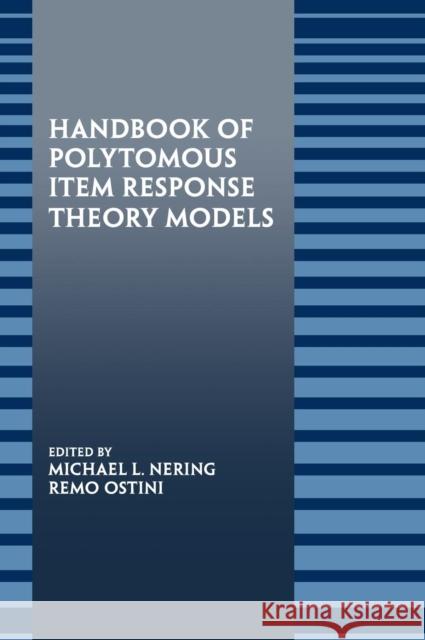
Handbook of Polytomous Item Response Theory Models Micheal Nering 9780805859928 Taylor and Francis - książkaWidoczna okładka, to zdjęcie poglądowe, a rzeczywista szata graficzna może różnić się od prezentowanej.

Handbook of Polytomous Item Response Theory Models

ISBN-13: 9780805859928 / Angielski / Twarda / 2010 / 306 str.

Micheal Nering
cena 365,79 zł
(netto: 348,37 VAT:  5%)

Najniższa cena z 30 dni: 352,57 zł
Termin realizacji zamówienia:
ok. 22 dni roboczych
Bez gwarancji dostawy przed świętami

Darmowa dostawa!

This comprehensive Handbook focuses on the most used polytomous item response theory (IRT) models. These models help us understand the interaction between examinees and test questions where the questions have various response categories. The book reviews all of the major models and includes discussions about how and where the models originated, conceptually and in practical terms. Diverse perspectives on how these models can best be evaluated are also provided. Practical applications provide a realistic account of the issues practitioners face using these models. Disparate elements of the book are linked through editorial sidebars that connect common ideas across chapters, compare and reconcile differences in terminology, and explain variations in mathematical notation. These sidebars help to demonstrate the commonalities that exist across the field. By assembling this critical information, the editors hope to inspire others to use polytomous IRT models in their own research so they too can achieve the type of improved measurement that such models can provide. Part 1 examines the most commonly used polytomous IRT models, major issues that cut across these models, and a common notation for calculating functions for each model. An introduction to IRT software is also provided. Part 2 features distinct approaches to evaluating the effectiveness of polytomous IRT models in various measurement contexts. These chapters appraise evaluation procedures and fit tests and demonstrate how to implement these procedures using IRT software. The final section features groundbreaking applications. Here the goal is to provide solutions to technical problems to allow for the most effective use of these models in measuring educational, psychological, and social science abilities and traits. This section also addresses the major issues encountered when using polytomous IRT models in computerized adaptive testing. Equating test scores across different testing contexts is the focus of the last chapter. The various contexts include personality research, motor performance, health and quality of life indicators, attitudes, and educational achievement. Featuring contributions from the leading authorities, this handbook will appeal to measurement researchers, practitioners, and students who want to apply polytomous IRT models to their own research. It will be of particular interest to education and psychology assessment specialists who develop and use tests and measures in their work, especially researchers in clinical, educational, personality, social, and health psychology. This book also serves as a supplementary text in graduate courses on educational measurement, psychometrics, or item response theory.


Kategorie:
Nauka, Psychologia
Kategorie BISAC:
Psychology > Assessment, Testing & Measurement
Education > Testing & Measurement
Medical > Test Preparation & Review
Wydawca:
Taylor and Francis
Język:
Angielski
ISBN-13:
9780805859928
Rok wydania:
2010
Ilość stron:
306
Waga:
0.72 kg
Wymiary:
25.4 x 17.78 x 2.29
Oprawa:
Twarda
Wolumenów:
01
Dodatkowe informacje:
Bibliografia

Part 1. Development of Polytomous IRT Models. R. Ostini, M. Nering, New Perspectives and Applications. R. Hambleton, W. van der Linden, C. Well, IRT Models for the Analysis of Polytomously-Scored Data: Brief and Selected History of Model Building Advances. D. Thissen, L. Cai, R.D. Bock, The Nominal Categories Item Response Model. F. Samejima, The General Graded Response Model. G. Masters, The Partial Credit Model. D. Andrich, Understanding the Response Structure and Process in the Polytomous Rasch Model. Part 2. Polytomous IRT Model Evaluation. R.D. Bock, R. Gibbons, Factor Analysis of Categorical Item Responses. C.A.W. Glas, Testing Fit to IRT Models for Polytomously Scored Items. Part 3. Application of Polytomous IRT Models. C. Huang, R. Mislevy, An Application of the Polytomous Rasch Model to Mixed Strategies. A. Boyd, B. Dodd, S. Choi, Polytomous Models in Computerized Adaptive Testing. S. Kim, D. Harris, M. Kolen, Equating with Polytomous Item Response Models.

Michael L. Nering is the Director of the Psychometrics Department at Measured Progress, Inc. He received his Ph.D. in Psychology at the University of Minnesota in 1996. His research interests include person fit, computer-based assessment, equating and item response theory. He has published research in such journals as Applied Psychological Measurement, Measurement and Evaluation in Counseling and Development, Journal of Educational Measurement, and Educational and Psychological Measurement.

Remo Ostini is a Research Fellow in the Healthy Communities Research Centre at the University of Queensland in Australia. He received his Ph.D. in Psychology from the University of Minnesota in 2001. His research interests include health literacy motivation, personality and attitude measurement, and the psychology of morality. He has published research in such journals as the Journal of Medical Ethics, Pharmacoepidemiology and Drug Safety, and the Annals of Pharmacotherapy.


Udostępnij

Facebook - konto krainaksiazek.pl


Opinie o Krainaksiazek.pl na Opineo.pl

Partner Mybenefit

Krainaksiazek.pl w programie rzetelna firma Krainaksiaze.pl - płatności przez paypal

Czytaj nas na:

Facebook - krainaksiazek.pl
  • książki na zamówienie
  • granty
  • książka na prezent
  • kontakt
  • pomoc
  • opinie
  • regulamin
  • polityka prywatności

Zobacz:

  • Księgarnia czeska

  • Wydawnictwo Książkowe Klimaty

1997-2025 DolnySlask.com Agencja Internetowa

© 1997-2022 krainaksiazek.pl
     
KONTAKT | REGULAMIN | POLITYKA PRYWATNOŚCI | USTAWIENIA PRYWATNOŚCI
Zobacz: Księgarnia Czeska | Wydawnictwo Książkowe Klimaty | Mapa strony | Lista autorów
KrainaKsiazek.PL - Księgarnia Internetowa

Polityka prywatnosci - link
Krainaksiazek.pl - płatnośc Przelewy24
Przechowalnia Przechowalnia






