• Wyszukiwanie zaawansowane
  • Kategorie
  • Kategorie BISAC
  • Książki na zamówienie
  • Promocje
  • Granty
  • Książka na prezent
  • Opinie
  • Pomoc
  • Załóż konto
  • Zaloguj się

Handbook of Phenomenology and Cognitive Science » książka


zaloguj się | załóż konto
Logo Krainaksiazek.pl

koszyk

konto

szukaj
topmenu
Księgarnia internetowa
Szukaj
Książki na zamówienie
Promocje
Granty
Książka na prezent
Moje konto
Pomoc
 
 
Wyszukiwanie zaawansowane
Pusty koszyk
Bezpłatna dostawa dla zamówień powyżej 20 złBezpłatna dostawa dla zamówień powyżej 20 zł

Kategorie główne

• Nauka
 [2949965]
• Literatura piękna
 [1857847]

  więcej...
• Turystyka
 [70818]
• Informatyka
 [151303]
• Komiksy
 [35733]
• Encyklopedie
 [23180]
• Dziecięca
 [617748]
• Hobby
 [139972]
• AudioBooki
 [1650]
• Literatura faktu
 [228361]
• Muzyka CD
 [398]
• Słowniki
 [2862]
• Inne
 [444732]
• Kalendarze
 [1620]
• Podręczniki
 [167233]
• Poradniki
 [482388]
• Religia
 [509867]
• Czasopisma
 [533]
• Sport
 [61361]
• Sztuka
 [243125]
• CD, DVD, Video
 [3451]
• Technologie
 [219309]
• Zdrowie
 [101347]
• Książkowe Klimaty
 [123]
• Zabawki
 [2362]
• Puzzle, gry
 [3791]
• Literatura w języku ukraińskim
 [253]
• Art. papiernicze i szkolne
 [7933]
Kategorie szczegółowe BISAC

Handbook of Phenomenology and Cognitive Science

ISBN-13: 9789048126453 / Angielski / Twarda / 2009 / 688 str.
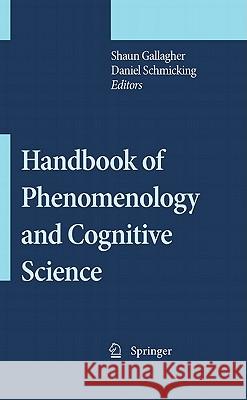
Daniel Schmicking; Shaun Gallagher
Handbook of Phenomenology and Cognitive Science Daniel Schmicking Shaun Gallagher 9789048126453 Springer - książkaWidoczna okładka, to zdjęcie poglądowe, a rzeczywista szata graficzna może różnić się od prezentowanej.

Handbook of Phenomenology and Cognitive Science

ISBN-13: 9789048126453 / Angielski / Twarda / 2009 / 688 str.

Daniel Schmicking; Shaun Gallagher
cena 1210,50 zł
(netto: 1152,86 VAT:  5%)

Najniższa cena z 30 dni: 1156,64 zł
Termin realizacji zamówienia:
ok. 22 dni roboczych
Bez gwarancji dostawy przed świętami

Darmowa dostawa!
inne wydania

This volume explores the essential issues involved in bringing phenomenology together with the cognitive sciences, and provides some examples of research located at the intersection of these disciplines. The topics addressed here cover a lot of ground, including questions about naturalizing phenomenology, the precise methods of phenomenology and how they can be used in the empirical cognitive sciences, specific analyses of perception, attention, emotion, imagination, embodied movement, action and agency, representation and cognition, inters- jectivity, language and metaphor. In addition there are chapters that focus on empirical experiments involving psychophysics, perception, and neuro- and psychopathologies. The idea that phenomenology, understood as a philosophical approach taken by thinkers like Husserl, Heidegger, Sartre, Merleau-Ponty, and others, can offer a positive contribution to the cognitive sciences is a relatively recent idea. Prior to the 1990s, phenomenology was employed in a critique of the first wave of cognitivist and computational approaches to the mind (see Dreyfus 1972). What some consider a second wave in cognitive science, with emphasis on connectionism and neuros- ence, opened up possibilities for phenomenological intervention in a more positive way, resulting in proposals like neurophenomenology (Varela 1996). Thus, bra- imaging technologies can turn to phenomenological insights to guide experimen- tion (see, e. g., Jack and Roepstorff 2003; Gallagher and Zahavi 2008).


Kategorie:
Inne
Kategorie BISAC:
Philosophy > Movements - Phenomenology
Philosophy > Mind & Body
Medical > Psychiatria
Wydawca:
Springer
Język:
Angielski
ISBN-13:
9789048126453
Rok wydania:
2009
Wydanie:
2010
Ilość stron:
688
Waga:
1.10 kg
Wymiary:
23.37 x 15.49 x 4.32
Oprawa:
Twarda
Wolumenów:
01
Dodatkowe informacje:
Bibliografia

From the reviews:

"It is a much needed volume for examination of possible connections between phenomenology and cognitive science, the current vanguard of the dominant mainstream school of cognitive psychology. ... There are different topics covered and there are different perspectives presented. ... chapters have their respective merits and deserve consideration. Springer has provided to readers a broad coverage of the possible relationship between phenomenology and cognitive science." (Thomas F. Cloonan, Journal of Phenomenological Psychology, Vol. 43 (2), 2012)

Introduction, D. Schmicking, S. Gallagher; I. Phenomenology and experimental cognitive science. 1. Phenomenology and the problem of naturalization, D. Zahavi 2. Phenomenology and non-reductionistic cognitive science, S. Gallagher 3. A toolbox of phenomenological methods, D. Schmicking 4. A formal language of consciousness, E. Marbach II: Consciousness, attention, and emotion. 5. Consciousness, M. Rowlands 6. Attention in context, P.S. Arvidson 7. The phenomenology and neurobiology of moods and emotions, M. Ratcliffe 8. Phenomenology, imagination, and interdisciplinary research, J. Jansen 9. The function of weak phantasy in perception and thinking, D. Lohmar III: Embodiment. 10. Myself with no body? Body, bodily-consciousness and self-consciousness, D. Legrand 11. A Husserlian, Neurophenomenologic Approach to Embodiment, J-L. Petit 12. Body and Movement: Basic Dynamic Principles, M. Sheets-Johnstone 13. Empirical and phenomenological studies of embodied cognition, D. Morris IV: Intersubjectivity. 14. The Problem of Other Minds, S. Overgaard.15. Mutual gaze and intersubjectivity, B. Stawarska 16. Knowing other people’s mental states as if they were one’s own, F. de Vignemon 17. Intersubjectivity, cognition, and language, N. Praetorius V: Perception, action and enactive phenomenology. 18. The problem of representation, M. Wheeler 19. Action and agency, T. Grünbaum 20. Meaning, World and the Second Person, J. Botero VI: Language and meaning. 21. Husserl and language, P. Bundgaard 22. Metaphor and cognition, M.S. Johnson 23. Phenomenology and cognitive linguistics, J. Zlatov VII: Applications and experiments. 24. The role of phenomenology in psychophysics, S. Horst 25. A neuro-phenomenological study of epileptic seizure anticipation, C. Petitmengin 26. How unconscious is subliminal perception, M. Overgaard 27. IW—'the man who lost his body', D. McNeill VIII: Pathologies. 28. Phenomenology and psychopathology, T. Fuchs. 29. Delusional atmosphere and delusional belief, M. Ratcliffe 30. Autoscopy: Disrupted Self in Neuropsychiatric Disorders and Anomalous Conscious States, A. Mishara 31. Phenomenology as Description and as Explanation: The Case of Schizophrenia, L. Sass 32. Agency with impairments of movement, J. Cole Index.

Shaun Gallagher is Professor of Philosophy and Cognitive Sciences, and Senior Researcher at the Institute of Simulation and Training, at the University of Central Florida (USA); he has secondary research appointments at the University of Hertfordshire and the University of Copenhagen. He has been Visiting Scientist at the Cognition and Brain Sciences Unit, Cambridge, and Visiting Professor at the University of Copenhagen, the Centre de Recherche en Epistémelogie Appliquée (CREA), Paris, and the Ecole Normale Supériure, Lyon.

The Handbook of Phenomenology and Cognitive Science contains a comprehensive and authoritative overview of the main ideas and methods currently used at the intersection of phenomenology and the neuro- and cognitive sciences. The idea that phenomenology, in the European continental tradition, has something to offer to the cognitive sciences is a relatively recent development in our attempt to understand the mind. Here in one volume the leading researchers in this area address the central topics that define the intersection between phenomenological studies and the cognitive sciences. They address questions about methodology, the analysis of perception, memory, imagination, attention, emotion, intersubjectivity, the role of the body and language, and they explore a variety of pathologies that throw light on our everyday experiences. The authors draw on the classical works of phenomenologists such as Husserl, Heidegger, Merleau-Ponty, Gurwitsch, and Sartre, but they also push the traditional lines of phenomenology to new boundaries, mapping out new terrain in connection with the empirical science of the mind and body. These essays are revelatory for both phenomenologists who want to understand what cognitive science can contribute to an understanding of experience, and for scientists who want to understand how they can use phenomenology in their empirical studies.

Gallagher, Shaun Shaun Gallagher is Professor and Chair of the Phil... więcej >


Udostępnij

Facebook - konto krainaksiazek.pl


Opinie o Krainaksiazek.pl na Opineo.pl

Partner Mybenefit

Krainaksiazek.pl w programie rzetelna firma Krainaksiaze.pl - płatności przez paypal

Czytaj nas na:

Facebook - krainaksiazek.pl
  • książki na zamówienie
  • granty
  • książka na prezent
  • kontakt
  • pomoc
  • opinie
  • regulamin
  • polityka prywatności

Zobacz:

  • Księgarnia czeska

  • Wydawnictwo Książkowe Klimaty

1997-2025 DolnySlask.com Agencja Internetowa

© 1997-2022 krainaksiazek.pl
     
KONTAKT | REGULAMIN | POLITYKA PRYWATNOŚCI | USTAWIENIA PRYWATNOŚCI
Zobacz: Księgarnia Czeska | Wydawnictwo Książkowe Klimaty | Mapa strony | Lista autorów
KrainaKsiazek.PL - Księgarnia Internetowa

Polityka prywatnosci - link
Krainaksiazek.pl - płatnośc Przelewy24
Przechowalnia Przechowalnia





