• Wyszukiwanie zaawansowane
  • Kategorie
  • Kategorie BISAC
  • Książki na zamówienie
  • Promocje
  • Granty
  • Książka na prezent
  • Opinie
  • Pomoc
  • Załóż konto
  • Zaloguj się

Handbook of Multimedia for Digital Entertainment and Arts » książka


zaloguj się | załóż konto
Logo Krainaksiazek.pl

koszyk

konto

szukaj
topmenu
Księgarnia internetowa
Szukaj
Książki na zamówienie
Promocje
Granty
Książka na prezent
Moje konto
Pomoc
 
 
Wyszukiwanie zaawansowane
Pusty koszyk
Bezpłatna dostawa dla zamówień powyżej 20 złBezpłatna dostawa dla zamówień powyżej 20 zł

Kategorie główne

• Nauka
 [2949965]
• Literatura piękna
 [1857847]

  więcej...
• Turystyka
 [70818]
• Informatyka
 [151303]
• Komiksy
 [35733]
• Encyklopedie
 [23180]
• Dziecięca
 [617748]
• Hobby
 [139972]
• AudioBooki
 [1650]
• Literatura faktu
 [228361]
• Muzyka CD
 [398]
• Słowniki
 [2862]
• Inne
 [444732]
• Kalendarze
 [1620]
• Podręczniki
 [167233]
• Poradniki
 [482388]
• Religia
 [509867]
• Czasopisma
 [533]
• Sport
 [61361]
• Sztuka
 [243125]
• CD, DVD, Video
 [3451]
• Technologie
 [219309]
• Zdrowie
 [101347]
• Książkowe Klimaty
 [123]
• Zabawki
 [2362]
• Puzzle, gry
 [3791]
• Literatura w języku ukraińskim
 [253]
• Art. papiernicze i szkolne
 [7933]
Kategorie szczegółowe BISAC

Handbook of Multimedia for Digital Entertainment and Arts

ISBN-13: 9781489985231 / Angielski / Miękka / 2014 / 769 str.
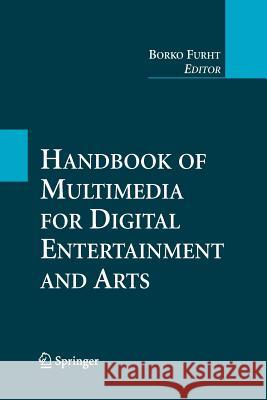
Borko Furht (Florida Atlantic University
Handbook of Multimedia for Digital Entertainment and Arts Borko Furht (Florida Atlantic University   9781489985231 Springer - książkaWidoczna okładka, to zdjęcie poglądowe, a rzeczywista szata graficzna może różnić się od prezentowanej.

Handbook of Multimedia for Digital Entertainment and Arts

ISBN-13: 9781489985231 / Angielski / Miękka / 2014 / 769 str.

Borko Furht (Florida Atlantic University
cena 806,99 zł
(netto: 768,56 VAT:  5%)

Najniższa cena z 30 dni: 771,08 zł
Termin realizacji zamówienia:
ok. 22 dni roboczych
Bez gwarancji dostawy przed świętami

Darmowa dostawa!
inne wydania

The advances in computer entertainment, multi-player and online games, technology-enabled art, culture and performance have created a new form of entertainment and art. The success of this new field has influenced the development of the digital entertainment industry and related products/services, which has impacted every aspect of our lives. Handbook of Multimedia for Digital Entertainment and Arts is an edited volume contributed by worldwide experts in the field of the new digital and interactive media, and their applications in entertainment and arts. This handbook covers leading edge media technologies, and the latest research applied to digital entertainment and arts. The main focus of Handbook of Multimedia for Digital Entertainment and Arts targets interactive and online games, edutainment, e-performance, personal broadcasting, innovative technologies for digital arts, digital visual and auditory media, augmented reality, moving media, and other advanced topics. The final chapters of this book present future trends and developments within this explosive field. Handbook of Multimedia for Digital Entertainment and Arts serve as a primary reference for advanced-level students, researchers and professors studying computer science and electrical engineering. With the dramatic growth of interactive digital entertainment and art applications, this handbook is also suitable as a reference for practitioners, programmers, and engineers working in this field.


Kategorie:
Informatyka
Kategorie BISAC:
Computers > Networking - Hardware
Computers > Database Administration & Management
Computers > System Administration - Storage & Retrieval
Wydawca:
Springer
Język:
Angielski
ISBN-13:
9781489985231
Rok wydania:
2014
Wydanie:
2009
Ilość stron:
769
Waga:
1.19 kg
Wymiary:
23.5 x 15.5
Oprawa:
Miękka
Wolumenów:
01
Dodatkowe informacje:
Wydanie ilustrowane

From the reviews:

"This handbook is a good collection of the latest research papers on digital entertainment ... . The target audience includes post-graduates, research scholars, and teachers of computing, electronics, and electrical engineering, as well as programmers in the field of digital art and edutainment. A sound literature review and a helpful index are a plus." (Soubhik Chakraborty, ACM Computing Reviews, August, 2010)

PART I – DIGITAL ENTERTAINMENT TECHNOLOGIES Topics will include: Digital entertainment systems and their performance Interactive Digital Entertainment Unification framework Networked and free-standing interactive computer games Massive multi-player online games E-performance: e-Opera, e-Theatre, e-Concert Wearable computing for entertainment purposes Telepresence for entertainment and education purposes Entertainment robotics Development of haptic devices Home automation Novel interactive entertainment applications PART II –NEW MEDIA EMERGING TECHNOLOGIES Topics will include: Digital consumer networks Personal broadcasting Novel applications for mobile phones Social and interactive computing applications Collaborative spaces and environments Media technologies applied in the arts Mixed reality and enhanced visualization Adaptive media and AI Augmented reality Interactive music Video annotation in multimedia entertainment PART III – DIGITAL ART Topics will include: Algorithmic art Software art Net art Tangible computing Sonic Art Graphical user interface in art applications Virtual reality systems for 3D digital art PART IV – DIGITAL VISUAL AND AUDITORY MEDIA Topics will include: Digital photography Digital imaging asart Advances in 3D modeling Digital printing Non-photorealistic rendering Digital sound and music Digital music synthesis and composition Graphics and animation Digital comics Software & hardware implementations Digital video Interactive movies Interactive television and cinema PART V – CULTURE OF NEW MEDIA Topics will include: Digital lifestyle Managing digital entertainment Philosophy of new media Digital identity New human-computer interaction models

The list of contributors includes:

Jakob Abesser, Fraunhofer Institute, Ilmenau, Germany

Harry Agius, Brunel University, Uxbridge, United Kingdom

Dewan Tanvir Ahmed, University of Ottawa, Ottawa, Canada

Salah Uddin Ahmed, Norwegian University of Science and Technology, Norway

Marios Angelides, Brunel University, Uxbridge, United Kingdom

Lora Aroyo, Eindhoven University of Technology, Eindhoven, The Netherlands

Shumeet Baluja, Google, Mountain View, CA, USA

Pieter Bellekens, Eindhoven University of Technology, Eindhoven, The Netherlands

Oliver Bimber, Bauhaus University, Weimar, Germany

Leslie Bishko, Emily Carr University, Vancouver, Canada

Alan Bovik, University of Texas at Austin, Austin, Texas, USA

Karlheinz Brandenburg, Fraunhofer Institute, Ilmenau, Germany

Pedro Sergio Branco, University of Minho, Guimaraes, Portugal

Anthony Brooks, Aalborg University, Esbjerg, Denmark

Siwoo Byun, Anyang University, Anyang, Korea

Yiwei Cao, Technical University of Aachen, Aachen, Germany

Cristoforo Camerano, University of Catania, Italy

Petros Caravelas, Athens University of Economics and Business, Athens, Greece

Matina Charami, Athens University of Economics and Business, Athens, Greece

Michele Covell, Google, Mountain View, CA, USA

Christian Dittmar, Fraunhofer Institute, Ilmenau, Germany

Peter Dunker, Fraunhofer Institute, Ilmenau, Germany

Magy Seif El-Nasr, Simon Fraser University, Vancouver, Canada

Stefano Ferretti, University of Bologna, Bologna, Italy

Michael Fink, The Hebrew University of Jerusalem, Israel

Jenneke Fokker, Delft University of Technology, Delft, The Netherlands

Luigi Fortuna, University of Catania, Italy

Mattia Frasca, University of Catania, Italy

Yeung Siu Fung, The Chinese University of Hong Kong, Ma Liu Shui, China

Marco Furini, University of Modena and Reggio Emilia, Italy

Daniel Gartner, Fraunhofer Institute, Ilmenau, Germany

Holger Grossmann, Fraunhofer Institute, Ilmenau, Germany

Matthias Gruhne, Fraunhofer Institute, Ilmenau, Germany

Ian Gwilt, University of Technology, Sydney, Australia

Masaki Hoshino, Sony Corporation, Tokyo, Japan

Geert-Jan Houben, Eindhoven University of Technology, Eindhoven, The Netherlands

Wolfgang Hürst, Utrecht University, Utrecht, The Netherlands

Letizia Jaccheri, Norwegian University of Science and Technology, Norway

Matthias Jarke, Technical University of Aachen, Aachen, Germany

Sung Ho Jin, Information and Communications University, Daejeon, Korea

Yohan Jin, University of Texas at Dallas, Texas, USA

Naoki Kamimaeda, Sony Corporation, Tokyo, Japan

Mohan Kankanhalli, National University of Singapore, Singapore

Munchurl Kim, Information and Communication University, Daejeon, Korea

Munjo Kim, Information and Communication University, Daejeon, Korea

Ralf Klamma, Technical University of Aachen, Aachen, Germany

Bumshik Lee, Information and Communication University, Daejeon, Korea

Han Kyu Lee, Electronics and Telecommunications Research Institute, Daejeon, Korea

Heekyung Lee, Electronics and Telecommunications Research Institute, Daejeon, Korea

In-Kwon Lee, Yonsei University, Seoul, Korea

George Lekakos, Athens University of Economics and Business, Athens, Greece

Hua-Fu Li, Kainan University, Taoyuan, Taiwan

Jeongyeon Lim, Information and Communication University, Daejeon, Korea

John C.S. Lui, The Chinese University of Hong Kong, Ma Liu Shui, China

Rastislav Lukac, Epson Canada Ltd., Toronto, Canada

Hanna Lukashevich, Fraunhofer Institute, Ilmenau, Germany

Aderito Fernandes Marcos, University of Minho, Guimaraes, Portugal

David Milam, Simon Fraser University, Surrey, Canada

Manuela Montangero, University of Modena and Reggio Emilia, Italy

Anush K. Moorthy, University of Texas at Austin, Austin, Texas, USA

Michael Nixon, Simon Fraser University, Vancouver, Canada

Stefanie Nowak, Fraunhofer Institute, Ilmenau, Germany

Johan Pouwelse, Delft University of Technology, Delft, The Netherlands

B. Prabhakaran, University of Texas at Dallas, Texas, USA

Marcel Reinders, Delft University of Technology, Delft, The Netherlands

Yong Man Ro, Information and Communications University, Daejeon, Korea

Graham Sellers, Advanced Micro Devices, Orlando, Florida, USA

Kalpana Seshadrinathan, University of Texas at Austin, Austin, Texas, USA

Shervin Shirmohammadi, University of Ottawa, Ottawa, Canada

Anastas Sofokleus, Brunel University, Uxbridge, United Kingdom

Sara Owsley Sood, Pomona College, Claremont, CA, USA

Flavia Sparacino, Sensing Places and MIT, Santa Monica, CA, USA

Myunghoon Suk, University of Texas at Dallas, Texas, USA

Tomohiro Tsunoda, Sony Corporation, Tokyo, Japan

Athanasios Vasiliakos, University of Peloponnese, Nauplion, Greece

Arjen de Vries, CWI, Amsterdam, The Netherlands

Ron Wakkary, Simon Fraser University, Surrey, Canada

Jun Wang , Delft University of Technology, Delft, The Netherlands

Huaxin Wei, Simon Fraser University, Vancouver, Canada

Kay Wolter, Fraunhofer Institute, Ilmenau, Germany

Linxing Xiao, Tsinghua University, Beijing, China

WeiQi Yan, Queen’s University of Belfast, Belfast, UK

Xubo Yang, Shanghai Jiao Tong University, Shanghai, China

Jong-Chul Yoon, Yonsei University, Seoul, Korea

Damon Daylamani Zad, Brunel University, Uxbridge, United Kingdom

Nelson Troca Zagalo, University of Minho, Braga, Portugal

Veronica Zammitto, Simon Fraser University, Vancouver, Canada

Jie Zhou, Tsinghua University, Beijing, China

The advances in computer entertainment, multi-player and online games, technology-enabled art, culture and performance have created a new form of entertainment and art. The success of this new field has influenced the development of the digital entertainment industry and related products/services, which has impacted every aspect of our lives.

Handbook of Multimedia for Digital Entertainment and Arts is an edited volume contributed by worldwide experts in the field of the new digital and interactive media, and their applications in entertainment and arts. This handbook covers leading edge media technologies, and the latest research applied to digital entertainment and arts. The main focus of Handbook of Multimedia for Digital Entertainment and Arts targets interactive and online games, edutainment, e-performance, personal broadcasting, innovative technologies for digital arts, digital visual and auditory media, augmented reality, moving media, and other advanced topics. The final chapters of this book present future trends and developments within this explosive field.

Handbook of Multimedia for Digital Entertainment and Arts serves as a primary reference for advanced-level students, researchers and professors studying computer science and electrical engineering. With the dramatic growth of interactive digital entertainment and art applications, this handbook is also suitable as a reference for practitioners, programmers, and engineers working in this field.



Udostępnij

Facebook - konto krainaksiazek.pl


Opinie o Krainaksiazek.pl na Opineo.pl

Partner Mybenefit

Krainaksiazek.pl w programie rzetelna firma Krainaksiaze.pl - płatności przez paypal

Czytaj nas na:

Facebook - krainaksiazek.pl
  • książki na zamówienie
  • granty
  • książka na prezent
  • kontakt
  • pomoc
  • opinie
  • regulamin
  • polityka prywatności

Zobacz:

  • Księgarnia czeska

  • Wydawnictwo Książkowe Klimaty

1997-2025 DolnySlask.com Agencja Internetowa

© 1997-2022 krainaksiazek.pl
     
KONTAKT | REGULAMIN | POLITYKA PRYWATNOŚCI | USTAWIENIA PRYWATNOŚCI
Zobacz: Księgarnia Czeska | Wydawnictwo Książkowe Klimaty | Mapa strony | Lista autorów
KrainaKsiazek.PL - Księgarnia Internetowa

Polityka prywatnosci - link
Krainaksiazek.pl - płatnośc Przelewy24
Przechowalnia Przechowalnia




