• Wyszukiwanie zaawansowane
  • Kategorie
  • Kategorie BISAC
  • Książki na zamówienie
  • Promocje
  • Granty
  • Książka na prezent
  • Opinie
  • Pomoc
  • Załóż konto
  • Zaloguj się

Handbook of Mathematical Models in Computer Vision » książka


zaloguj się | załóż konto
Logo Krainaksiazek.pl

koszyk

konto

szukaj
topmenu
Księgarnia internetowa
Szukaj
Książki na zamówienie
Promocje
Granty
Książka na prezent
Moje konto
Pomoc
 
 
Wyszukiwanie zaawansowane
Pusty koszyk
Bezpłatna dostawa dla zamówień powyżej 20 złBezpłatna dostawa dla zamówień powyżej 20 zł

Kategorie główne

• Nauka
 [2946600]
• Literatura piękna
 [1856966]

  więcej...
• Turystyka
 [72221]
• Informatyka
 [151456]
• Komiksy
 [35826]
• Encyklopedie
 [23190]
• Dziecięca
 [619653]
• Hobby
 [140543]
• AudioBooki
 [1577]
• Literatura faktu
 [228355]
• Muzyka CD
 [410]
• Słowniki
 [2874]
• Inne
 [445822]
• Kalendarze
 [1744]
• Podręczniki
 [167141]
• Poradniki
 [482898]
• Religia
 [510455]
• Czasopisma
 [526]
• Sport
 [61590]
• Sztuka
 [243598]
• CD, DVD, Video
 [3423]
• Technologie
 [219201]
• Zdrowie
 [101638]
• Książkowe Klimaty
 [124]
• Zabawki
 [2473]
• Puzzle, gry
 [3898]
• Literatura w języku ukraińskim
 [254]
• Art. papiernicze i szkolne
 [8170]
Kategorie szczegółowe BISAC

Handbook of Mathematical Models in Computer Vision

ISBN-13: 9781441938855 / Angielski / Miękka / 2010 / 606 str.
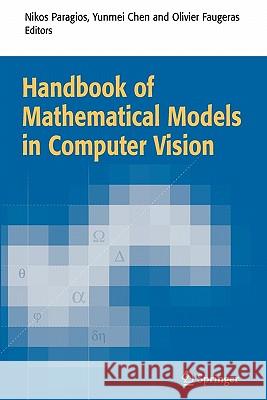
Nikos Paragios; Yunmei Chen; Olivier D. Faugeras
Handbook of Mathematical Models in Computer Vision Nikos Paragios Yunmei Chen Olivier D. Faugeras 9781441938855 Not Avail - książkaWidoczna okładka, to zdjęcie poglądowe, a rzeczywista szata graficzna może różnić się od prezentowanej.

Handbook of Mathematical Models in Computer Vision

ISBN-13: 9781441938855 / Angielski / Miękka / 2010 / 606 str.

Nikos Paragios; Yunmei Chen; Olivier D. Faugeras
cena 403,47 zł
(netto: 384,26 VAT:  5%)

Najniższa cena z 30 dni: 385,52 zł
Termin realizacji zamówienia:
ok. 22 dni roboczych
Bez gwarancji dostawy przed świętami

Darmowa dostawa!

Abstract Biological vision is a rather fascinating domain of research. Scientists of various origins like biology, medicine, neurophysiology, engineering, math ematics, etc. aim to understand the processes leading to visual perception process and at reproducing such systems. Understanding the environment is most of the time done through visual perception which appears to be one of the most fundamental sensory abilities in humans and therefore a significant amount of research effort has been dedicated towards modelling and repro ducing human visual abilities. Mathematical methods play a central role in this endeavour. Introduction David Marr's theory v DEGREESas a pioneering step tov DEGREESards understanding visual percep tion. In his view human vision was based on a complete surface reconstruction of the environment that was then used to address visual subtasks. This approach was proven to be insufficient by neuro-biologists and complementary ideas from statistical pattern recognition and artificial intelligence were introduced to bet ter address the visual perception problem. In this framework visual perception is represented by a set of actions and rules connecting these actions. The emerg ing concept of active vision consists of a selective visual perception paradigm that is basically equivalent to recovering from the environment the minimal piece information required to address a particular task of intere


Kategorie:
Informatyka
Kategorie BISAC:
Computers > Software Development & Engineering - Computer Graphics
Computers > Computer Science
Computers > Artificial Intelligence - Computer Vision & Pattern Recognition
Wydawca:
Not Avail
Język:
Angielski
ISBN-13:
9781441938855
Rok wydania:
2010
Ilość stron:
606
Waga:
0.97 kg
Wymiary:
23.5 x 15.5
Oprawa:
Miękka
Wolumenów:
01

From the reviews:

"The focus of the book is on mathematical methods that both model and reproduce human visual abilities. ... This book is a must-have for those interested in the full breadth of research done in the biological & computer vision community. As a bonus, the chapters can also be used in a seminar-based, advanced undergraduate course in mathematical based computer vision. " (Arjan Kuijper, IAPR Newsletter, October, 2006)

"Computational visual perception can be defined as the discipline of enabling computers to identify features in image data. ... I found this book to be detailed and comprehensive enough to be well worth the time spent on it. Citations linking the text to the relevant literature are profusely sprinkled throughout the text, and a very extensive bibliography is included ... . the production qualities are excellent. ... it should be a useful reference text for researchers or practitioners in this field." (R. M. Malyankar, Computing Reviews, January, 2006)

"The editors of this important compendium view their task as a contribution to modeling and simulating human vision by machine. ... The editors should be congratulated for bringing together high-level researchers to contribute chapters on cutting-edge technologies based on mathematical modeling. This compendium is a solid contribution to the recent literature combining the theories and applications of mathematical modeling to the domain of computer vision." (R. Goldberg, Computing Reviews, June, 2006)

Image Reconstruction.- Diffusion Filters and Wavelets: What Can They Learn from Each Other?.- Total Variation Image Restoration: Overview and Recent Developments.- PDE-Based Image and Surface Inpainting.- Boundary Exraction, Segmentation and Grouping.- Levelings: Theory and Practice.- Graph Cuts in Vision and Graphics: Theories and Applications.- Minimal Paths and Fast Marching Methods for Image Analysis.- Integrating Shape and Texture in DeformabIe Models: from Hybrid Methods to Metamorphs.- Variational Segmentation with Shape Priors.- Curve Propagation, Level Set Methods and Grouping.- On a Stochastic Model of Geometric Snakes.- Shape Modeling & Registration.- Invariant Processing and Occlusion Resistant Recognition of Planar Shapes.- Planar Shape Analysis and Its Applications in Image-Based Inferences.- Diffeomorphic Point Matching.- Uncertainty-Driven, Point-Based Image Registration.- Motion Analysis, Optical Flow & Tracking.- Optical Flow Estimation.- From Bayes to PDEs in Image Warping.- Image Alignment and Stitching.- Visual Tracking: A Short Research Roadmap.- Shape Gradient for Image and Video Segmentation.- Model-Based Human Motion Capture.- Modeling Dynamic Scenes: An Overview of Dynamic Textures.- 3D from Images, Projective Geometry & Stereo Reconstruction.- Differential Geometry from the Frenet Point of View: Boundary Detection, Stereo, Texture and Color.- Shape From Shading.- 3D from Image Sequences: Calibration, Motion and Shape Recovery.- Multi-view Reconstruction of Static and Dynamic Scenes.- Graph Cut Algorithms for Binocular Stereo with Occlusions.- Modelling Non-Rigid Dynamic Scenes from Multi-View Image Sequences.- Applications: Medical Image Analysis.- Interactive Graph-Based Segmentation Methods in Cardiovascular Imaging.- 3D Active Shape and Appearance Models in Cardiac Image Analysis.- Characterization of Diffusion Anisotropy in DWI.- Segmentation of Diffusion Tensor Images.- Variational Approaches to the Estimation, Regularizatinn and Segmentation of Diffusion Tensor Images.- An Introduction to Statistical Methods of Medical Image Registration.

Visual perception refers to the ability of understanding the visual information that is provided by the environment. Such a mechanism integrates several human abilities and was studied by many researchers with different scientific origins including philosophy, physiology, biology, neurobiology, mathematics and engineering. In particular in the recent years an effort to understand, formalize and finally reproduce mechanical visual perception systems able to see and understand the environment using computational theories was made by mathematicians, statisticians and engineers. Such a task connects visual tasks with optimization processes and the answer to the visual perception task corresponds to the lowest potential of a task-driven objective function. In this edited volume we present the most prominent mathematical models that are considered in computational vision. To this end, tasks of increasing complexity are considered and we present the state-of-the-art methods to cope with such tasks. The volume consists of six thematic areas that provide answers to the most dominant questions of computational vision:

Image reconstruction,

Segmentation and object extraction,

Shape modeling and registration,

Motion analysis and tracking,

3D from images, geometry and reconstruction

Applications in medical image analysis


Udostępnij

Facebook - konto krainaksiazek.pl


Opinie o Krainaksiazek.pl na Opineo.pl

Partner Mybenefit

Krainaksiazek.pl w programie rzetelna firma Krainaksiaze.pl - płatności przez paypal

Czytaj nas na:

Facebook - krainaksiazek.pl
  • książki na zamówienie
  • granty
  • książka na prezent
  • kontakt
  • pomoc
  • opinie
  • regulamin
  • polityka prywatności

Zobacz:

  • Księgarnia czeska

  • Wydawnictwo Książkowe Klimaty

1997-2025 DolnySlask.com Agencja Internetowa

© 1997-2022 krainaksiazek.pl
     
KONTAKT | REGULAMIN | POLITYKA PRYWATNOŚCI | USTAWIENIA PRYWATNOŚCI
Zobacz: Księgarnia Czeska | Wydawnictwo Książkowe Klimaty | Mapa strony | Lista autorów
KrainaKsiazek.PL - Księgarnia Internetowa

Polityka prywatnosci - link
Krainaksiazek.pl - płatnośc Przelewy24
Przechowalnia Przechowalnia





