• Wyszukiwanie zaawansowane
  • Kategorie
  • Kategorie BISAC
  • Książki na zamówienie
  • Promocje
  • Granty
  • Książka na prezent
  • Opinie
  • Pomoc
  • Załóż konto
  • Zaloguj się

Handbook of Developmental Research Methods » książka


zaloguj się | załóż konto
Logo Krainaksiazek.pl

koszyk

konto

szukaj
topmenu
Księgarnia internetowa
Szukaj
Książki na zamówienie
Promocje
Granty
Książka na prezent
Moje konto
Pomoc
 
 
Wyszukiwanie zaawansowane
Pusty koszyk
Bezpłatna dostawa dla zamówień powyżej 20 złBezpłatna dostawa dla zamówień powyżej 20 zł

Kategorie główne

• Nauka
 [2946912]
• Literatura piękna
 [1852311]

  więcej...
• Turystyka
 [71421]
• Informatyka
 [150889]
• Komiksy
 [35717]
• Encyklopedie
 [23177]
• Dziecięca
 [617324]
• Hobby
 [138808]
• AudioBooki
 [1671]
• Literatura faktu
 [228371]
• Muzyka CD
 [400]
• Słowniki
 [2841]
• Inne
 [445428]
• Kalendarze
 [1545]
• Podręczniki
 [166819]
• Poradniki
 [480180]
• Religia
 [510412]
• Czasopisma
 [525]
• Sport
 [61271]
• Sztuka
 [242929]
• CD, DVD, Video
 [3371]
• Technologie
 [219258]
• Zdrowie
 [100961]
• Książkowe Klimaty
 [124]
• Zabawki
 [2341]
• Puzzle, gry
 [3766]
• Literatura w języku ukraińskim
 [255]
• Art. papiernicze i szkolne
 [7810]
Kategorie szczegółowe BISAC

Handbook of Developmental Research Methods

ISBN-13: 9781606236093 / Angielski / Twarda / 2011 / 788 str.
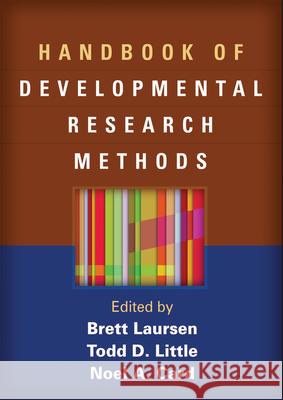
Brett Laursen; Todd D. Little; Noel A. Card
Handbook of Developmental Research Methods Brett Laursen Todd D. Little Noel A. Card 9781606236093 Guilford Publications - książkaWidoczna okładka, to zdjęcie poglądowe, a rzeczywista szata graficzna może różnić się od prezentowanej.

Handbook of Developmental Research Methods

ISBN-13: 9781606236093 / Angielski / Twarda / 2011 / 788 str.

Brett Laursen; Todd D. Little; Noel A. Card
cena 450,80
(netto: 429,33 VAT:  5%)

Najniższa cena z 30 dni: 448,95
Termin realizacji zamówienia:
ok. 22 dni roboczych
Bez gwarancji dostawy przed świętami

Darmowa dostawa!
inne wydania

Appropriate for use in developmental research methods or analysis of change courses, this is the first methods handbook specifically designed to meet the needs of those studying development. Leading developmental methodologists present cutting-edge analytic tools and describe how and when to use them in accessible, nontechnical language. They also provide valuable guidance for strengthening developmental research with designs that anticipate potential sources of bias. Throughout the chapters, research examples demonstrate the procedures in action and give readers a better understanding of how to match research questions to developmental methods. The companion website (www.guilford.com/laursen-materials) supplies data and program syntax files for many of the chapter examples.

Kategorie:
Nauka, Socjologia i społeczeństwo
Kategorie BISAC:
Psychology > Research & Methodology
Psychology > Developmental - General
Wydawca:
Guilford Publications
Język:
Angielski
ISBN-13:
9781606236093
Rok wydania:
2011
Ilość stron:
788
Waga:
1.56 kg
Wymiary:
26.09 x 18.52 x 4.42
Oprawa:
Twarda
Wolumenów:
01
Dodatkowe informacje:
Bibliografia
Obwoluta
Wydanie ilustrowane

"The study of developmental change is a cardinal activity of behavioral and social science, but determining how to do it has prompted denial, disagreement, and despair for nearly a century. The contributors to this excellent volume are an outstanding group whose qualifications for guiding the field at this point in our history are truly stellar. Graduate students and faculty members alike will find this well-organized, highly informative volume indispensable as they articulate questions, design research, and analyze data pertaining to the study of change."--John R. Nesselroade, PhD, Hugh Scott Hamilton Professor of Psychology, University of Virginia

"In 41 chapters, this volume covers a very wide range of research methods, all extremely relevant to the developmental researcher. I know of no other handbook that even comes close to being so generally useful to young developmental researchers seeking to improve their knowledge of research methods. Numerous advanced topics are also treated--in many cases in depth--making the book valuable for methodologists as well. A highly commendable feature is the discussion of each method's applicability and assumptions."--Lars R. Bergman, PhD, Department of Psychology, Stockholm University, Sweden

"This is perhaps the most comprehensive and accessible handbook on developmental methodology yet written. Impressively, the handbook both covers current thinking on longstanding, classic issues and presents cutting-edge developments in emergent areas of developmental research, analysis, and design. Unlike many edited volumes whose chapters vary widely in style, format, and technical detail, the book is unified in its approach and eminently readable. It would serve nicely as the core text for a graduate seminar on developmental research methods."--Daniel J. Bauer, PhD, Department of Psychology, University of North Carolina at Chapel Hill

"The Handbook has an all-star roster of contributors who know both developmental and methodological issues. Especially impressive is that the volume covers a wide range of cutting-edge methodological issues at a level that is understandable to the practicing developmentalist. It is sure to be a valuable resource for decades to come for those who study change."--David A. Kenny, PhD, Department of Psychological Sciences, University of Connecticut

"The editors have compiled a volume that could easily become a standard reference that defines a generation of developmental researchers. This is an ideal reference for researchers at any career stage seeking an accessible yet informative introduction to state-of-the-art methods. The illustrative applications to substantive problems in human development will be useful to methodologists interested in further developing these methods. The chapters interweave research design with data analysis, reflecting the complex interdependence of the two in developmental research."--Keith A. Markus, PhD, Department of Psychology, John Jay College of Criminal Justice, City University of New York

"Comprehensive and consolidated, this volume is a 'one-stop shop' for methodological advances that need to be in every developmental scientist's tool box."--Antonio A. Morgan-Lopez, PhD, Department of Psychology, University of North Carolina at Chapel Hill-_x000D_This Handbook is an impressive collection of methods that span the familiar through cutting edge…useful to developmental researchers at all career and experience levels….Does a preeminent job at providing coverage of sufficient breadth and depth, making it an essential volume for both graduate students and seasoned investigators studying human development. From the perspective of someone new to developmental research, the value of the six chapters on foundational issues cannot be overstated. These chapters could easily form the starting point for a graduate seminar in developmental research methods. The scope of topics covered…ensures that The Handbook of Developmental Research Methods will be relevant for many years to come. Researchers working across the life span will find several examples with topics in the study of childhood, adolescence, and adulthood. Researchers working with both normative and clinical populations will also find examples throughout the Handbook….The Handbook will also be valuable for methodologists.--International Journal of Social Research Methodology, 6/1/2014

_x000D_

_x000D_

I. Measurement and Design
_x000D_
1. Foundational Issues of Design and Measurement in Developmental Research, Scott M. Hofer, Valgeir Thorvaldsson, and Andrea M. Piccinin
_x000D_
2. Causal Inference, Identification, and Plausibility, E. Michael Foster
_x000D_
3. Accelerated Longitudinal Designs, Susan C. Duncan and Terry E. Duncan
_x000D_
4. Time-Scale-Dependent Longitudinal Designs, Theodore A. Walls, William D. Barta, Robert S. Stawski, Charles E. Collyer, and Scott M. Hofer
_x000D_
5. Event Frequency Measurement, Brett Laursen, Jaap Denissen, and David F. Bjorklund
_x000D_
6. The Impact of Scaling and Measurement Methods on Individual Differences in Growth, Susan E. Embretson and John Poggio
_x000D_
7. Investigating Factorial Invariance in Longitudinal Data, Roger E. Millsap and Heining Cham
_x000D_
II. Approaches to Data Collection
_x000D_
8. Foundational Issues in Longitudinal Data Collection, Lea Pulkkinen and Katja Kokko
_x000D_
9. The Use of Large-Scale Data Sets for the Study of Developmental Science, Pamela Davis-Kean and Justin Jager
_x000D_
10. Telemetrics and Online Data Collection: Collecting Data at a Distance, Joshua Wilt, David M. Condon, and William Revelle
_x000D_
11. Collecting and Analyzing Longitudinal Diary Data, Bernhard Schmitz, Julia Klug, and Silke Hertel
_x000D_
12. Retrospective Methods in Developmental Science, Andrea Follmer Greenhoot
_x000D_
13. Peer Ratings, William M. Bukowski, Antonius H. N. Cillessen, and Ana Maria Velásquez
_x000D_
III. Interindividual Longitudinal Analysis
_x000D_
14. Foundational Issues in Investigating Development as Interindividual Variation, Jari-Erik Nurmi
_x000D_
15. Analysis of Experimental and Quasi-Experimental Data: Pinpointing Explanations, Richard Gonzalez, Tianyi Yu, and Brenda Volling
_x000D_
16. Autoregressive and Cross-Lagged Panel Analysis for Longitudinal Data, James P. Selig and Todd D. Little
_x000D_
17. Analyzing Change between Two or More Groups: Analysis of Variance versus Analysis of Covariance, Kamala London and Daniel B. Wright
_x000D_
18. Mediation Models for Developmental Data, Matthew S. Fritz and David P. MacKinnon
_x000D_
IV. Intraindividual Longitudinal Analysis
_x000D_
19. Foundational Issues in Intraindividual Longitudinal Analysis, Michael J. Rovine and Lawrence L. Lo
_x000D_
20. Dynamic Factor Analysis and Control of Developmental Processes, Peter Molenaar and Lawrence L. Lo
_x000D_
21. P-Technique Factor Analysis, Ihno A. Lee and Todd D. Little
_x000D_
22. Hazard, Event History, and Survival Modeling, Margaret K. Keiley, Cassandra Kirkland, Ali Zaremba, and Ashley Anders Jackson
_x000D_
V. Combining Interindividual and Intraindividual Longitudinal Analysis
_x000D_
23. Foundational Issues in the Contemporary Modeling of Longitudinal Trajectories, John J. McArdle
_x000D_
24. Growth Curve Modeling from a Structural Equation Modeling Perspective, Kevin J. Grimm and Nilam Ram
_x000D_
25. Growth Curve Modeling from a Multilevel Model Perspective, Joop J. Hox and Jan Boom
_x000D_
26. Nonlinear Growth Modeling, Shelley A. Blozis
_x000D_
27. Group-Based Trajectory Modeling in Developmental Science, Daniel S. Nagin and Candice L. Odgers
_x000D_
28. Longitudinal Mixture Models and the Identification of Archetypes, Nilam Ram, Kevin J. Grimm, Lisa M. Gatzke-Kopp, and Peter C. M. Molenaar
_x000D_
29. Multilevel Structural Equation Modeling, James A. Bovaird and Leslie H. Shaw
_x000D_
VI. Nonindependent Data Analysis
_x000D_
30. Foundational Issues in Nonindependent Data Analysis, William L. Cook
_x000D_
31. Dyadic Data Analyses in a Developmental Context, Robert A. Ackerman, M. Brent Donnellan, Deborah A. Kashy, and Rand D. Conger
_x000D_
32. Applying the Social Relations Model to Developmental Research, Noel A. Card and Russell B. Toomey
_x000D_
33. Analysis of Static Social Networks and their Developmental Effects, Scott D. Gest and Thomas A. Kindermann
_x000D_
34. Actor-Based Model for Network and Behavior Dynami


Brett Laursen, PhD, is Professor of Psychology and Director of Graduate Training at Florida Atlantic University. He is also a Docent Professor of Social Developmental Psychology at the University of Jyväskylä, Finland. In 2008, Dr. Laursen received an honorary doctorate from Örebro University, Sweden. He is a Fellow of the American Psychological Association (Division 7, Developmental) and a Fellow and Charter Member of the Association for Psychological Science. In addition to his own research on parent–child and peer relationships, Dr. Laursen is a consultant and collaborator on several large longitudinal projects currently under way in North America and Europe.
 
Todd D. Little, PhD, is Professor of Educational Psychology and Leadership at Texas Tech University and founding Director of the Texas Tech University Research Institute. Dr. Little is past president of the American Psychological Association's Division 5 (Evaluation, Measurement, and Statistics) and winner of the Division's 2013 Cohen Award for Distinguished Contributions to Teaching and Mentoring. He organizes and teaches in the internationally renowned Stats Camps that he founded in 2002.
 
Noel A. Card, PhD, is Associate Professor in Family Studies and Human Development at the University of Arizona. His research centers on social development and quantitative methods, and especially the interface of these disciplines. Dr. Card's developmental research focuses on aggression and peer relations during childhood and adolescence; his quantitative interests include longitudinal analyses, analysis of interdependent data, and meta-analysis. He is a recipient of the Society for Research in Child Development’s Early Career Research Award.


Laursen, Brett Brett Laursen is Professor of Psychology and Direc... więcej >
Little, Todd D. Patricia H. Hawley is an assistant professor of De... więcej >


Udostępnij

Facebook - konto krainaksiazek.pl


Opinie o Krainaksiazek.pl na Opineo.pl

Partner Mybenefit

Krainaksiazek.pl w programie rzetelna firma Krainaksiaze.pl - płatności przez paypal

Czytaj nas na:

Facebook - krainaksiazek.pl
  • książki na zamówienie
  • granty
  • książka na prezent
  • kontakt
  • pomoc
  • opinie
  • regulamin
  • polityka prywatności

Zobacz:

  • Księgarnia czeska

  • Wydawnictwo Książkowe Klimaty

1997-2025 DolnySlask.com Agencja Internetowa

© 1997-2022 krainaksiazek.pl
     
KONTAKT | REGULAMIN | POLITYKA PRYWATNOŚCI | USTAWIENIA PRYWATNOŚCI
Zobacz: Księgarnia Czeska | Wydawnictwo Książkowe Klimaty | Mapa strony | Lista autorów
KrainaKsiazek.PL - Księgarnia Internetowa

Polityka prywatnosci - link
Krainaksiazek.pl - płatnośc Przelewy24
Przechowalnia Przechowalnia






