• Wyszukiwanie zaawansowane
  • Kategorie
  • Kategorie BISAC
  • Książki na zamówienie
  • Promocje
  • Granty
  • Książka na prezent
  • Opinie
  • Pomoc
  • Załóż konto
  • Zaloguj się

Handbook for Teaching Introductory Psychology: Volume Ii » książka


zaloguj się | załóż konto
Logo Krainaksiazek.pl

koszyk

konto

szukaj
topmenu
Księgarnia internetowa
Szukaj
Książki na zamówienie
Promocje
Granty
Książka na prezent
Moje konto
Pomoc
 
 
Wyszukiwanie zaawansowane
Pusty koszyk
Bezpłatna dostawa dla zamówień powyżej 20 złBezpłatna dostawa dla zamówień powyżej 20 zł

Kategorie główne

• Nauka
 [2952079]
• Literatura piękna
 [1850969]

  więcej...
• Turystyka
 [71058]
• Informatyka
 [151066]
• Komiksy
 [35579]
• Encyklopedie
 [23181]
• Dziecięca
 [620496]
• Hobby
 [139036]
• AudioBooki
 [1646]
• Literatura faktu
 [228729]
• Muzyka CD
 [379]
• Słowniki
 [2932]
• Inne
 [445708]
• Kalendarze
 [1409]
• Podręczniki
 [164793]
• Poradniki
 [480107]
• Religia
 [510956]
• Czasopisma
 [511]
• Sport
 [61267]
• Sztuka
 [243299]
• CD, DVD, Video
 [3411]
• Technologie
 [219640]
• Zdrowie
 [100984]
• Książkowe Klimaty
 [124]
• Zabawki
 [2281]
• Puzzle, gry
 [3363]
• Literatura w języku ukraińskim
 [258]
• Art. papiernicze i szkolne
 [8020]
Kategorie szczegółowe BISAC

Handbook for Teaching Introductory Psychology: Volume Ii

ISBN-13: 9780805839210 / Angielski / Miękka / 2001 / 280 str.
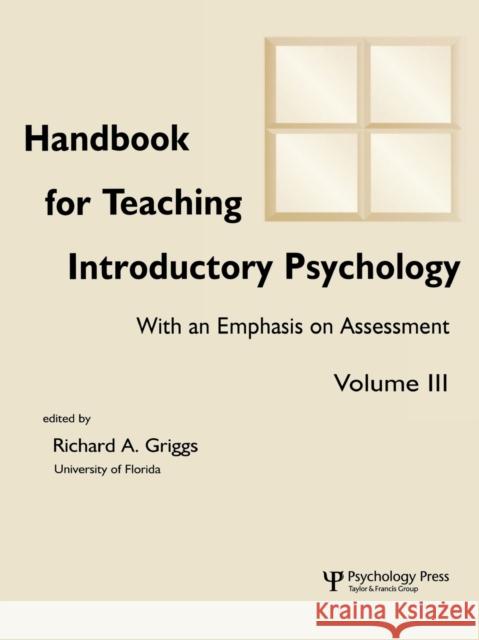
Richard A. Griggs
Handbook for Teaching Introductory Psychology: Volume Ii Hebl, Michelle Rae 9780805839210 Lawrence Erlbaum Associates - książkaWidoczna okładka, to zdjęcie poglądowe, a rzeczywista szata graficzna może różnić się od prezentowanej.

Handbook for Teaching Introductory Psychology: Volume Ii

ISBN-13: 9780805839210 / Angielski / Miękka / 2001 / 280 str.

Richard A. Griggs
cena 165,46
(netto: 157,58 VAT:  5%)

Najniższa cena z 30 dni: 105,05
Termin realizacji zamówienia:
ok. 22 dni roboczych.

Darmowa dostawa!

Like its predecessors, Volume III of the Handbook for Teaching Introductory Psychology provides introductory psychology instructors with teaching ideas and activities that can immediately be put into practice in the classroom. It contains an organized collection of articles from Teaching of Psychology (TOP), the official journal of the Society for the Teaching of Psychology, Division 2 of the American Psychological Association. Volume III contains 89 articles from TOP that have not been included in other volumes. Another distinction between this volume and its predecessors is its emphasis on testing and assessment.
The book is divided into two sections. Section One, "Issues and Approaches in Teaching Introductory Psychology," contains 52 articles on critical issues, such as: how to approach the course; understanding students' interests, perceptions, and motives; students' existing knowledge of psychology (including their misconceptions); a comparison of introductory textbooks and tips on how to evaluate them; test questions and student factors affecting exam performance; an overview of different forms of feedback; giving extra credit; and how to deal with academic dishonesty.
Section Two consists of 37 articles that present demonstrations, class and laboratory projects, and other techniques to enhance teaching and learning in both the introductory, as well as advanced courses in the discipline. This section is organized so as to parallel the order of topics found in most introductory psychology textbooks.
Intended for academicians who teach the introductory psychology course and/or oversee grad assistants who teach the course, all royalties of the book go directly to the Society for the Teaching of Psychology to promote its activities to further improve the teaching of psychology.


Kategorie:
Nauka, Pedagogika i oświata
Kategorie BISAC:
Education > Teaching - Subjects - Social Science
Wydawca:
Lawrence Erlbaum Associates
Seria wydawnicza:
Handbook for Teaching Introductory Psychology
Język:
Angielski
ISBN-13:
9780805839210
Rok wydania:
2001
Numer serii:
000207833
Ilość stron:
280
Waga:
0.64 kg
Wymiary:
27.74 x 21.69 x 1.45
Oprawa:
Miękka
Wolumenów:
01

"Anyone who teaches introductory psychology will find many things useful and provocative here."
—Ashton Trice
James Madison University

"The quality of the articles/scholarship is high. Teaching of Psychology is a well-respected journal and Griggs has done a good job compiling a nice set of selections. I would recommend such a volume for new faculty or GTAs....Richard Griggs is a respected authority in the field of psychology teaching so his perspective should be a valuable one."
—Randolph A. Smith
Ouachita Baptist University

Contents: Preface. Section I: Issues and Approaches in Teaching Introductory Psychology. Part I: Approaches to the Introductory Course. D. McAdam, Bringing Psychology to Life. D.C. Appleby, Using Psychology Today Articles to Increase the Perceived Relevance of the Introductory Course. N.B.L. Ferguson, Encouraging Responsibility, Active Participation, and Critical Thinking in General Psychology Students. S.W. VanderStoep, A. Fagerlin, J.S. Feenstra, What Do Students Remember From Introductory Psychology? Part II: Students' Interests, Perceptions, and Motives. B. Perlman, L.I. McCann, Student Perspectives on the First Day of Class. A.H. Becker, S.K. Calhoon, What Introductory Psychology Students Attend to on a Course Syllabus. B. Perlman, L.I. McCann, Students' Pet Peeves About Teaching. R.G. Laffitte, Jr., Effects of Topic Order in Introductory Psychology on Student Achievement, Interest, and Perceived Course Difficulty. W.S. Messer, R.A. Griggs, Student Belief and Involvement in the Paranormal and Performance in Introductory Psychology. W. Weiten, D. Deguara, E. Rehmke, L. Sewall, University, Community College, and High School Students' Evaluations of Textbook Pedagogical Aids. Part III: Students' Knowledge About Psychology. R.A. Griggs, S.E. Ransdell, Misconceptions Tests or Misconceived Tests? H.C. Rickard, R. Rogers, N.R. Ellis, W.B. Beidleman, Some Retention, But Not Enough. M.A. Barnett, Commonsense and Research Findings in Personality. M.A. Barnett, J. Knust, T. McMillan, J. Kaufman, C. Sinisi, Research Findings in Developmental Psychology: Common Sense Revisited. P.A. Lamal, College Students' Misconceptions About Behavior Analysis. R.L. Miller, W.J. Wozniak, M.R. Rust, B.R. Miller, J. Slezak, Counterattitudinal Advocacy as a Means of Enhancing Instructional Effectiveness: How to Teach Students What They Do Not Want to Know. Part IV: Introductory Textbooks: Objective Features. R.A. Griggs, Introductory Psychology Textbooks: Assessing Levels of Difficulty. J.S. Zechmeister, E.B. Zechmeister, Introductory Textbooks and Psychology's Core Concepts. P. Marek, R.A. Griggs, A.N. Christopher, Pedagogical Aids in Textbooks: Do College Students' Perceptions Justify Their Prevalence? R.A. Griggs, S.L. Jackson, P. Marek, A.N. Christopher, Critical Thinking in Introductory Psychology Texts and Supplements. Part V: Introductory Textbooks: Problems. G. Windholz, P.A. Lamal, Kohler's Insight Revisited. R.A. Griggs, Who Is Mrs. Cantlie and Why Are They Doing Those Terrible Things to Her Homunculi? E.J. Letourneau, T.C. Lewis, The Portrayal of Child Sexual Assault in Introductory Psychology Textbooks. Part VI: Examinations: Questions. D.D. Kerkman, K.L. Kellison, M.F. Piñon, D. Schmidt, S. Lewis, The Quiz Game: Writing and Explaining Questions Improve Quiz Scores. P.W. Foos, Effects of Student-Written Questions on Student Test Performance. E.B. Gurman, W.B. Holliman, K. Camperell, Oral Application Questions as a Teaching Strategy. A.F. Nield, M.G. Wintre, Multiple-Choice Questions With an Option to Comment: Student Attitudes and Use. D.K. Dodd, L. Leal, Answer Justification: Removing the "Trick" From Multiple-Choice Questions. K.A. Wollen, R.L. Quackenbush, C.K. Hamlin, The Use of Literal and Applied Test Questions to Assess Understanding of Concepts. Part VII: Examinations: Test Factors Affecting Exam Performance. R.C. Sinclair, A.S. Soldat, M.M. Mark, Affective Cues and Processing Strategy: Color-Coded Examination Forms Influence Performance. W.R. Balch, Item Order Affects Performance on Multiple-Choice Exams. D.L. Neely, F.J. Springston, S.J.H. McCann, Does Item Order Affect Performance on Multiple-Choice Exams? C.A. Grover, A.H. Becker, S.F. Davis, Chapters and Units: Frequent Versus Infrequent Testing Revisited. Part VIII: Examinations: Student Factors Affecting Exam Performance. R.A. Griggs, S.L. Jackson, A Reexamination of the Relationship of High School Psychology and Natural Science Courses to Performance in a College Introductory Psychology Class. D.J. Woehr, T.A. Cavell, Self-Report Measures of Ability, Effort, and Nonacademic Activity as Predictors of Introductory Psychology Test Scores. H.P. Beck, S. Rorrer-Woody, L.G. Pierce, The Relations of Learning and Grade Orientations to Academic Performance. L. Baker, B.R. Lombardi, Students' Lecture Notes and Their Relation to Test Performance. Part IX: Examinations: Feedback. D.M. Carkenord, Assessing the Essay Feedback Technique of Providing an Example of a Full-Credit Answer. L.C. Light, W.J. McKeachie, Y-G. Lin, Self-Scoring: A Self-Monitoring Procedure. H. Friedman, Immediate Feedback, No Return Test Procedure for Introductory Courses. R.A. Smith, R. Wight, Student Evaluation of Friedman's Immediate Feedback, No Return Test Procedure for Introductory Psychology. W.E. Addison, Consequences of Missing Postexam Review Sessions. Part X: Extra Credit. J.C. Norcross, L.J. Horrocks, J.F. Stevenson, Of Barfights and Gadflies: Attitudes and Practices Concerning Extra Credit in College Courses. N. Oley, Extra Credit and Peer Tutoring: Impact on the Quality of Writing in Introductory Psychology in an Open Admissions College. G.W. Hill, IV, J.J. Palladino, J.A. Eison, Blood, Sweat, and Trivia: Faculty Ratings of Extra-Credit Opportunities. J.C. Norcross, H.S. Dooley, J.F. Stevenson, Faculty Use and Justification of Extra Credit: No Middle Ground? E.N. Junn, Empowering the Marginal Student: A Skills-Based Extra-Credit Assignment. Part XI: Academic Dishonesty. S.F. Davis, C.A. Grover, A.H. Becker, L.N. McGregor, Academic Dishonesty: Prevalence, Determinants, Techniques, and Punishments. S.F. Davis, H.W. Ludvigson, Additional Data on Academic Dishonesty and a Proposal for Remediation. F.S. Bellezza, S.F. Bellezza, Detection of Cheating on Multiple-Choice Tests by Using Error-Similarity Analysis. F.S. Bellezza, S.F. Bellezza, Detection of Copying on Multiple-Choice Tests: An Update. M.D. Caron, S.K. Whitbourne, R.P. Halgin, Fraudulent Excuse Making Among College Students. Section II: Demonstrations and Activities in Introductory Psychology. Part XII: General. J. Krauss, A Jigsaw Puzzle Approach to Learning History in Introductory Psychology. J.P. Sheldon, Student-Created Skits: Interactive Class Demonstrations. E.A. Rider, Understanding and Applying Psychology Through Use of News Clippings. T.J. Lawson, The Media Assignment: Enhancing Psychology Students' Ability to Apply Their Knowledge of Psychology. T.M. Osberg, Psychology is Not Just Common Sense: An Introductory Psychology Demonstration. H. Pennington, Excerpts From Journal Articles as Teaching Devices. Part XIII: Research Methods and Statistics. V.A. Kazmerski, D.G. Blasko, Teaching Observational Research in Introductory Psychology: Computerized and Lecture-Based Methods. M.J. Marshall, D.R. Linden, Simulating Clever Hans in the Classroom. B.C. Beins, Using the Barnum Effect to Teach About Ethics and Deception in Research. A. Kohn, Defying Intuition: Demonstrating the Importance of the Empirical Technique. J.A. Bates, Teaching Hypothesis Testing by Debunking a Demonstration of Telepathy. R.A. Ward, A.F. Grasha, Using Astrology to Teach Research Methods to Introductory Psychology Students. Part XIV: Biopsychology. E.R. Harcum, Reaction Time as a Behavioral Demonstr

Michelle Rae Hebl, Charles L. Brewer, Jr. Benjamin, Ludy T.


Udostępnij

Facebook - konto krainaksiazek.pl


Opinie o Krainaksiazek.pl na Opineo.pl

Partner Mybenefit

Krainaksiazek.pl w programie rzetelna firma Krainaksiaze.pl - płatności przez paypal

Czytaj nas na:

Facebook - krainaksiazek.pl
  • książki na zamówienie
  • granty
  • książka na prezent
  • kontakt
  • pomoc
  • opinie
  • regulamin
  • polityka prywatności

Zobacz:

  • Księgarnia czeska

  • Wydawnictwo Książkowe Klimaty

1997-2026 DolnySlask.com Agencja Internetowa

© 1997-2022 krainaksiazek.pl
     
KONTAKT | REGULAMIN | POLITYKA PRYWATNOŚCI | USTAWIENIA PRYWATNOŚCI
Zobacz: Księgarnia Czeska | Wydawnictwo Książkowe Klimaty | Mapa strony | Lista autorów
KrainaKsiazek.PL - Księgarnia Internetowa

Polityka prywatnosci - link
Krainaksiazek.pl - płatnośc Przelewy24
Przechowalnia Przechowalnia





