• Wyszukiwanie zaawansowane
  • Kategorie
  • Kategorie BISAC
  • Książki na zamówienie
  • Promocje
  • Granty
  • Książka na prezent
  • Opinie
  • Pomoc
  • Załóż konto
  • Zaloguj się

Guidelines for Process Safety in Outsourced Manufacturing Operations » książka


zaloguj się | załóż konto
Logo Krainaksiazek.pl

koszyk

konto

szukaj
topmenu
Księgarnia internetowa
Szukaj
Książki na zamówienie
Promocje
Granty
Książka na prezent
Moje konto
Pomoc
 
 
Wyszukiwanie zaawansowane
Pusty koszyk
Bezpłatna dostawa dla zamówień powyżej 20 złBezpłatna dostawa dla zamówień powyżej 20 zł

Kategorie główne

• Nauka
 [2946600]
• Literatura piękna
 [1856966]

  więcej...
• Turystyka
 [72221]
• Informatyka
 [151456]
• Komiksy
 [35826]
• Encyklopedie
 [23190]
• Dziecięca
 [619653]
• Hobby
 [140543]
• AudioBooki
 [1577]
• Literatura faktu
 [228355]
• Muzyka CD
 [410]
• Słowniki
 [2874]
• Inne
 [445822]
• Kalendarze
 [1744]
• Podręczniki
 [167141]
• Poradniki
 [482898]
• Religia
 [510455]
• Czasopisma
 [526]
• Sport
 [61590]
• Sztuka
 [243598]
• CD, DVD, Video
 [3423]
• Technologie
 [219201]
• Zdrowie
 [101638]
• Książkowe Klimaty
 [124]
• Zabawki
 [2473]
• Puzzle, gry
 [3898]
• Literatura w języku ukraińskim
 [254]
• Art. papiernicze i szkolne
 [8170]
Kategorie szczegółowe BISAC

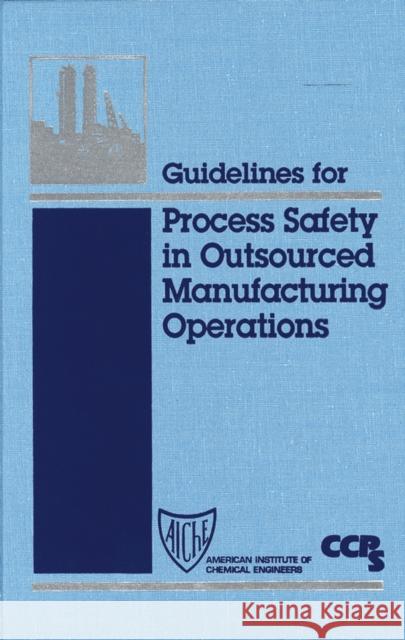
Guidelines for Process Safety in Outsourced Manufacturing Operations

ISBN-13: 9780816908127 / Angielski / Twarda / 2000 / 240 str.
Center for Chemical Process Safety (CCPS)
Guidelines for Process Safety in Outsourced Manufacturing Operations Center For Chemical Process Safety (Ccps) 9780816908127 AMERICAN INSTITUTE OF CHEMICAL ENGINEERS - książkaWidoczna okładka, to zdjęcie poglądowe, a rzeczywista szata graficzna może różnić się od prezentowanej.

Guidelines for Process Safety in Outsourced Manufacturing Operations

ISBN-13: 9780816908127 / Angielski / Twarda / 2000 / 240 str.

Center for Chemical Process Safety (CCPS)
cena 800,73 zł
(netto: 762,60 VAT:  5%)

Najniższa cena z 30 dni: 792,54 zł
Termin realizacji zamówienia:
ok. 30 dni roboczych
Bez gwarancji dostawy przed świętami

Darmowa dostawa!

In today's competitive economy, companies often augment in-house production by outsourcing chemical reaction processes and distillation, drying, formulating, blending, and packaging operations. While most of these tolling, or contracted manufacturing services, proceed without incident, recent major accidents have pointed to weaknesses in some tolling arrangements, such as reactivity of materials and processes. This Guidelines book provides the reader with proven procedures to improve process safety throughout the life cycle of a contracted manufacturing operation. Extensive checklists and examples used throughout the book make it a valuable learning tool and reference for companies conducting toll manufacturing, or considering outsourcing manufacturing operations.


Kategorie:
Technologie
Kategorie BISAC:
Technology & Engineering > Industrial Health & Safety
Wydawca:
AMERICAN INSTITUTE OF CHEMICAL ENGINEERS
Język:
Angielski
ISBN-13:
9780816908127
Rok wydania:
2000
Ilość stron:
240
Waga:
0.54 kg
Wymiary:
23.11 x 15.75 x 2.03
Oprawa:
Twarda
Wolumenów:
01
Dodatkowe informacje:
Bibliografia
Glosariusz/słownik
Wydanie ilustrowane

Preface.

Acknowledgments.

Acronyms and Abbreviations.

1. Introduction.

1.1 This Guideline s Scope.

1.2 The Guideline s Audience.

1.3 What Is Outsource Manufacturing?

1.4 Why Toll? Business, Technical and Safety Considerations.

1.5 Advantages and Disadvantages of Tolling.

1.6 Joint Responsibilities.

1.7 Using Process Safety to Ensure Safety, Product Quality, and Environmental Compliance.

1.8 How to use This Guideline.

2. The Toller Selection Process.

2.1 Potential Candidates: How to Find One How to Be One.

2.1.1 Identifying Technical Specialties and Expertise.

2.1.2 Prequalified Tollers The Preferred Route.

2.1.3 Finding a New Toller Technical and Trade Association Networking.

2.2 The Initial Qualification Process.

2.2.1 Assessing the Candidates Lines of Communication.

2.2.2 A Typical Questionnaire.

2.2.3 Weighing Special technical Competencies.

2.2.4 Financial.

2.2.5 Consider Location.

2.2.6 Consider the Environmental Baseline.

2.2.7 Verifying Safety, Quality, and Contractual Obligations.

2.2.8 Process Equipment Capabilities.

2.2.9 Personnel Capabilities and Expertise.

2.2.10 Capability to Scale–up Production.

2.2.11 Process Safety.

2.2.12 Security.

2.2.13 Corporate Health, Safety, and Environmental Policies.

2.2.14 Housekeeping and Appearance.

2.2.15 Insurance Review and Experience Modifiers.

2.2.16 Conducting a Site Visit.

2.2.17 Compatibility with Ongoing Operations.

2.2.18 Initial Qualification of International Tollers.

2.3 Making the Final Selection.

2.3.1 Comparing and Ranking the Initial Qualification Information.

2.3.2 Audit and Verification Process.

2.3.3 Confidentially Agreements.

2.3.4 Finalizing the Technology Package.

2.3.5 Evaluating Proposals.

2.3.6 Contract Award ands Negotiation.

3. Mutual Agreements, Obligations, and Contract Considerations.

3.1 Defining the Rights and Expectations of the Parties.

3.2 Legal Obligations, Defining Boundaries, Contract Topics.

3.3 Technology Transfer.

3.5 Knowledge Enhancement for Both Parties.

3.5.1 New Learning about Processing Hazards and Production Efficiency.

3.6 Roles and Responsibilities.

3.6.1 What Is Contained in a Detailed Technology Package?

3.6.2 Scale Up Technology.

3.6.3 Emergency Response Considerations.

3.6.4 Wastes and Emissions.

3.6.5 Establishing and Maintaining Communication.

3.6.6 Participation in PHAs: Resolving the Issues.

3.6.7 Training Requirements.

3.7 Health, Safety, and Environmental Considerations.

3.8 Management Systems.

3.8.1 Management of Change, Including Change of Personal.

3.8.2 Defining and Executing Training Requirements.

3.9 Access and Right to Audit.

3.10 Requalification: The Time Frame Issue.

3.11 Equipment Selection, Preparation, and Decontamination.

3.12 Performance Clauses and Bonuses.

3.13 Insurance Requirements.

3.14 Permit Requirements: Required Filings.

3.15 Escape and Termination Clauses.

3.16 Notification of Accidents, Incidents, Releases and Agency Inspections.

3.17 Right to Assist in Investigation.

3.18 Pre–startup Safety Review (PSR).

3.19 Formalizing Agreements, Obligations, and Other Considerations.

4. Pre–Startup and Startup Activities.

4.1 The Path to a Successful Toll.

4.2 Establishing Specifications and Analytical Techniques.

4.3 Developing or Revising Required Procedures.

4.3.1 Operating Procedures.

4.3.2 Maintenance Procedures.

4.3.3 Material Control/Purchasing Procedures.

4.3.4 Emergency Response Plan Procedures.

4.3.5 Safe Work Practice Procedures.

4.3.6 Laboratory Procedures.

4.4 Process Hazard Analysis.

4.4.1 Defining the PHA Team.

4.4.2 Selecting the PHA Method.

4.4.3 Performing the PHA.

4.5 Training Startup Team.

4.6 Performing a Pre–startup Safety Review.

4.6.1 Resolving PSSR Issues and Action Items.

4.6.2 Considerations for Restart after Extended Downtime.

4.6.3 Defining When the Process IS Ready for Startup.

4.6.4 Confirming Permits are Complete.

5. Ongoing Operations: Audits and Follow–Up.

5.1 Audit as Appropriate for the Process and Product.

5.1.1 Regulatory Requirements: PSM, RMP, and Others.

5.1.2 Management Systems.

5.1.3 Documenting the Audits.

5.1.4 Auditing as Specified in the Technical Package.

5.2 Consulting.

5.2.1 Points of Contact.

5.2.2 Communication.

5.2.3 Periodic Visits.

5.3 Managing Issues: Guidelines and Suggestions.

5.3.1 Management of Change Issues.

5.3.2 Process Issues.

5.3.3 Personnel Issues.

5.3.4 Acquisition of a Toller by Another Company.

5.3.5 Regulatory Issues.

5.3.6 Handling, Transporting, and Storing Materials and Waste.

5.3.7 Incident Investigations.

5.3.8 Analysis of New Hazards.

5.4 Performance Monitoring.

6. Closure and Audit.

6.1 Health, Safety, and Environmental Considerations.

6.1.1 Decommissioning and Clean Up.

6.1.2 Proper Waste Disposal.

6.2 Business and Contractual Concerns.

6.2.1 Return of Proprietary Documents.

6.2.2 Governmental Notification.

6.2.3 Sample Retention and Record Retention.

6.3 Closure Review Checklist.

6.4 Analysis of the Operation.

6.5 Tolling Operations: Final Evaluation.

Appendix A. Sample Toller Pre–Assessment Questionnaire.

Appendix B. Sample Toller HS&E Assessmaent.

Appendix C. Sample Toller Assessment: Quantitative Format.

Appendix D. The ISD Model and Job Task Analysis Techniques.

Appendix E. List of Referenced Regulations.

Appendix F. Selected Resources.

Bibliography.

Glossary.

Index.

The CENTER FOR CHEMICAL PROCESS SAFETY (CCPS), an industry technology alliance of the American Institute of Chemical Engineers (AIChE), has been a world leader in developing and disseminatinginformation on process safety management and technology since 1985. CCPS has published over 80 books in its process safety guidelines and process safety concepts series. For more information, visit www.ccpsonline.org.

Center for Chemical Process Safety (CCPS) The CENTER FOR CHEMICAL PROCESS SAFETY (CCPS), an ... więcej >


Udostępnij

Facebook - konto krainaksiazek.pl


Opinie o Krainaksiazek.pl na Opineo.pl

Partner Mybenefit

Krainaksiazek.pl w programie rzetelna firma Krainaksiaze.pl - płatności przez paypal

Czytaj nas na:

Facebook - krainaksiazek.pl
  • książki na zamówienie
  • granty
  • książka na prezent
  • kontakt
  • pomoc
  • opinie
  • regulamin
  • polityka prywatności

Zobacz:

  • Księgarnia czeska

  • Wydawnictwo Książkowe Klimaty

1997-2025 DolnySlask.com Agencja Internetowa

© 1997-2022 krainaksiazek.pl
     
KONTAKT | REGULAMIN | POLITYKA PRYWATNOŚCI | USTAWIENIA PRYWATNOŚCI
Zobacz: Księgarnia Czeska | Wydawnictwo Książkowe Klimaty | Mapa strony | Lista autorów
KrainaKsiazek.PL - Księgarnia Internetowa

Polityka prywatnosci - link
Krainaksiazek.pl - płatnośc Przelewy24
Przechowalnia Przechowalnia





