• Wyszukiwanie zaawansowane
  • Kategorie
  • Kategorie BISAC
  • Książki na zamówienie
  • Promocje
  • Granty
  • Książka na prezent
  • Opinie
  • Pomoc
  • Załóż konto
  • Zaloguj się

Group-Theoretical Methods for Integration of Nonlinear Dynamical Systems » książka


zaloguj się | załóż konto
Logo Krainaksiazek.pl

koszyk

konto

szukaj
topmenu
Księgarnia internetowa
Szukaj
Książki na zamówienie
Promocje
Granty
Książka na prezent
Moje konto
Pomoc
 
 
Wyszukiwanie zaawansowane
Pusty koszyk
Bezpłatna dostawa dla zamówień powyżej 20 złBezpłatna dostawa dla zamówień powyżej 20 zł

Kategorie główne

• Nauka
 [2949965]
• Literatura piękna
 [1857847]

  więcej...
• Turystyka
 [70818]
• Informatyka
 [151303]
• Komiksy
 [35733]
• Encyklopedie
 [23180]
• Dziecięca
 [617748]
• Hobby
 [139972]
• AudioBooki
 [1650]
• Literatura faktu
 [228361]
• Muzyka CD
 [398]
• Słowniki
 [2862]
• Inne
 [444732]
• Kalendarze
 [1620]
• Podręczniki
 [167233]
• Poradniki
 [482388]
• Religia
 [509867]
• Czasopisma
 [533]
• Sport
 [61361]
• Sztuka
 [243125]
• CD, DVD, Video
 [3451]
• Technologie
 [219309]
• Zdrowie
 [101347]
• Książkowe Klimaty
 [123]
• Zabawki
 [2362]
• Puzzle, gry
 [3791]
• Literatura w języku ukraińskim
 [253]
• Art. papiernicze i szkolne
 [7933]
Kategorie szczegółowe BISAC

Group-Theoretical Methods for Integration of Nonlinear Dynamical Systems

ISBN-13: 9783764326159 / Angielski / Twarda / 1992 / 292 str.
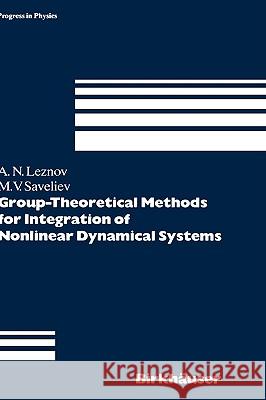
A. N. Leznov; Andrei N. Leznov; Mikhail V. Saveliev
Group-Theoretical Methods for Integration of Nonlinear Dynamical Systems A. N. Leznov Andrei N. Leznov Mikhail V. Saveliev 9783764326159 Springer - książkaWidoczna okładka, to zdjęcie poglądowe, a rzeczywista szata graficzna może różnić się od prezentowanej.

Group-Theoretical Methods for Integration of Nonlinear Dynamical Systems

ISBN-13: 9783764326159 / Angielski / Twarda / 1992 / 292 str.

A. N. Leznov; Andrei N. Leznov; Mikhail V. Saveliev
cena 201,72 zł
(netto: 192,11 VAT:  5%)

Najniższa cena z 30 dni: 192,74 zł
Termin realizacji zamówienia:
ok. 22 dni roboczych
Bez gwarancji dostawy przed świętami

Darmowa dostawa!

The book reviews a large number of 1- and 2-dimensional equations that describe nonlinear phenomena in various areas of modern theoretical and mathematical physics. It is meant, above all, for physicists who specialize in the field theory and physics of elementary particles and plasma, for mathe maticians dealing with nonlinear differential equations, differential geometry, and algebra, and the theory of Lie algebras and groups and their representa tions, and for students and post-graduates in these fields. We hope that the book will be useful also for experts in hydrodynamics, solid-state physics, nonlinear optics electrophysics, biophysics and physics of the Earth. The first two chapters of the book present some results from the repre sentation theory of Lie groups and Lie algebras and their counterpart on supermanifolds in a form convenient in what follows. They are addressed to those who are interested in integrable systems but have a scanty vocabulary in the language of representation theory. The experts may refer to the first two chapters only occasionally. As we wanted to give the reader an opportunity not only to come to grips with the problem on the ideological level but also to integrate her or his own concrete nonlinear equations without reference to the literature, we had to expose in a self-contained way the appropriate parts of the representation theory from a particular point of view."


Kategorie:
Nauka, Matematyka
Kategorie BISAC:
Gardening > General
Mathematics > Mathematical Analysis
Mathematics > Rachunek różniczkowy
Wydawca:
Springer
Seria wydawnicza:
Progress in Mathematical Physics
Język:
Angielski
ISBN-13:
9783764326159
Rok wydania:
1992
Wydanie:
1992
Numer serii:
000226113
Ilość stron:
292
Waga:
1.37 kg
Wymiary:
23.5 x 15.5
Oprawa:
Twarda
Wolumenów:
01
Dodatkowe informacje:
Bibliografia
Wydanie ilustrowane

Background of the theory of Lie algebras and Lie groups and their representations.- § 1.1 Lie algebras and Lie groups.- 1.1.1 Basic definitions.- 1.1.2 Contractions and deformations.- 1.1.3 Functional algebras.- § 1.2 ?-graded Lie algebras and their classification.- 1.2.1 Definitions.- 1.2.2 Semisimple, nilpotent and solvable Lie algebras. The Levi-Malcev theorem.- 1.2.3 Simple Lie algebras of finite growth: Classification and Dynkin-Coxeter diagrams.- 1.2.4 Root systems and the Weylgroup.- 1.2.5 A parametrization and ordering of roots of simple finite-dimensional Lie algebras.- 1.2.6 The real forms of complex simple Lie algebras.- § 1.3 sl(2)-subalgebras of Lie algebras.- 1.3.1 Embeddings of sl(2) into Lie algebras.- 1.3.2 Infinite-dimensional graded Lie algebras corresponding to embeddings of sl(2) into simple finite-dimensional Lie algebras.- 1.3.3 Explicit realization of simple finite-dimensional Lie algebras for the principal embedding of sl(2).- § 1.4 The structure of representations.- 1.4.1 Terminology.- 1.4.2 The adjoint representation.- 1.4.3 The regular representation and Casimir operators.- 1.4.4 Bases in the space of representation.- 1.4.5 Fundamental representations.- § 1.5 A parametrization of simple Lie groups.- § 1.6 The highest vectors of irreducible representations of semisimple Lie groups.- 1.6.1 Generalities.- 1.6.2 Expression for the highest matrix elements in terms of the adjoint representation.- 1.6.3 A formal expression for the highest matrix elements of the fundamental representations.- 1.6.4 Recurrence relations for the highest matrix elements of the fundamental representations.- 1.6.5 The highest matrix elements of irreducible representations expressed via generalized Euler angles.- § 1.7 Superalgebras and superspaces.- 1.7.1 Superspaces.- 1.7.2 Classical Lie superalgebras.- Representations of complex semisimple Lie groups and their real forms.- § 2.1 Infinitesimal shift operators on semisimple Lie groups.- 2.1.1 General expression of infinitesimal operators.- 2.1.2 The asymptotic domain.- § 2.2 Casimir operators and the spectrum of their eigenvalues.- 2.2.1 General formulation of the problem.- 2.2.2 Quadratic Casimir operators.- 2.2.3 Construction of Casimir operators for semisimple Lie groups.- § 2.3 Representations of semisimple Lie groups.- 2.3.1 Integral form of realization of operator-irreducible representations.- 2.3.2 The matrix elements of finite transformations.- § 2.4 Intertwining operators and the invariant bilinear form.- 2.4.1 Intertwining operators and problems of reducibility, equivalence and unitarity of representations.- 2.4.2 Construction of intertwining operators.- 2.4.3 The invariant Hermitian form.- § 2.5 Harmonic analysis on semisimple Lie groups.- 2.5.1 General method.- 2.5.2 Characters of operator-irreducible representations.- 2.5.3 Plancherel measure of the principal continuous series of unitary representations.- § 2.6 Whittaker vectors.- A general method of integrating two-dimensional nonlinear systems.- § 3.1 General method.- 3.1.1 Lax-type representation.- 3.1.2 Examples.- 3.1.3 Construction of solutions.- § 3.2 Systems generated by the local part of an arbitrary graded Lie algebra.- 3.2.1 Exactly integrable systems.- 3.2.2 Systems associated with infinite-dimensional Lie algebras.- 3.2.3 Hamiltonian formalism.- 3.2.4 Solutions of exactly integrable systems (Goursát problem).- § 3.3 Generalization for systems with fermionic fields.- § 3.4 Lax-type representation as a realization of self-duality of cylindrically-symmetric gauge fields.- Integration of nonlinear dynamical systems associated with finite-dimensional Lie algebras.- § 4.1 The generalized (finite nonperiodic) Toda lattice.- 4.1.1 Preliminaries.- 4.1.2 Construction of exact solutions on the base of the general scheme of Chapter 3.- 4.1.3 Examples.- 4.1.4 Construction of solutions without appealing to the Lax-type representation.- 4.1.4.1 Symmetry properties of the Toda lattice for the series A, B, C and the reduction procedure.- 4.1.4.2 Direct solution of the system (3.1.10) for the series A.- 4.1.4.3 Invariant generalization of the reduction scheme for arbitrary simple Lie algebras.- 4.1.5 The one-dimensional generalized Toda lattice.- 4.1.6 Boundary value problem (instantons and monopoles).- § 4.2 Complete integration of the two-dimensionalized system of Lotka-Volterra-type equations (difference KdV) as the Bäcklund transformation of the Toda lattice.- § 4.3 String-type systems (nonabelian versions of the Toda system).- § 4.4 The case of a generic Lie algebra.- § 4.5 Supersymmetric equations.- § 4.6 The formulation of the one-dimensional system (3.2.13) based on the notion of functional algebra.- Internal symmetries of integrable dynamical systems.- § 5.1 Lie-Bäcklund transformations. The characteristic algebra and defining equations of exponential systems.- § 5.2 Systems of type (3.2.8), their characteristic algebra and local integrals.- § 5.3 A complete description of Lie-Bäcklund algebras for the diagonal exponential systems of rank 2.- § 5.4 The Lax-type representation of systems (3.2.8) and explicit solution of the corresponding initial value (Cauchy) problem.- § 5.5 The Bäcklund transformation of the exactly integrable systems as a corollary of a contraction of the algebra of their internal symmetry.- § 5.6 Application of the methods of perturbation theory in the search for explicit solutions of exactly integrable systems (the canonical formalism).- § 5.7 Perturbation theory in the Yang-Feldmann formalism.- § 5.8 Methods of perturbation theory in the one-dimensional problem.- § 5.9 Integration of nonlinear systems associated with infinite-dimensional Lie algebras.- Scalar Lax-pairs and soliton solutions of the generalized periodic Toda lattice.- § 6.1 A group-theoretical meaning of the spectral parameter and the equations for the scalar LA-pair.- § 6.2 Soliton solutions of the sine-Gordon equation.- § 6.3 Generalized Bargmann potentials.- § 6.4 Soliton solutions for the vector representation of Ar.- Exactly integrable quantum dynamical systems.- § 7.1 The Hamiltonian (canonical) formalism and the Yang-Feldmann method.- § 7.2 Basics from perturbation theory.- § 7.3 One-dimensional generalized Toda lattice with fixed end-points.- 7.3.1 Schrödinger’s picture.- 7.3.2 Heisenberg’s picture (the canonical formalism).- 7.3.3 Heisenberg’s picture (Yang-Feldmann’s formalism).- § 7.4 The Liouville equation.- § 7.5 Multicomponent 2-dimensional models. 1.- § 7.6 Multicomponent 2-dimensional models. 2.- Afterword.


Udostępnij

Facebook - konto krainaksiazek.pl


Opinie o Krainaksiazek.pl na Opineo.pl

Partner Mybenefit

Krainaksiazek.pl w programie rzetelna firma Krainaksiaze.pl - płatności przez paypal

Czytaj nas na:

Facebook - krainaksiazek.pl
  • książki na zamówienie
  • granty
  • książka na prezent
  • kontakt
  • pomoc
  • opinie
  • regulamin
  • polityka prywatności

Zobacz:

  • Księgarnia czeska

  • Wydawnictwo Książkowe Klimaty

1997-2025 DolnySlask.com Agencja Internetowa

© 1997-2022 krainaksiazek.pl
     
KONTAKT | REGULAMIN | POLITYKA PRYWATNOŚCI | USTAWIENIA PRYWATNOŚCI
Zobacz: Księgarnia Czeska | Wydawnictwo Książkowe Klimaty | Mapa strony | Lista autorów
KrainaKsiazek.PL - Księgarnia Internetowa

Polityka prywatnosci - link
Krainaksiazek.pl - płatnośc Przelewy24
Przechowalnia Przechowalnia






