• Wyszukiwanie zaawansowane
  • Kategorie
  • Kategorie BISAC
  • Książki na zamówienie
  • Promocje
  • Granty
  • Książka na prezent
  • Opinie
  • Pomoc
  • Załóż konto
  • Zaloguj się

Group Rights as Human Rights: A Liberal Approach to Multiculturalism » książka


zaloguj się | załóż konto
Logo Krainaksiazek.pl

koszyk

konto

szukaj
topmenu
Księgarnia internetowa
Szukaj
Książki na zamówienie
Promocje
Granty
Książka na prezent
Moje konto
Pomoc
 
 
Wyszukiwanie zaawansowane
Pusty koszyk
Bezpłatna dostawa dla zamówień powyżej 20 złBezpłatna dostawa dla zamówień powyżej 20 zł

Kategorie główne

• Nauka
 [2946912]
• Literatura piękna
 [1852311]

  więcej...
• Turystyka
 [71421]
• Informatyka
 [150889]
• Komiksy
 [35717]
• Encyklopedie
 [23177]
• Dziecięca
 [617324]
• Hobby
 [138808]
• AudioBooki
 [1671]
• Literatura faktu
 [228371]
• Muzyka CD
 [400]
• Słowniki
 [2841]
• Inne
 [445428]
• Kalendarze
 [1545]
• Podręczniki
 [166819]
• Poradniki
 [480180]
• Religia
 [510412]
• Czasopisma
 [525]
• Sport
 [61271]
• Sztuka
 [242929]
• CD, DVD, Video
 [3371]
• Technologie
 [219258]
• Zdrowie
 [100961]
• Książkowe Klimaty
 [124]
• Zabawki
 [2341]
• Puzzle, gry
 [3766]
• Literatura w języku ukraińskim
 [255]
• Art. papiernicze i szkolne
 [7810]
Kategorie szczegółowe BISAC

Group Rights as Human Rights: A Liberal Approach to Multiculturalism

ISBN-13: 9781402042089 / Angielski / Twarda / 2006 / 263 str.
Neus Torbisco Casals; Torbisco N. Casals
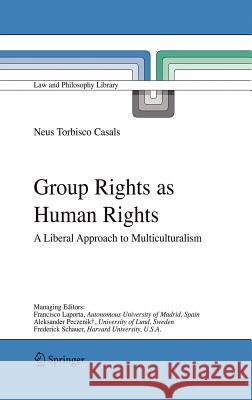
Group Rights as Human Rights: A Liberal Approach to Multiculturalism Torbisco Casals, Neus 9781402042089 Springer - książkaWidoczna okładka, to zdjęcie poglądowe, a rzeczywista szata graficzna może różnić się od prezentowanej.

Group Rights as Human Rights: A Liberal Approach to Multiculturalism

ISBN-13: 9781402042089 / Angielski / Twarda / 2006 / 263 str.

Neus Torbisco Casals; Torbisco N. Casals
cena 403,47
(netto: 384,26 VAT:  5%)

Najniższa cena z 30 dni: 385,52
Termin realizacji zamówienia:
ok. 22 dni roboczych
Bez gwarancji dostawy przed świętami

Darmowa dostawa!

Liberal theories have long insisted that cultural diversity in democratic societies can be accommodated through classical liberal tools, in particular through individual rights, and they have often rejected the claims of cultural minorities for group rights as illiberal. Group Rights as Human Rights argues that such a rejection is misguided. Based on a thorough analysis of the concept of group rights, it proposes to overcome the dominant dichotomy between "individual" human rights and "collective" group rights by recognizing that group rights also serve individual interests. It also challenges the claim that group rights, so understood, conflict with the liberal principle of neutrality; on the contrary, these rights help realize the neutrality ideal as they counter cultural biases that exist in Western states. Group rights deserve to be classified as human rights because they respond to fundamental, and morally important, human interests. Reading the theories of Will Kymlicka and Charles Taylor as complementary rather than opposed, Group Rights as Human Rights sees group rights as anchored both in the value of cultural belonging for the development of individual autonomy and in each person's need for a recognition of her identity. This double foundation has important consequences for the scope of group rights: it highlights their potential not only in dealing with national minorities but also with immigrant groups; and it allows to determine how far such rights should also benefit illiberal groups. Participation, not intervention, should here be the guiding principle if group rights are to realize the liberal promise.


Kategorie:
Nauka, Prawo i administracja
Kategorie BISAC:
Philosophy > Political
Law > Public
Law > Reference
Wydawca:
Springer
Seria wydawnicza:
Law and Philosophy Library
Język:
Angielski
ISBN-13:
9781402042089
Rok wydania:
2006
Wydanie:
2006
Numer serii:
000038988
Ilość stron:
263
Waga:
1.27 kg
Wymiary:
29.7 x 21.0
Oprawa:
Twarda
Wolumenów:
01
Dodatkowe informacje:
Bibliografia

Introduction. 1. Multiculturalism and Group Rights: The Issues. 2. Outline of the Book. Part 1: Cultural Minorities and Group Rights: Contested Concepts. 1.1 Introduction. 1.2 A Preliminary Elucidation of the Concept of Minority. 1.2.1 Objective Elements. 1.2.2 The Subjective Element. 1.3. Minorities and Group Rights: The Inadequacy of the Dominant Approach. 1.3.1 The Problem of Defining ‘Minority’ Revisited. 1.3.2 What Conception of Group Rights? 1.4. Liberalism vs. Communitarianism: An Inadequate Framework. 1.5. Conclusion. Part 2: Towards an Alternative Notion of Group Rights. 2.1 Introduction. 2.2 Group Rights: an Unnecessary Concept? 2.2.1 The Reductionist Strategy. 2.2.2 Questioning the Need for the Language of Rights. 2.3 Two Complementary Conceptions of Group Rights. 2.3.1 Group Rights as Rights to Public Goods. 2.3.2 Group Rights as Special Rights. 2.4. Conclusion. Part 3: Understanding Multiculturalism: Which Groups Qualify? 3.1. Introduction. 3.2. Social Minorities. 3.3. Cultural Minorities. 3.4. Against Group Rights? Some Provisional Conclusions. Part 4: Tolerance, Neutrality and Group Rights. 4.1. Introduction. 4.2. The Tolerance Approach and the Question of Group Rights. 4.2.1 Tolerance and Neutrality in Liberal Thought. 4.2.2 Neutrality and its Tension with Group Rights. 4.3. The Cultural Dimension of Politics: Liberalism, Nationalism and Nation-Building. 4.3.1 ‘E Pluribus Unum’: The Historical Link between Nationalism and Liberalism. 4.3.2 The Politics of Nation-Building. 4.3.3 The Liberal Justification of Nationalism. 4.3.4 The Awakening of Minorities. 4.4. Illusions of Neutrality and the Tolerance Model. 4.4.1 State Interference and Cultural Domination: Past and Present. 4.4.2 Beyond History: The Tolerance Approach as an Ideal? 4.5. Group Rights and Neutrality. 4.5.1 Consequential and Justificatory Neutrality. 4.5.2 The Compatibility of Group Rights and Neutrality. 4.6. Conclusion. Part 5: On the Relevance of CulturalBelonging: Group Rights as Instrumental Rights and as Fundamental Rights. 5.1. Introduction. 5.2. The Instrumental Justification of Group Rights. 5.2.1 The Limits of Global Humanism. 5.2.2 Compensatory Justice Arguments. 5.2.3 Conclusion: The Instrumental Relevance of Group Rights. 5.3. Group Rights as Basic Rights: The Connection between Autonomy and Cultural Belonging. 5.3.1 Cultural Belonging as the Basis of Autonomy: The Theory of Will Kymlicka. 5.3.2 Cultural Belonging as a Primary Good. 5.3.3 The Burdens of Assimilation and the Limits of Coercion. 5.4. Group Rights as Basic Rights: The Challenge of Recognition. 5.4.1 Recognition and Culture in the Theory of Charles Taylor. 5.4.2 The Politics of Recognition and the Critique of ‘Neutrality Liberalism’. 5.4.3 Recognition and Autonomy: Some Criticisms. 5.4.4 Regaining Autonomy and Respect: Toward a Reformulation of the Politics of Recognition. 5.5. Conclusion. Part 6: Multiculturalism, Ethnic Minorities, and the Limits of Cultural Diversity. 6.1. Introduction. 6.2. National and Ethnic Minorities: A Different Normative Status? 6.2.1 The Challenge of Immigration: Between Assimilation and the ‘Politics of Multiculturalism’. 6.2.2 The Foulard Affair: French Schools and the Muslim Headscarf. 6.3. The Justification of the Rights of Ethnic Minorities: a Problem for Liberal Nationalism? 6.3.1 Kymlicka’s Theory and the Rights of Ethnic Minorities. 6.3.2 Identity, Recognition and Group Rights for Ethnic Minorities. 6.4. Limits to Cultural Pluralism: the Justification of ‘Partial Citizenship’. 6.5. Conclusion. Epilogue The Value of Cultural Pluralism: Some Final Remarks on an Unexplored Topic. Concluding Remarks.

Liberal theories have long insisted that cultural diversity in democratic societies can be accommodated through classical liberal tools, in particular through individual rights, and they have often rejected the claims of cultural minorities for group rights as illiberal. Group Rights as Human Rights argues that such a rejection is misguided. Based on a thorough analysis of the concept of group rights, it proposes to overcome the dominant dichotomy between "individual" human rights and "collective" group rights by recognizing that group rights also serve individual interests. It also challenges the claim that group rights, so understood, conflict with the liberal principle of neutrality; on the contrary, these rights help realize the neutrality ideal as they counter cultural biases that exist in Western states. Group rights deserve to be classified as human rights because they respond to fundamental, and morally important, human interests. Reading the theories of Will Kymlicka and Charles Taylor as complementary rather than opposed, Group Rights as Human Rights sees group rights as anchored both in the value of cultural belonging for the development of individual autonomy and in each person’s need for a recognition of her identity. This double foundation has important consequences for the scope of group rights: it highlights their potential not only in dealing with national minorities but also with immigrant groups; and it allows to determine how far such rights should also benefit illiberal groups. Participation, not intervention, should here be the guiding principle if group rights are to realize the liberal promise.




Udostępnij

Facebook - konto krainaksiazek.pl


Opinie o Krainaksiazek.pl na Opineo.pl

Partner Mybenefit

Krainaksiazek.pl w programie rzetelna firma Krainaksiaze.pl - płatności przez paypal

Czytaj nas na:

Facebook - krainaksiazek.pl
  • książki na zamówienie
  • granty
  • książka na prezent
  • kontakt
  • pomoc
  • opinie
  • regulamin
  • polityka prywatności

Zobacz:

  • Księgarnia czeska

  • Wydawnictwo Książkowe Klimaty

1997-2025 DolnySlask.com Agencja Internetowa

© 1997-2022 krainaksiazek.pl
     
KONTAKT | REGULAMIN | POLITYKA PRYWATNOŚCI | USTAWIENIA PRYWATNOŚCI
Zobacz: Księgarnia Czeska | Wydawnictwo Książkowe Klimaty | Mapa strony | Lista autorów
KrainaKsiazek.PL - Księgarnia Internetowa

Polityka prywatnosci - link
Krainaksiazek.pl - płatnośc Przelewy24
Przechowalnia Przechowalnia




