• Wyszukiwanie zaawansowane
  • Kategorie
  • Kategorie BISAC
  • Książki na zamówienie
  • Promocje
  • Granty
  • Książka na prezent
  • Opinie
  • Pomoc
  • Załóż konto
  • Zaloguj się

Group Decision Making Under Multiple Criteria: Methods and Applications » książka


zaloguj się | załóż konto
Logo Krainaksiazek.pl

koszyk

konto

szukaj
topmenu
Księgarnia internetowa
Szukaj
Książki na zamówienie
Promocje
Granty
Książka na prezent
Moje konto
Pomoc
 
 
Wyszukiwanie zaawansowane
Pusty koszyk
Bezpłatna dostawa dla zamówień powyżej 20 złBezpłatna dostawa dla zamówień powyżej 20 zł

Kategorie główne

• Nauka
 [2946600]
• Literatura piękna
 [1856966]

  więcej...
• Turystyka
 [72221]
• Informatyka
 [151456]
• Komiksy
 [35826]
• Encyklopedie
 [23190]
• Dziecięca
 [619653]
• Hobby
 [140543]
• AudioBooki
 [1577]
• Literatura faktu
 [228355]
• Muzyka CD
 [410]
• Słowniki
 [2874]
• Inne
 [445822]
• Kalendarze
 [1744]
• Podręczniki
 [167141]
• Poradniki
 [482898]
• Religia
 [510455]
• Czasopisma
 [526]
• Sport
 [61590]
• Sztuka
 [243598]
• CD, DVD, Video
 [3423]
• Technologie
 [219201]
• Zdrowie
 [101638]
• Książkowe Klimaty
 [124]
• Zabawki
 [2473]
• Puzzle, gry
 [3898]
• Literatura w języku ukraińskim
 [254]
• Art. papiernicze i szkolne
 [8170]
Kategorie szczegółowe BISAC

Group Decision Making Under Multiple Criteria: Methods and Applications

ISBN-13: 9783540171775 / Angielski / Miękka / 1986 / 400 str.
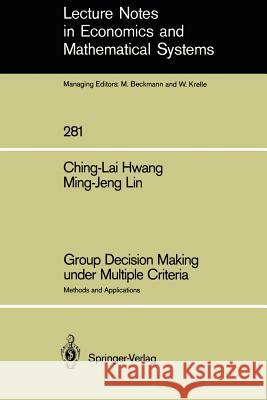
Ching-Lai Hwang; Ming-Jeng Lin
Group Decision Making Under Multiple Criteria: Methods and Applications Hwang, Ching-Lai 9783540171775 Springer - książkaWidoczna okładka, to zdjęcie poglądowe, a rzeczywista szata graficzna może różnić się od prezentowanej.

Group Decision Making Under Multiple Criteria: Methods and Applications

ISBN-13: 9783540171775 / Angielski / Miękka / 1986 / 400 str.

Ching-Lai Hwang; Ming-Jeng Lin
cena 403,47 zł
(netto: 384,26 VAT:  5%)

Najniższa cena z 30 dni: 385,52 zł
Termin realizacji zamówienia:
ok. 22 dni roboczych
Bez gwarancji dostawy przed świętami

Darmowa dostawa!

This monograph is intended for an advanced undergraduate or graduate course of engineering and management science. as well as for persons in business. industry. military or in any field. who want an introductory and a capsule look into the methods of group decision making under multiple criteria. This is a sequel to our previous works entitled "Multiple Objective Decision Making--Methods and Applications (No. 164 of the Lecture Notes). and "Multiple Attribute Decision Making--Methods and Applications (No. 186 of the Lecture Notes). Moving from a single decision maker (the consideration of Lecture Notes 164 and 186) to a multiple decision maker setting introduces a great deal of complexity into the analysis. The problem is no longer the selection of the most preferred alternative among the nondominated solutions according to one individual's (single decision maker's) preference structure. The analysis is extended to account for the conflicts among different interest groups who have different objectives. goals. and so forth. Group decision making under multiple criteria includes such diverse and interconnected fields as preference analysis. utility theory. social choice theory. committee decision theory. theory of voting. game theory. expert evaluation analysis. aggregation of qualitative factors. economic equilibrium theory. etc; these are simplified and systematically classified for beginners. This work is to provide readers with a capsule look into the existing methods. their characteristics. and applicability in the complexity of group decision making.


Kategorie:
Nauka, Ekonomia i biznes
Kategorie BISAC:
Business & Economics > Operations Research
Business & Economics > Decision Making & Problem Solving
Wydawca:
Springer
Seria wydawnicza:
Lecture Notes in Economics and Mathematical Systems
Język:
Angielski
ISBN-13:
9783540171775
Rok wydania:
1986
Wydanie:
1987
Numer serii:
000221492
Ilość stron:
400
Waga:
1.29 kg
Wymiary:
23.5 x 15.5
Oprawa:
Miękka
Wolumenów:
01

I. Introduction.- II. Social Choice Theory.- 1. Voting.- 1.1 Nonranked Voting System.- 1.1.1 One Nember Elected From Two Candidates.- 1.1.2 One Nember Elected From Many Candidates.- (a) The First-Past-The-Post System.- (b) Majority Representation System.- Repeated Ballots.- The Second Ballot.- Note:.- Case 1 of Dodgson.- Case 2 of Dodgson.- Case 3 of Dodgson Modified.- 1.1.3 Election of Two or Nore Nembers.- 1.1.3.1 The Single Nontransferable Vote.- 1.1.3.2 Multiple Vote.- 1.1.3.3 Limited Vote.- 1.1.3.4 Cumulative Vote.- 1.1.3.5 List Systems.- (a) Highest Average.- (b) Greatest Remainder.- 1.1.3.6 Approval Voting.- 1.2 Preferential Voting System.- 1.2.1 Simple Majority Decision Rule.- 1.2.1.1 Two-Alternative Case.- 1.2.1.2 More Than Two Alternatives Case.- (a) Paradox of Voting.- Example 1 of Condorcet.- Example 2 of Condorcet.- (b) The Condorcet Effect.- Note: Nonminority Rule.- 2. Social Choice Function.- 2.1 Introduction.- Condorcet Principle.- 2.2 Notation, Definitions and Basic Properties.- 2.3 Condorcet’s Function.- 2.4 Borda’s Function.- 2.5 Copeland’s Function.- 2.6 Nanson’s Function.- 2.7 Dodgson’s Function.- 2.8 Kemeny’s Function.- 2.9 Cook and Seiford’s Function.- 2.10 Fishburn’s Function.- 2.11 Eigenvector Function.- 2.12 Bernardo’s Assignment Approach.- 2.13 Cook and Seiford’s Ordinal Intersection Method.- 3. Social Welfare Function.- 3.1 Introduction.- 3.2 Notation and Statement of Problem for Social Choice and Individual Values.- 3.3 Arrow’s Conditions for Social Welfare Function.- 3.4 Arrow’s Possibility Theorem for Two Alternatives.- 3.5 Arrow’s General Possibility Theorem.- 3.6 Black’s Single-Peaked Preferences.- 3.7 Bowman and Colantoni’s Approach.- 3.8 Goodman and Markowitz’s Approach.- 3.9 Cardinal Social Welfare Function.- 3.9.1 Value Function for Certainty Case.- 3.9.2 Utility Function for Uncertainty Case.- 3.9.2.1 Additive Group Utility Function.- 3.9.2.2 Multiplicative Group Utility Function.- 3.9.3 Some Applications.- 3.9.3.1 Gynnastics Conpetitions.- 3.9.3.2 Extended Contribution Rule Method (ECR Method).- 3.9.3.3 The Selection of Trajectories for the Marine Jupiter/Saturn 1977 Project.- 3.10 Comparison Between Arrow’s Conditions for Social Welfare Function and Properties of Social Choice Function..- III. Experts Judgment and/or Group Participation.- 1. Introduction.- 2. Brainstorming.- 2.1 Introduction.- 2.2 Rules and Procedure for Brainstorming Method.- 2.3 Advantages and Disadvantages.- 2.4 Note on Various Modified Techniques.- 3. Brainwriting.- 3.1 Introduction.- 3.2 Procedure of Brainwriting Pool and Its Discussion.- 3.3 Brainwriting and Its Variations.- 4. The Nominal Group Technique (NGT).- 4.1 Introduction.- 4.2 The Nominal Group Technique Process.- 4.3 Advantages and Disadvantages of NGT.- 5. Synectics.- 5.1 Introduction.- 5.2 The Process of Synectics.- 5.3 Advantages and Disadvantages of Synectics.- Note.- 6. Surveys.- 6.1 Introduction.- 6.2 Survey Procedure.- 6.3 Advantages and Disadvantages of Surveys.- 7. Delphi Method.- 7.1 Introduction.- 7.2 The Procedure of Delphi Method.- 7.3 Advantages and Disadvantages of Delphi Method.- Note.- 7.4 Example.- 8. Conferences.- 8.1 Introduction.- 8.2 Planning and Conducting the Conference.- Note.- 9. Successive Proportional Additive Numeration or Social Participatory Allocative Network (SPAN).- 9.1 Introduction.- 9.2 The Procedure of SPAN Technique.- 9.3 Example.- 9.4 Advantages and Disadvantages of SPAN.- 10. Interpretive Structural Modeling (ISM).- 10.1 Introduction.- 10.2 The Procedure of ISM.- 10.3 Digraphs, Binary Matrices, and Computer Inplementation.- 10.4 Example: Urban Planning for Dayton, Ohio.- 10.5 Advantages and Disadvantages of ISM.- 11. Decision Making Trial and Evaluation Laboratory (Dematel).- 11.1 Introduction.- 11.2 Objectives, Ideas, and Goals.- 11.3 Procedure.- 11.3.1 Franework of the World Problematique.- 11.3.2 Participants.- 11.3.3 Questions Asked.- 11.3.4 Analysis of Individual Perceptions of World Problematique.- 11.3.5 Analysis of the Average Perceptions by Group of the World Problematique.- 11.3.6 Comparison of Individual Perceptions of the World Problematique.- 11.4 Example: Perception of the World Problematique.- Note.- 12. Cognitive Map.- 12.1 Introduction.- 12.2 Basic Elements of a Cognitive Map.- 12.3 Analysis of Signed Digraph.- 12.4 The Cognitive Map of Collectivities.- 12.5 Inferring the Properties of a Cognitive Map.- 12.6 Example: Building and Analyzing an Energy Demand Signed Digraph.- 12.7 The Limitation of the Cognitive Map.- 13. Kane’s Simulation (KSIM).- 13.1 Introduction.- 13.2 The Procedure of KSIM.- 13.3 Example: Shall We Permit Bird Hunting in Eco Valley?.- 13.4 Advantages and Disadvantages of KSIM.- 13.5 Other Simulations.- Note.- 14. Implementing and Controlling a Project.- 14.1 Introduction.- 14.2 Gantt Chart.- 14.3 Program Evaluation Review Technique (PERT) and Critical Path Method (CPM).- 14.4 The Planning-Programming-Budgeting System (PPBS).- 14.5 DELTA Chart.- 15. Group Decision Making Under Multiple Criteria for Evaluation/Selection of Alternatives.- 15.1. Introduction.- 15.2. A General Formulation.- 15.3. The Ordinal Approach.- 15.3.1 The Agreed Criteria Approach.- 15.3.2 The Individual Approach.- 15.3.3 Numerical Example.- 15.4. The Cardinal Approach.- 15.4.1 The Agreed Criteria Approach.- 15.4.2 The Individual Approach.- 15.4.2.1 The Additive Weighted Value Approach.- 15.4.2.2 Topsis and Borda’S Function Approach.- 15.4.3 Example.- 15.5 Note.- 16. A Systems Approach to Expert Judgments and/or Group Participation Analysis.- 16.1 Introduction.- 16.2 Processes in the Systems Approach.- 16.3 Note.- IV. Game Theory.- 1. Introduction.- 2. Some Basic Concepts.- The Extensive Form of a Game.- The Normal Form of a Game.- The Characteristic Function Form of a Game.- Cooperative and Noncooperative Games.- Essential and Inessential Games.- Zero-Sum, Constant-Sum, General-Sum Games.- 3. The Normal form Payoff Function.- 3.1 Introduction.- 3.2 Pareto Optimal Set.- 3.3 The Nash-Harsanyi Arbitration Solution.- 3.4 Compromise Solution.- 4. The Characteristic Function Form.- 4.1 Introduction.- 4.2 Core Concept.- 4.3 Shapley Value.- 4.4 The Parametric Approach.- V. Concluding Remarks.- VI. References.


Udostępnij

Facebook - konto krainaksiazek.pl


Opinie o Krainaksiazek.pl na Opineo.pl

Partner Mybenefit

Krainaksiazek.pl w programie rzetelna firma Krainaksiaze.pl - płatności przez paypal

Czytaj nas na:

Facebook - krainaksiazek.pl
  • książki na zamówienie
  • granty
  • książka na prezent
  • kontakt
  • pomoc
  • opinie
  • regulamin
  • polityka prywatności

Zobacz:

  • Księgarnia czeska

  • Wydawnictwo Książkowe Klimaty

1997-2025 DolnySlask.com Agencja Internetowa

© 1997-2022 krainaksiazek.pl
     
KONTAKT | REGULAMIN | POLITYKA PRYWATNOŚCI | USTAWIENIA PRYWATNOŚCI
Zobacz: Księgarnia Czeska | Wydawnictwo Książkowe Klimaty | Mapa strony | Lista autorów
KrainaKsiazek.PL - Księgarnia Internetowa

Polityka prywatnosci - link
Krainaksiazek.pl - płatnośc Przelewy24
Przechowalnia Przechowalnia





