• Wyszukiwanie zaawansowane
  • Kategorie
  • Kategorie BISAC
  • Książki na zamówienie
  • Promocje
  • Granty
  • Książka na prezent
  • Opinie
  • Pomoc
  • Załóż konto
  • Zaloguj się

Gravity, Black Holes, and the Very Early Universe: An Introduction to General Relativity and Cosmology » książka


zaloguj się | załóż konto
Logo Krainaksiazek.pl

koszyk

konto

szukaj
topmenu
Księgarnia internetowa
Szukaj
Książki na zamówienie
Promocje
Granty
Książka na prezent
Moje konto
Pomoc
 
 
Wyszukiwanie zaawansowane
Pusty koszyk
Bezpłatna dostawa dla zamówień powyżej 20 złBezpłatna dostawa dla zamówień powyżej 20 zł

Kategorie główne

• Nauka
 [2946600]
• Literatura piękna
 [1856966]

  więcej...
• Turystyka
 [72221]
• Informatyka
 [151456]
• Komiksy
 [35826]
• Encyklopedie
 [23190]
• Dziecięca
 [619653]
• Hobby
 [140543]
• AudioBooki
 [1577]
• Literatura faktu
 [228355]
• Muzyka CD
 [410]
• Słowniki
 [2874]
• Inne
 [445822]
• Kalendarze
 [1744]
• Podręczniki
 [167141]
• Poradniki
 [482898]
• Religia
 [510455]
• Czasopisma
 [526]
• Sport
 [61590]
• Sztuka
 [243598]
• CD, DVD, Video
 [3423]
• Technologie
 [219201]
• Zdrowie
 [101638]
• Książkowe Klimaty
 [124]
• Zabawki
 [2473]
• Puzzle, gry
 [3898]
• Literatura w języku ukraińskim
 [254]
• Art. papiernicze i szkolne
 [8170]
Kategorie szczegółowe BISAC

Gravity, Black Holes, and the Very Early Universe: An Introduction to General Relativity and Cosmology

ISBN-13: 9780387736297 / Angielski / Twarda / 2007 / 280 str.
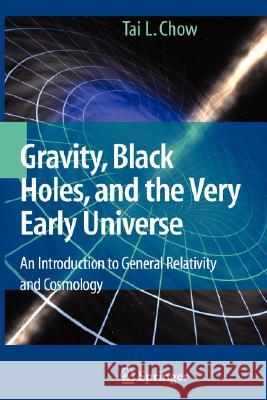
Tai L. Chow
Gravity, Black Holes, and the Very Early Universe: An Introduction to General Relativity and Cosmology Chow, Tai L. 9780387736297 Springer - książkaWidoczna okładka, to zdjęcie poglądowe, a rzeczywista szata graficzna może różnić się od prezentowanej.

Gravity, Black Holes, and the Very Early Universe: An Introduction to General Relativity and Cosmology

ISBN-13: 9780387736297 / Angielski / Twarda / 2007 / 280 str.

Tai L. Chow
cena 302,60 zł
(netto: 288,19 VAT:  5%)

Najniższa cena z 30 dni: 289,13 zł
Termin realizacji zamówienia:
ok. 22 dni roboczych
Bez gwarancji dostawy przed świętami

Darmowa dostawa!

Chow introduces the mathematical methods essential to understanding and applying general relativity--tensor calculus, some differential geometry, etc.--but leaves to more advanced references derivations that a beginning student would likely find overly long and tedious. The book employs standard tensor analysis--which requires only basic calculus for its understanding--and resists the temptation to adopt more powerful mathematical formalisms (like exterior calculus and differential forms) used by researchers in the field. In this way, the student can concentrate on learning physics--and not be distracted by the complexities of unfamiliar mathematical methods. The book also offers comprehensive discussion of the physics of black holes. The author hits just the right level of presentation: sufficient mathematical detail to demonstrate or make plausible the physical attributes of black holes - in contrast to "hand-waving" discussions found in popularizations of the subject - yet not so much mathematics as to lose track of the physics in an impenetrable forest of equations. An equally strong point is the author's discussion of the most exciting contemporary issues in astrophysics apart from black holes: recent measurements of the cosmic microwave background, the existence of the cosmological constant, dark matter, dark energy and the accelerated expansion of the universe. The final chapters on unification and inflation are also very well done and not generally found in other introductory treatments of general relativity. In sum, the book is highly informative and has a user-friendly style, which should make it an attractive choice for teachers and students.


Kategorie:
Nauka, Fizyka
Kategorie BISAC:
Science > Fizyka relatywistyczna
Science > Fizyka matematyczna
Science > Mechanics - General
Wydawca:
Springer
Język:
Angielski
ISBN-13:
9780387736297
Rok wydania:
2007
Wydanie:
2008
Ilość stron:
280
Waga:
1.32 kg
Wymiary:
23.5 x 15.5
Oprawa:
Twarda
Wolumenów:
01
Dodatkowe informacje:
Bibliografia
Wydanie ilustrowane

From the reviews:

"Chow ... has successfully filled the gap in the literature between introductory texts for lay readers interested in cosmology and advanced works. Chow's book is aimed at undergraduates but is accessible to all readers ... . Chapters can stand alone for quick reference, yet the book's progressive nature makes it a viable course resource for supporting all physics curricula. ... this work will be suitable for all science libraries and collections. Summing Up: Recommended. General readers; lower-division undergraduates through graduate students." (J. H. Murphy, CHOICE, Vol. 45 (8), 2008)

"This book has its roots in the lecture notes of Professor Chow, who taught an undergraduate course in relativity and cosmology ... . I was interested by the ideas and the historical aspects developed ... on the inflationary universe and the physics of the very early universe. ... The book may be useful for general information on cosmology and to a physicist already well prepared in general relativity and cosmology to prepare a course on these subjects." (Fernande Grandjean, Belgian Physical Society Magazine, Issue 2, June, 2009)

Preface Chapter 1 Basic Ideas of General Relativity 1.1 Inadequacy of special relativity and Mach's principle 1.2 Einstein's principle of equivalence 1.3 Immediate consequences of the principle of equivalence The bending of a light beam Gravitational shift of spectral lines 1.4 The curved spacetime concept 1.5 The principle of general covariance 1.6 Distance and time intervals References Problems Chapter 2 Curvilinear Coordinates and General Tensors 2.1 Curvilinear coordinates 2.2 Parallel displacement and covariant differentiation 2.3 Symmetry properties of the Christoffel symbols 2.4 Christoffel symbols and the metric tensor 2.5 The Geodesics 2.6 The stationary property of geodesics 2.7 The curvature tensor 2.8 Geodesic deviation 2.9 Laws of physics in curved space 2.10 The metric tensor and the classical gravitational potential 2.11 Some useful calculation aids References Problems Chapter 3 Einstein's Law of Gravitation 3-1 Introduction (summary of general principles) 3-2 A heuristic derivation of Einstein's equations 3-3 Energy-momentum tensor References Problems Chapter 4 The Schwarzschild Solution 4-1 The Schwarzschild metric 4-2 The Schwarzschild solution of the vacuum field equations The gravitational redshift 4-3 Isotropic coordinates 4-4 Schwarzschild geodesic 4-5 First integrals of the Schwarzschild solutions 4-6 Quasiuniform gravitational field References Problems Chapter 5 Experimental Tests of Einstein's Theory 5-1 Precession of the perihelion of Mercury 5-2 Deflection of light rays in a gravitational field 5-3 Light retardation (The Shaoiro experiment) 5-4 Test of gravitational radiation(Hulse-Taylor's measurement of decay of the orbit of the binary pulsar PSR-1913+16) References Problems Chapter 6 The Physics of Black Holes 6-1 The Schwarzschild black holes 6-2 Inside a black hole 6-3 How a black hole forms 6-4 The Kerr-Newmann black holes Energy extraction from a rotating black hole: the Penrose process The area theorem Energy extraction from two coalescing black holes 6-5 Thermodynamics of black holes Quantum mechanics of black holes; Hawking radiation 6-6 The detection of black holes a. Detection of stellar-mass black holes b. Supermassive black holes in the centers of galaxies c. Intermediate-mass black holes 6-7 How do electric and gravitational fields get out of black holes? 6-8 Black holes and particle Physics References Problems Chapter 7 Introduction to Cosmology 7-1 Introduction 7-2 A little history on the development of western cosmological concepts Ancient Greece The renaissance of cosmology Newton and infinite universe Newton's law pf gravity predicts a non-stationary universe Olbers's paradox 7-3 The discovery of expansion of the universe 7-4 The Big Bang Cosmological redshift 7-5 The microwave background radiation 7-6 Additional evidence for the Big Bang References Problems Chapter 8 Big Bang Models 8-1 The cosmic fluid and fundamental observers 8-2 Properties of the Robertson-Walker metric 8-3 Cosmic dynamics; Friedmann's equations 8-4 The solutions of Friedmann's equations A. Flat model (k = 0) B. Closed model (k = 1) C. Open model (k = -1) 8-5 Dark matter and the fate of the universe 8-6 The Beginning, the end, and time's arrow 8-7 An accelerating universe? 8-8 The co

Tai L. Chow is Professor of Physics at California State University, Stanislaus. He has written a successful text on Mathematical Methods with Cambridge University Press:

Chow, Mathematical Methods for Physicists: A Concise Introduction (Cambridge, ISBN 0521655447 , 555 pp., Hardcover, $58.00 [Hardcover: $120.00], 7/2000)

In the early 1900s, Albert Einstein formulated two theories that would forever change the landscape of physics: the Special Theory of Relativity and the General Theory of Relativity. By 1925, quantum mechanics had been born out of the dissection of these two theories, and shortly after that, relativistic quantum field theory. We now had in place some important ties between the laws of physics and the types of particle interactions the new physics was uncovering.

Gravity is one of the four types of forces that are found throughout the universe. In fact, although it is a relatively weak force, it operates at huge distances, and so must be accounted for in any cosmological system. Unfortunately, gravity continues to defy our neat categorization of how all the forces in nature work together.

Professor Tai Chow, from the California State University at Stanislaus in Turlock, lays out for us the basic ideas of Einstein, including his law of gravitation, explains the physics behind black holes, and weaves into this an absorbing account an explanation of the structure of the universe and the science of cosmology, including presenting the various models of the Big Bang, the Inflationary Universe, and the Unification of Forces. Travel with him down this engaging path to reach some fascinating conclusions, which raise even more interesting questions for the future of astronomy and physics.

Says Dr. Mark Silverman of Trinity College in Hartford, Connecticut:

"The author … introduces the mathematical methods essential to understanding and applying general relativity…but leaves to more advanced references derivations that a beginning student would likely find overly long and tedious…. In this way the student can concentrate on learning physics ….A strong point [is] the comprehensive discussion of the physics of black holes. Here again the author has hit just the right level of presentation: sufficient mathematical detail to demonstrate …the physical attributes of black holes…yet not so much mathematics as to lose track of the physics in an impenetrable forest of equations. An equally strong point is the discussion of the most exciting contemporary issues in astrophysics apart from black holes…"

Chow, Tai L. Tai L. Chow is Professor of Physics at California ... więcej >


Udostępnij

Facebook - konto krainaksiazek.pl


Opinie o Krainaksiazek.pl na Opineo.pl

Partner Mybenefit

Krainaksiazek.pl w programie rzetelna firma Krainaksiaze.pl - płatności przez paypal

Czytaj nas na:

Facebook - krainaksiazek.pl
  • książki na zamówienie
  • granty
  • książka na prezent
  • kontakt
  • pomoc
  • opinie
  • regulamin
  • polityka prywatności

Zobacz:

  • Księgarnia czeska

  • Wydawnictwo Książkowe Klimaty

1997-2025 DolnySlask.com Agencja Internetowa

© 1997-2022 krainaksiazek.pl
     
KONTAKT | REGULAMIN | POLITYKA PRYWATNOŚCI | USTAWIENIA PRYWATNOŚCI
Zobacz: Księgarnia Czeska | Wydawnictwo Książkowe Klimaty | Mapa strony | Lista autorów
KrainaKsiazek.PL - Księgarnia Internetowa

Polityka prywatnosci - link
Krainaksiazek.pl - płatnośc Przelewy24
Przechowalnia Przechowalnia





