• Wyszukiwanie zaawansowane
  • Kategorie
  • Kategorie BISAC
  • Książki na zamówienie
  • Promocje
  • Granty
  • Książka na prezent
  • Opinie
  • Pomoc
  • Załóż konto
  • Zaloguj się

Gramsci and Languages: Unification, Diversity, Hegemony » książka


zaloguj się | załóż konto
Logo Krainaksiazek.pl

koszyk

konto

szukaj
topmenu
Księgarnia internetowa
Szukaj
Książki na zamówienie
Promocje
Granty
Książka na prezent
Moje konto
Pomoc
 
 
Wyszukiwanie zaawansowane
Pusty koszyk
Bezpłatna dostawa dla zamówień powyżej 20 złBezpłatna dostawa dla zamówień powyżej 20 zł

Kategorie główne

• Nauka
 [2949965]
• Literatura piękna
 [1857847]

  więcej...
• Turystyka
 [70818]
• Informatyka
 [151303]
• Komiksy
 [35733]
• Encyklopedie
 [23180]
• Dziecięca
 [617748]
• Hobby
 [139972]
• AudioBooki
 [1650]
• Literatura faktu
 [228361]
• Muzyka CD
 [398]
• Słowniki
 [2862]
• Inne
 [444732]
• Kalendarze
 [1620]
• Podręczniki
 [167233]
• Poradniki
 [482388]
• Religia
 [509867]
• Czasopisma
 [533]
• Sport
 [61361]
• Sztuka
 [243125]
• CD, DVD, Video
 [3451]
• Technologie
 [219309]
• Zdrowie
 [101347]
• Książkowe Klimaty
 [123]
• Zabawki
 [2362]
• Puzzle, gry
 [3791]
• Literatura w języku ukraińskim
 [253]
• Art. papiernicze i szkolne
 [7933]
Kategorie szczegółowe BISAC

Gramsci and Languages: Unification, Diversity, Hegemony

ISBN-13: 9789004231115 / Angielski / Twarda / 2013 / 272 str.
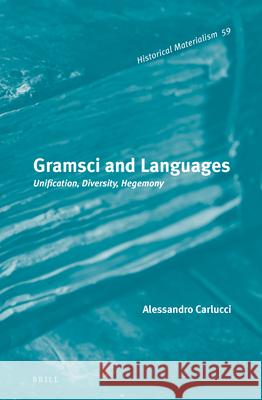
Alessandro Carlucci
Gramsci and Languages: Unification, Diversity, Hegemony Alessandro Carlucci 9789004231115 Brill Academic Publishers - książkaWidoczna okładka, to zdjęcie poglądowe, a rzeczywista szata graficzna może różnić się od prezentowanej.

Gramsci and Languages: Unification, Diversity, Hegemony

ISBN-13: 9789004231115 / Angielski / Twarda / 2013 / 272 str.

Alessandro Carlucci
cena 583,53
(netto: 555,74 VAT:  5%)

Najniższa cena z 30 dni: 583,53
Termin realizacji zamówienia:
ok. 30 dni roboczych
Bez gwarancji dostawy przed świętami

Darmowa dostawa!

Antonio Gramsci (1891-1937) is one of the most translated Italian authors of all time. After the Second World War his thought became increasingly influential, and remained relevant throughout the second half of the century. Today, it is generally agreed that his Marxism has highly original and personal features, as confirmed by the fact that his international influence has continued to grow since the fall of the Berlin Wall and the collapse of the Soviet Union. Gramsci and Languages offers an explanation of this originality and traces the origins of certain specific features of Gramsci's political thought by looking at his lifelong interest in language, especially in questions of linguistic diversity and unification.


Kategorie:
Nauka, Ekonomia i biznes
Kategorie BISAC:
Political Science > Political Ideologies - Communism, Post-Communism & Socialism
Language Arts & Disciplines > Linguistics - General
Social Science > Antropologia
Wydawca:
Brill Academic Publishers
Seria wydawnicza:
Historical Materialism Book
Język:
Angielski
ISBN-13:
9789004231115
Rok wydania:
2013
Numer serii:
000458712
Ilość stron:
272
Oprawa:
Twarda
Wolumenów:
01

AWARDS
Gramsci and Languages by Alessandro Carlucci has been awarded the prestigious 'Giuseppe Sormani International Prize' for the best monograph on Antonio Gramsci (4th edition, 2012-2017). The book is one of the two 'ex aequo' winners.

REVIEWS
"Carlucci's study is a meticulous and at times brilliant exploration of Gramsci's relationship with the linguistic question [...] a very enjoyable and informative read for anyone passionate about Gramscian matters, and about language in a social context more generally."
Neelam Srivastava, Senior Lecturer in Postcolonial Literature at Newcastle University, H-Italy (March 2016).

"So much partial or misdirected work has recently appeared in English that appropriates Gramsci for its putative authority that Alessandro Carlucci (in Gramsci and Languages: Unification, Diversity, Hegemony ) has done yeoman work providing new background and readings of the still untranslated parts of The Prison Notebooks (Lawrence & Wishart [1971]) to show about Gramsci's lifelong interest in the interplay of culture, politics, and language. Carlucci places Gramsci's university studies in linguistics under Matteo Bartoli as cementing Gramsci's linkage of politics and language that came from his Sardinian origins. The nature of linguistic communication as a medium for controlling populations or possibility for contesting bourgeois hegemony remains an undertone to nearly all of Gramsci's Prison Notebooks . Carlucci's thorough review of linguistics in Gramsci has the benefit of knowing the entirety of the Prison Notebooks , which have unfortunately still remained largely untranslated. More importantly, Carlucci places these writings within the context of left debates of the time."
Professor Stephen Shapiro, University of Warwick, The Year's Work in Critical and Cultural Theory , Oxford University Press, 2014.

"The volume offers a comprehensive analysis of the interplay between political and linguistic reflections in the philosophy of Antonio Gramsci, during the diverse and very different periods of the life of this thinker and political leader. It begins in deepest Sardinia with a very young Gramsci, and passes through his experiences in Turin, Moscow and finally in prison. This comprehensive and meticulous close examination is claimed as the necessary methodology in the well-organised introduction (pp. 1-18) and, together with its ever compelling ideas, constitutes the volume's main contribution [...] The main merit of this volume is precisely that of bringing cohesion and unity to the study of a thinker who is first and foremost a political leader committed to action, but who in the end emerges as an important figure in the history of Italian linguistic thought."
Luciano Giannelli, Rivista Italiana di Dialettologia , 2014.

" Gramsci and Languages is a very important addition to contemporary studies on Gramsci. It should be of interest also to philosophers (and philosophers of language in particular), and to scholars in social, cultural, and political studies."
Piotr Stalmaszczyk, Professor of English and General Linguistics at the University of Lodz, .

"With this book, Carlucci makes a significant contribution to the growing international scholarship and debates on Gramsci. The originality of Gramsci and Languages lies mainly in its ability to recast three fundamental aspects of Gramsci's political, intellectual and personal biography: the role of Sardinia, the influence of Italian and European historical linguistics on the development of Gramsci's thought, as well as his encounter with Bolshevism and Lenin's thought."
Giuseppe Vacca, President of the Fondazione Istituto Gramsci.

"This is a fascinating study of how Gramsci's interest in language shaped his politics and political theory. The reader will find important, newly discovered material on the influence of both Saussure and Soviet scholars of the 1920s. This book gives the clearest and most up to date account of Gramsci the philo

Preface

Introduction

Linguistic reflections as an integral part of Gramsci's legacy
Modern linguistics and the philosophy of praxis
Towards a better understanding of Gramsci's views
1. The limited number of writings usually considered
2. The risks involved in neglecting Gramsci's biography
3. Identifying sources and cultural links: a productive trend in recent research
4. Linguistic themes and the debates on Gramsci's Leninism
Diversity and unification: a few considerations in conclusion

1. Experiencing Linguistic Diversity and Cultural Unification
1.1. Sardinian in Gramsci's life
1.2. Gramsci's correspondence
1.3. The Sardinian years
1.4. Turin
1.5. The Sassari Brigade in Turin, April-July 1919
1.5.1. The arrival of the Brigade
1.5.2. The editorial board of L'Ordine Nuovo
1.5.3. The successful campaign among Sardinian soldiers
1.6. From Turin to the prison years
1.7. Gramsci's views on national linguistic unification
1.7.1. 'Every individual ... is a philosopher'
1.7.2. The shortcomings of monolingualism
1.7.3. Final remarks

2. Influences and Differences: The Formation of Gramsci's Views
2.1. Gramsci's direct and indirect sources in language studies
2.2. Echoes of Saussure's ideas
2.2.1. Grammar
2.2.2. Metaphors
2.2.3. Language planning
2.2.4. The penetration of Saussurean concepts into Italian intellectual culture
2.2.5. A possible channel of transmission: the Cours in Russia, 1917-1925
2.2.6. Final remarks
2.3. Language and social classes
2.3.1. Sociological linguistics and the Marxist critique of language
2.3.2. Bukharin
2.3.3. Sociolinguistic variation and the national question in the USSR
2.3.4. Grammar and language education for the popular masses
2.3.5. Final remarks
2.4. Glottopolitical aspects of Lenin's influence
2.4.1. Early Marxist approaches to language policies: Marx and Engels
2.4.2. The Second International
2.4.3. Lenin
2.4.4. Did Gramsci know Lenin's ideas on language?
2.4.5. Affinities
2.4.6. Jewish autonomy: a case of partial divergence
2.4.7. Final remarks
2.5. Rationalising and unifying linguistic communication
2.5.1. Soviet Esperantism
2.5.2. Proletarian culture
2.5.3. Sources and periodisation
2.5.4. Continuity and consistency of Gramsci's glottopolitical views
2.5.5. Final remarks: Soviet inputs and the development of Gramsci's views

3. Political Implications
3.1. Gramsci and the linguistics of his time
3.2. Language and politics in Gramsci's writings
3.3. The role of linguistic themes in shaping Gramsci's politics
3.3.1. Necessary conditions
3.3.2. Centres of irradiation
3.3.3. The Jacobins
3.3.4. Language and hegemony
3.4. Gramsci's specificity
3.4.1. A man 'in flesh and blood'
3.4.2. Gramsci's Marxism
3.4.3. Final remarks

Conclusions: Gramscian Links between Language and Politics
Gramsci in linguistics...
...and linguistics in Gramsci

Appendix: Gramsci's Legacy, 1937-2007
4.1. The reception of Gramsci's writings: the letters
4.2. Lost, unpublished and recently published material
4.2.1. Matteo Bartoli's glottology course of 1912-13
4.2.2. Gramsci's translation of Finck's work
4.2.3. Gramsci's comments on Panzini's Italian grammar
4.2.4. Early work on Manzoni
4.3. Pre-prison writings and prison notes
4.4. Gramsci's writings on language
4.5. Gramsci and linguistic disciplines
4.5.1. Early research
4.5.2. Exploring Gramsci's ideas on language
4.5.3. Using Gramsci's ideas on language
4.5.4. Gramsci's influence and its limits: some examples
4.5.5. Final remarks

References

Index

Alessandro Carlucci , Ph.D. (London, 2010), is Lector in Italian at the University of Oxford. He has published widely on Gramsci, and is the editor of New Approaches to Gramsci: Language, Philosophy and Politics , special issue of the Journal of Romance Studies (2012).


Udostępnij

Facebook - konto krainaksiazek.pl


Opinie o Krainaksiazek.pl na Opineo.pl

Partner Mybenefit

Krainaksiazek.pl w programie rzetelna firma Krainaksiaze.pl - płatności przez paypal

Czytaj nas na:

Facebook - krainaksiazek.pl
  • książki na zamówienie
  • granty
  • książka na prezent
  • kontakt
  • pomoc
  • opinie
  • regulamin
  • polityka prywatności

Zobacz:

  • Księgarnia czeska

  • Wydawnictwo Książkowe Klimaty

1997-2025 DolnySlask.com Agencja Internetowa

© 1997-2022 krainaksiazek.pl
     
KONTAKT | REGULAMIN | POLITYKA PRYWATNOŚCI | USTAWIENIA PRYWATNOŚCI
Zobacz: Księgarnia Czeska | Wydawnictwo Książkowe Klimaty | Mapa strony | Lista autorów
KrainaKsiazek.PL - Księgarnia Internetowa

Polityka prywatnosci - link
Krainaksiazek.pl - płatnośc Przelewy24
Przechowalnia Przechowalnia






