• Wyszukiwanie zaawansowane
  • Kategorie
  • Kategorie BISAC
  • Książki na zamówienie
  • Promocje
  • Granty
  • Książka na prezent
  • Opinie
  • Pomoc
  • Załóż konto
  • Zaloguj się

Geostatistical Functional Data Analysis » książka


zaloguj się | załóż konto
Logo Krainaksiazek.pl

koszyk

konto

szukaj
topmenu
Księgarnia internetowa
Szukaj
Książki na zamówienie
Promocje
Granty
Książka na prezent
Moje konto
Pomoc
 
 
Wyszukiwanie zaawansowane
Pusty koszyk
Bezpłatna dostawa dla zamówień powyżej 20 złBezpłatna dostawa dla zamówień powyżej 20 zł

Kategorie główne

• Nauka
 [2949965]
• Literatura piękna
 [1857847]

  więcej...
• Turystyka
 [70818]
• Informatyka
 [151303]
• Komiksy
 [35733]
• Encyklopedie
 [23180]
• Dziecięca
 [617748]
• Hobby
 [139972]
• AudioBooki
 [1650]
• Literatura faktu
 [228361]
• Muzyka CD
 [398]
• Słowniki
 [2862]
• Inne
 [444732]
• Kalendarze
 [1620]
• Podręczniki
 [167233]
• Poradniki
 [482388]
• Religia
 [509867]
• Czasopisma
 [533]
• Sport
 [61361]
• Sztuka
 [243125]
• CD, DVD, Video
 [3451]
• Technologie
 [219309]
• Zdrowie
 [101347]
• Książkowe Klimaty
 [123]
• Zabawki
 [2362]
• Puzzle, gry
 [3791]
• Literatura w języku ukraińskim
 [253]
• Art. papiernicze i szkolne
 [7933]
Kategorie szczegółowe BISAC

Geostatistical Functional Data Analysis

ISBN-13: 9781119387848 / Angielski / Twarda / 2021 / 448 str.
Jorge Mateu Mahiques;Ramon Giraldo
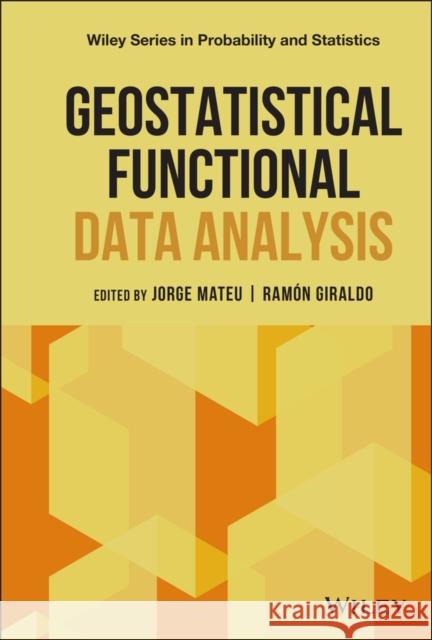
Geostatistical Functional Data Analysis Jorge Mateu Mahiques Ramon Giraldo  9781119387848 Wiley-Blackwell (an imprint of John Wiley & S - książkaWidoczna okładka, to zdjęcie poglądowe, a rzeczywista szata graficzna może różnić się od prezentowanej.

Geostatistical Functional Data Analysis

ISBN-13: 9781119387848 / Angielski / Twarda / 2021 / 448 str.

Jorge Mateu Mahiques;Ramon Giraldo
cena 508,06 zł
(netto: 483,87 VAT:  5%)

Najniższa cena z 30 dni: 502,87 zł
Termin realizacji zamówienia:
ok. 30 dni roboczych
Bez gwarancji dostawy przed świętami

Darmowa dostawa!

This book presents a unified approach to modelling functional data when spatial and spatio-temporal correlations are present. The editors link together for the first time the wide research areas of geostatistics and functional data analysis to provide the reader with a new area called geostatistical functional data analysis that will bring new insights and new open questions to researchers coming from both scientific fields. Leading experts in the field, the Editors have put together a collection of chapters covering state-of-the-art methods in this area. The individual chapters combine formal statements of the results including mathematical proofs with informal and naive statements of classical and new results.This book serves the scientific community to know what has been done so far, and to know what type of open questions need of future answers. After an introduction and brief overview, the book includes the following: A detailed exposition of the spatial kriging methodology when dealing with functions. A detailed exposition of more classical statistical techniques already adapted to the functional case and now extended in the right way to handle spatial correlations. Learning ANOVA, regression, clustering methods is crucial for a correct use of the statistical methods when the spatial correlation is present among a collection of curves sampled in a region. A thorough guide to understanding similarities and differences between spatio-temporal data analysis and functional data analysis. The reader will be guided in terms of modelling and computational issues. The information here allows the reader not only to fully understand kriging methods, but to use the most innovative functional methods adapted to spatially correlated functions, to deal with spatio-temporal datasets from a functional perspective, and to being able to handle massive databases from a more computational perspective. This book provides a complete an up-to-date account to deal with functional data that is spatially correlated, but also includes the most innovative developments in different open avenues in this field.


Kategorie:
Nauka, Matematyka
Kategorie BISAC:
Social Science > Statistics
Science > Earth Sciences - Geology
Mathematics > Prawdopodobieństwo i statystyka
Wydawca:
Wiley-Blackwell (an imprint of John Wiley & S
Język:
Angielski
ISBN-13:
9781119387848
Rok wydania:
2021
Numer serii:
000906604
Ilość stron:
448
Oprawa:
Twarda
Wolumenów:
01
Dodatkowe informacje:
Bibliografia

List of Contributors xiiiForeword xvi1 Introduction to Geostatistical Functional Data Analysis 1Jorge Mateu and Ramón Giraldo1.1 Spatial Statistics 11.2 Spatial Geostatistics 71.2.1 Regionalized Variables 71.2.2 Random Functions 71.2.3 Stationarity and Intrinsic Hypothesis 91.3 Spatiotemporal Geostatistics 121.3.1 Relevant Spatiotemporal Concepts 121.3.2 Spatiotemporal Kriging 161.3.3 Spatiotemporal Covariance Models 171.4 Functional Data Analysis in Brief 18References 22Part I Mathematical and Statistical Foundations 272 Mathematical Foundations of Functional Kriging in Hilbert Spaces and Riemannian Manifolds 29Alessandra Menafoglio, Davide Pigoli, and Piercesare Secchi2.1 Introduction 292.2 Definitions and Assumptions 302.3 Kriging Prediction in Hilbert Space: A Trace Approach 332.3.1 Ordinary and Universal Kriging in Hilbert Spaces 332.3.2 Estimating the Drift 362.3.3 An Example: Trace-Variogram in Sobolev Spaces 372.3.4 An Application to Nonstationary Prediction of Temperatures Profiles 392.4 An Operatorial Viewpoint to Kriging 422.5 Kriging for Manifold-Valued Random Fields 452.5.1 Residual Kriging 452.5.2 An Application to Positive Definite Matrices 472.5.3 Validity of the Local Tangent Space Approximation 492.6 Conclusion and Further Research 53References 533 Universal, Residual, and External Drift Functional Kriging 55Maria Franco-Villoria and Rosaria Ignaccolo3.1 Introduction 563.2 Universal Kriging for Functional Data (UKFD) 563.3 Residual Kriging for Functional Data (ResKFD) 583.4 Functional Kriging with External Drift (FKED) 603.5 Accounting for Spatial Dependence in Drift Estimation 613.5.1 Drift Selection 623.6 Uncertainty Evaluation 623.7 Implementation Details in R 643.7.1 Example: Air Pollution Data 643.8 Conclusions 69References 714 Extending Functional Kriging When Data Are Multivariate Curves: Some Technical Considerations and Operational Solutions 73David Nerini, Claude Manté, and Pascal Monestiez4.1 Introduction 734.2 Principal Component Analysis for Curves 744.2.1 Karhunen-Loève Decomposition 744.2.2 Dealing with a Sample 764.3 Functional Kriging in a Nutshell 784.3.1 Solution Based on Basis Functions 794.3.2 Estimation of Spatial Covariances 814.4 An Example with the Precipitation Observations 824.4.1 Fitting Variogram Model 834.4.2 Making Prediction 834.5 Functional Principal Component Kriging 854.6 Multivariate Kriging with Functional Data 884.6.1 Multivariate FPCA 914.6.2 MFPCA Displays 934.6.3 Multivariate Functional Principal Component Kriging 944.6.4 Mixing Temperature and Precipitation Curves 964.7 Discussion 984.A Appendices 1004.A.1 Computation of the Kriging Variance 100References 1025 Geostatistical Analysis in Bayes Spaces: Probability Densities and Compositional Data 104Alessandra Menafoglio, Piercesare Secchi, and Alberto Guadagnini5.1 Introduction and Motivations 1045.2 Bayes Hilbert Spaces: Natural Spaces for Functional Compositions 1055.3 A Motivating Case Study: Particle-Size Data in Heterogeneous Aquifers -Data Description 1085.4 Kriging Stationary Functional Compositions 1105.4.1 Model Description 1105.4.2 Data Preprocessing 1125.4.3 An Example of Application 1135.4.4 Uncertainty Assessment 1165.5 Analyzing Nonstationary Fields of FCs 1195.6 Conclusions and Perspectives 123References 1246 Spatial Functional Data Analysis for Probability Density Functions: Compositional Functional Data vs. Distributional Data Approach 128Elvira Romano, Antonio Irpino, and Jorge Mateu6.1 FDA and SDA When Data Are Densities 1306.1.1 Features of Density Functions as Compositional Functional Data 1316.1.2 Features of Density Functions as Distributional Data 1356.2 Measures of Spatial Association for Georeferenced Density Functions 1386.2.1 Identification of Spatial Clusters by Spatial Association Measures for Density Functions 1396.3 Real Data Analysis 1416.3.1 The SDA Distributional Approach 1436.3.2 The Compositional-Functional Approach 1456.3.3 Discussion 1476.4 Conclusion 149Acknowledgments 151References 151Part II Statistical Techniques for Spatially Correlated Functional Data 1557 Clustering Spatial Functional Data 157Vincent Vandewalle, Cristian Preda, and Sophie Dabo-Niang7.1 Introduction 1577.2 Model-Based Clustering for Spatial Functional Data 1587.2.1 The Expectation-Maximization (EM) Algorithm 1607.2.1.1 E Step 1617.2.1.2 M Step 1617.2.2 Model Selection 1617.3 Descendant Hierarchical Classification (HC) Based on Centrality Methods 1627.3.1 Methodology 1647.4 Application 1657.4.1 Model-Based Clustering 1677.4.2 Hierarchical Classification 1697.5 Conclusion 171References 1728 Nonparametric Statistical Analysis of Spatially Distributed Functional Data 175Sophie Dabo-Niang, Camille Ternynck, Baba Thiam, and Anne-Françoise Yao8.1 Introduction 1758.2 Large Sample Properties 1788.2.1 Uniform Almost Complete Convergence 1808.3 Prediction 1818.4 Numerical Results 1848.4.1 Bandwidth Selection Procedure 1848.4.2 Simulation Study 1858.5 Conclusion 1938.A Appendix 1948.A.1 Some Preliminary Results for the Proofs 1948.A.2 Proofs 1968.A.2.1 Proof of Theorem 8.1 1968.A.2.2 Proof of Lemma A.3 1968.A.2.3 Proof of Lemma A.4 1968.A.2.4 Proof of Lemma A.5 2018.A.2.5 Proof of Lemma A.6 2018.A.2.6 Proof of Theorem 8.2 202References 2079 A Nonparametric Algorithm for Spatially Dependent Functional Data: Bagging Voronoi for Clustering, Dimensional Reduction, and Regression 211Valeria Vitelli, Federica Passamonti, Simone Vantini, and Piercesare Secchi9.1 Introduction 2119.2 The Motivating Application 2129.2.1 Data Preprocessing 2149.3 The Bagging Voronoi Strategy 2169.4 Bagging Voronoi Clustering (BVClu) 2189.4.1 BVClu of the Telecom Data 2219.4.1.1 Setting the BVClu Parameters 2219.4.1.2 Results 2239.5 Bagging Voronoi Dimensional Reduction (BVDim) 2239.5.1 BVDim of the Telecom Data 2259.5.1.1 Setting the BVDim Parameters 2259.5.1.2 Results 2279.6 Bagging Voronoi Regression (BVReg) 2319.6.1 Covariate Information: The DUSAF Data 2329.6.2 BVReg of the Telecom Data 2349.6.2.1 Setting the BVReg Parameters 2349.6.2.2 Results 2359.7 Conclusions and Discussion 236References 23910 Nonparametric Inference for Spatiotemporal Data Based on Local Null Hypothesis Testing for Functional Data 242Alessia Pini and Simone Vantini10.1 Introduction 24210.2 Methodology 24410.2.1 Comparing Means of Two Functional Populations 24410.2.2 Extensions 24810.2.2.1 Multiway FANOVA 24910.3 Data Analysis 25010.4 Conclusion and FutureWorks 256References 25811 Modeling Spatially Dependent Functional Data by Spatial Regression with Differential Regularization 260Mara S. Bernardi and Laura M. Sangalli11.1 Introduction 26011.2 Spatial Regression with Differential Regularization for Geostatistical Functional Data 26411.2.1 A Separable Spatiotemporal Basis System 26511.2.2 Discretization of the Penalized Sum-of-Square Error Functional 26811.2.3 Properties of the Estimators 27111.2.4 Model Without Covariates 27311.2.5 An Alternative Formulation of the Model 27411.3 Simulation Studies 27411.4 An Illustrative Example: Study of the Waste Production in Venice Province 27811.4.1 The Venice Waste Dataset 27811.4.2 Analysis of Venice Waste Data by Spatial Regression with Differential Regularization 27911.5 Model Extensions 282References 28312 Quasi-maximum Likelihood Estimators for Functional Linear Spatial Autoregressive Models 286Mohamed-Salem Ahmed, Laurence Broze, Sophie Dabo-Niang, and Zied Gharbi12.1 Introduction 28612.2 Model 28812.2.1 Truncated Conditional Likelihood Method 29112.3 Results and Assumptions 29312.4 Numerical Experiments 29812.4.1 Monte Carlo Simulations 29812.4.2 Real Data Application 30512.5 Conclusion 31212.A Appendix 313Proof of Proposition 12.A.1 313Proof of Theorem 12.1 314Proof of Theorem 12.2 317Proof of Theorem 12.3 319Proof of Lemma 12.A.2 322Proof of Lemma 12.A.3 322Proof of Lemma 12.A.5 323References 32513 Spatial Prediction and Optimal Sampling for Multivariate Functional Random Fields 329Martha Bohorquez, Ramón Giraldo, and Jorge Mateu13.1 Background 32913.1.1 Multivariate Spatial Functional Random Fields 32913.1.2 Functional Principal Components 33013.1.3 The Spatial Random Field of Scores 33113.2 Functional Kriging 33213.2.1 Ordinary Functional Kriging (OFK) 33213.2.2 Functional Kriging Using Scalar Simple Kriging of the Scores (FKSK) 33313.2.3 Functional Kriging Using Scalar Simple Cokriging of the Scores (FKCK) 33313.3 Functional Cokriging 33613.3.1 Cokriging with Two Functional Random Fields 33613.3.2 Cokriging with P Functional Random Fields 33813.4 Optimal Sampling Designs for Spatial Prediction of Functional Data 34013.4.1 Optimal Spatial Sampling for OFK 34113.4.2 Optimal Spatial Sampling for FKSK 34113.4.3 Optimal Spatial Sampling for FKCK 34213.4.4 Optimal Spatial Sampling for Functional Cokriging 34313.5 Real Data Analysis 34413.6 Discussion and Conclusions 348References 348Part III Spatio-Temporal Functional Data 35114 Spatio-temporal Functional Data Analysis 353Gregory Bopp, John Ensley, Piotr Kokoszka, and Matthew Reimherr14.1 Introduction 35314.2 Randomness Test 35514.3 Change-Point Test 35914.4 Separability Tests 36214.5 Trend Tests 36514.6 Spatio-Temporal Extremes 369References 37315 A Comparison of Spatiotemporal and Functional Kriging Approaches 375Johan Strandberg, Sara Sjöstedt de Luna, and Jorge Mateu15.1 Introduction 37515.2 Preliminaries 37615.3 Kriging 37815.3.1 Functional Kriging 37815.3.1.1 Ordinary Kriging for Functional Data 37815.3.1.2 Pointwise Functional Kriging 38015.3.1.3 Functional Kriging Total Model 38115.3.2 Spatiotemporal Kriging 38215.3.3 Evaluation of Kriging Methods 38415.4 A Simulation Study 38515.4.1 Separable 38515.4.2 Non-separable 39015.4.3 Nonstationary 39115.5 Application: Spatial Prediction of Temperature Curves in the Maritime Provinces of Canada 39415.6 Concluding Remarks 400References 40016 From Spatiotemporal Smoothing to Functional Spatial Regression: a Penalized Approach 403Maria Durban, Dae-Jin Lee, María del Carmen Aguilera Morillo, and Ana M. Aguilera16.1 Introduction 40316.2 Smoothing Spatial Data via Penalized Regression 40416.3 Penalized Smooth Mixed Models 40716.4 P-spline Smooth ANOVA Models for Spatial and Spatiotemporal data 40916.4.1 Simulation Study 41116.5 P-spline Functional Spatial Regression 41316.6 Application to Air Pollution Data 41516.6.1 Spatiotemporal Smoothing 41616.6.2 Spatial Functional Regression 416Acknowledgments 421References 421Index 424

Jorge Mateu is Full Professor of Statistics at the Department of Mathematics of University Jaume I of Castellon. His research focuses on stochastic processes with a particular interest in spatial and spatio-temporal point processes and geostatistics.Ramón Giraldo is Full Professor of Statistics at the Department of Statistics at the Universidad Nacional de Colombia. His research focuses on non-parametric statistics, functional data analysis, and spatial and spatio-temporal geostatistics.


Udostępnij

Facebook - konto krainaksiazek.pl


Opinie o Krainaksiazek.pl na Opineo.pl

Partner Mybenefit

Krainaksiazek.pl w programie rzetelna firma Krainaksiaze.pl - płatności przez paypal

Czytaj nas na:

Facebook - krainaksiazek.pl
  • książki na zamówienie
  • granty
  • książka na prezent
  • kontakt
  • pomoc
  • opinie
  • regulamin
  • polityka prywatności

Zobacz:

  • Księgarnia czeska

  • Wydawnictwo Książkowe Klimaty

1997-2025 DolnySlask.com Agencja Internetowa

© 1997-2022 krainaksiazek.pl
     
KONTAKT | REGULAMIN | POLITYKA PRYWATNOŚCI | USTAWIENIA PRYWATNOŚCI
Zobacz: Księgarnia Czeska | Wydawnictwo Książkowe Klimaty | Mapa strony | Lista autorów
KrainaKsiazek.PL - Księgarnia Internetowa

Polityka prywatnosci - link
Krainaksiazek.pl - płatnośc Przelewy24
Przechowalnia Przechowalnia





