• Wyszukiwanie zaawansowane
  • Kategorie
  • Kategorie BISAC
  • Książki na zamówienie
  • Promocje
  • Granty
  • Książka na prezent
  • Opinie
  • Pomoc
  • Załóż konto
  • Zaloguj się

Geospatial Technologies and Homeland Security: Research Frontiers and Future Challenges » książka


zaloguj się | załóż konto
Logo Krainaksiazek.pl

koszyk

konto

szukaj
topmenu
Księgarnia internetowa
Szukaj
Książki na zamówienie
Promocje
Granty
Książka na prezent
Moje konto
Pomoc
 
 
Wyszukiwanie zaawansowane
Pusty koszyk
Bezpłatna dostawa dla zamówień powyżej 20 złBezpłatna dostawa dla zamówień powyżej 20 zł

Kategorie główne

• Nauka
 [2939893]
• Literatura piękna
 [1808953]

  więcej...
• Turystyka
 [70366]
• Informatyka
 [150555]
• Komiksy
 [35137]
• Encyklopedie
 [23160]
• Dziecięca
 [608786]
• Hobby
 [136447]
• AudioBooki
 [1631]
• Literatura faktu
 [225099]
• Muzyka CD
 [360]
• Słowniki
 [2914]
• Inne
 [442115]
• Kalendarze
 [1068]
• Podręczniki
 [166599]
• Poradniki
 [468390]
• Religia
 [506548]
• Czasopisma
 [506]
• Sport
 [61109]
• Sztuka
 [241608]
• CD, DVD, Video
 [3308]
• Technologie
 [218981]
• Zdrowie
 [98614]
• Książkowe Klimaty
 [124]
• Zabawki
 [2174]
• Puzzle, gry
 [3275]
• Literatura w języku ukraińskim
 [260]
• Art. papiernicze i szkolne
 [7376]
Kategorie szczegółowe BISAC

Geospatial Technologies and Homeland Security: Research Frontiers and Future Challenges

ISBN-13: 9781402083396 / Angielski / Twarda / 2008 / 360 str.
Sui, Daniel
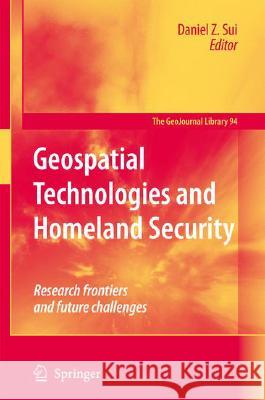
Geospatial Technologies and Homeland Security: Research Frontiers and Future Challenges Sui, Daniel 9781402083396 KLUWER ACADEMIC PUBLISHERS GROUP - książkaWidoczna okładka, to zdjęcie poglądowe, a rzeczywista szata graficzna może różnić się od prezentowanej.

Geospatial Technologies and Homeland Security: Research Frontiers and Future Challenges

ISBN-13: 9781402083396 / Angielski / Twarda / 2008 / 360 str.

Sui, Daniel
cena 602,40
(netto: 573,71 VAT:  5%)

Najniższa cena z 30 dni: 578,30
Termin realizacji zamówienia:
ok. 22 dni roboczych.

Darmowa dostawa!

Homeland security and context In the Geographical Dimensions of Terrorism (GDOT) (Cutter et al. 2003), the first book after 9/11 to address homeland security and geography, we developed several thematic research agendas and explored intersections between geographic research and the importance of context, both geographical and political, in relationship to the concepts of terrorism and security. It is good to see that a great deal of new thought and research continues to flow from that initial research agenda, as illustrated by many of the papers of this new book, entitled Geospatial Technologies and Homeland Security: Research Frontiers and Future Challenges. Context is relevant not only to understanding homeland security issues broadly, but also to the conduct of research on geospatial technologies. It is impossible to understand the implications of a homeland security strategy, let alone hope to make predictions, conduct meaningful modeling and research, or assess the value and dangers of geospatial technologies, without consideration of overarching political, social, economic, and geographic contexts within which these questions are posed.


Kategorie:
Nauka, Geografia
Kategorie BISAC:
Science > Earth Sciences - Geography
Science > Earth Sciences - Geology
Technology & Engineering > Remote Sensing & Geographic Information Systems
Wydawca:
KLUWER ACADEMIC PUBLISHERS GROUP
Seria wydawnicza:
Geojournal Library
Język:
Angielski
ISBN-13:
9781402083396
Rok wydania:
2008
Wydanie:
2008
Numer serii:
000044037
Ilość stron:
360
Waga:
0.72 kg
Wymiary:
23.39 x 15.6 x 2.24
Oprawa:
Twarda
Wolumenów:
01
Dodatkowe informacje:
Bibliografia
Wydanie ilustrowane

Dedication page/Acknowledgement,- Biography of the editor and contributors,- Foreword: Douglas Richardson,- Chapter 1. Geospatial technologies and homeland security: An overview: Daniel Z. Sui,- Chapter 2. Remote sensing and GIS as counterterrorism tools for homeland security: The case of Afghanistan: John (Jack) Shroder,- Chapter 3. Economic impacts of terrorist attacks and natural disasters: Case studies of Los Angles and Houston: Qisheng Pan et al,- Chapter 4. From crime analysis to homeland security: A role for neighborhood profiling?: David I Ashby et al,- Chapter 5. Measuring and mapping conflict-related deaths and segregation: Lessons from the Belfast ‘troubles’: Victor Mesev et al ,- Chapter 6. Internal security for communities: A spatial analysis of the effectiveness of sex offender laws: Douglas F. Wunneburger et al ,- Chapter 7. Remote sensing-based damage assessment for homeland security: Anthony M. Filippi,- Chapter 8. Estimating flood damage in Texas using GIS: Predictors, consequences, and policy implications: Samuel D. Brody and Sammy Zahran,- Chapter 9. Agent-based modeling and evacuation planning: F. Benjamin Zhan and Xuwei Chen,- Chapter 10. Building evacuation in emergencies: A review and interpretation of software for simulating pedestrian egress: Christian J.E. Castle and Paul A. Longley,- Chapter 11. High-resolution coastal elevation data: The key to planning for storm surge and sea level rise: Mark Monmonier,- Chapter 12. Remote sensing and GIS applications for precision area-wide pest management: Implications for homeland security: Yanbo Huang et al,- Chapter 13. Spatial epidemiology: Where have we come in 150 years?: Michael Ward,- Chapter 14. The role of geosurveillance and security in the politics of fear: Jeremy W. Crampton,- Chapter 15. Mapping the under-scrutinized: The West German census boycott movement of 1987 and the dangers of information-based Security: Matthew Hannah,- Chapter 16. The Importance of spatial thinking in anuncertain world: Robert S. Bednarz and Sarah W. Bednarz,- Chapter 17. GIS and homeland security education: Creating a better tomorrow in our classrooms today: David McIntye and Andrew Klein,- Chapter 18. Geospatial technologies and homeland security: Challenges and opportunities: Michael F. Goodchild,- Index

This edited volume, based upon the papers presented during the "Geospatial Technologies and Homeland Security Symposium" on Nov. 15, 2006, presents an overview of the latest development of geospatial technologies (including, but not limited to, GIS, RS, GPS, LBS, spatial analysis and modelling etc.) and their applications in piecing together the complex puzzles facing the challenges of the homeland security research and education. A wide variety of topics, ranging from conceptual and methodological to technical and social/legal issues, are covered by contributions from leading academic researchers.

This book will be of great interest to researchers and practitioners in both GIS and homeland security. It could also serve as a reference text for advanced GIS courses at the undergraduate level or main text for seminars in GIScience.


Udostępnij

Facebook - konto krainaksiazek.pl


Opinie o Krainaksiazek.pl na Opineo.pl

Partner Mybenefit

Krainaksiazek.pl w programie rzetelna firma Krainaksiaze.pl - płatności przez paypal

Czytaj nas na:

Facebook - krainaksiazek.pl
  • książki na zamówienie
  • granty
  • książka na prezent
  • kontakt
  • pomoc
  • opinie
  • regulamin
  • polityka prywatności

Zobacz:

  • Księgarnia czeska

  • Wydawnictwo Książkowe Klimaty

1997-2026 DolnySlask.com Agencja Internetowa

© 1997-2022 krainaksiazek.pl
     
KONTAKT | REGULAMIN | POLITYKA PRYWATNOŚCI | USTAWIENIA PRYWATNOŚCI
Zobacz: Księgarnia Czeska | Wydawnictwo Książkowe Klimaty | Mapa strony | Lista autorów
KrainaKsiazek.PL - Księgarnia Internetowa

Polityka prywatnosci - link
Krainaksiazek.pl - płatnośc Przelewy24
Przechowalnia Przechowalnia






