• Wyszukiwanie zaawansowane
  • Kategorie
  • Kategorie BISAC
  • Książki na zamówienie
  • Promocje
  • Granty
  • Książka na prezent
  • Opinie
  • Pomoc
  • Załóż konto
  • Zaloguj się

Geographies of Global Issues: Change and Threat » książka


zaloguj się | załóż konto
Logo Krainaksiazek.pl

koszyk

konto

szukaj
topmenu
Księgarnia internetowa
Szukaj
Książki na zamówienie
Promocje
Granty
Książka na prezent
Moje konto
Pomoc
 
 
Wyszukiwanie zaawansowane
Pusty koszyk
Bezpłatna dostawa dla zamówień powyżej 20 złBezpłatna dostawa dla zamówień powyżej 20 zł

Kategorie główne

• Nauka
 [2946912]
• Literatura piękna
 [1852311]

  więcej...
• Turystyka
 [71421]
• Informatyka
 [150889]
• Komiksy
 [35717]
• Encyklopedie
 [23177]
• Dziecięca
 [617324]
• Hobby
 [138808]
• AudioBooki
 [1671]
• Literatura faktu
 [228371]
• Muzyka CD
 [400]
• Słowniki
 [2841]
• Inne
 [445428]
• Kalendarze
 [1545]
• Podręczniki
 [166819]
• Poradniki
 [480180]
• Religia
 [510412]
• Czasopisma
 [525]
• Sport
 [61271]
• Sztuka
 [242929]
• CD, DVD, Video
 [3371]
• Technologie
 [219258]
• Zdrowie
 [100961]
• Książkowe Klimaty
 [124]
• Zabawki
 [2341]
• Puzzle, gry
 [3766]
• Literatura w języku ukraińskim
 [255]
• Art. papiernicze i szkolne
 [7810]
Kategorie szczegółowe BISAC

Geographies of Global Issues: Change and Threat

ISBN-13: 9789814585538 / Angielski / Twarda / 2016 / 582 str.
Nicola Ansell; Natascha Klocker; Tracey Skelton
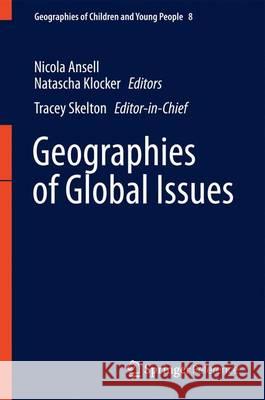
Geographies of Global Issues: Change and Threat Ansell, Nicola 9789814585538 Springer - książkaWidoczna okładka, to zdjęcie poglądowe, a rzeczywista szata graficzna może różnić się od prezentowanej.

Geographies of Global Issues: Change and Threat

ISBN-13: 9789814585538 / Angielski / Twarda / 2016 / 582 str.

Nicola Ansell; Natascha Klocker; Tracey Skelton
cena 1210,50
(netto: 1152,86 VAT:  5%)

Najniższa cena z 30 dni: 1156,64
Termin realizacji zamówienia:
ok. 22 dni roboczych
Bez gwarancji dostawy przed świętami

Darmowa dostawa!

Volume 8 explores children and young people s lives at a time of rapid and profound change, through the lens of diverse global processes: economic globalisation, environmental degradation, international development, cultural change, climate change and environmental hazards. Today s children and young people are growing up in a world that is rapidly changing and very different to that experienced by previous generations. Contemporary social, economic and environmental challenges make children and young people vulnerable and expose them to harm. Equally, they compel them to become instigators of change across geographical scales, from the household to the globe. Children and young people need to be adaptive and resourceful: economically, socially and emotionally. This volume is divided into two substantive sections. Chapters in the first section explore global economic changes and instabilities that are altering patterns of work, compelling children to take on new economic responsibilities and reshaping childcare arrangements. Several chapters address the ways in which global processes shape young people s subjectivities, with media, internet and education encouraging children and youth to view themselves as both entrepreneurs and global citizens. Other chapters consider the policies and development interventions implemented by global organisations and national governments. These can have unintended consequences because they are rooted in a normative discourse of a global child that bears little relation to lived realities. Chapters in the second section foreground children and young people s contributions to environmental issues and debates. Children and young people are affected by environmental change: by pollution, environmental hazards and climate change. They suffer displacement, ill-health and anxiety about the future. They are also intimately attached to and knowledgeable about their local environments. Children and young people actively shape their environments, yet their lives remain powerfully influenced by today s decision-makers. The window of opportunity to avoid catastrophic climate change is small. Evidence of children and young people s environmental knowledge and activism does not obviate the need for adults to take decisive action, now, to ensure a viable environment for future generations."


Kategorie:
Nauka, Ekonomia i biznes
Kategorie BISAC:
Social Science > Human Geography
Social Science > Children's Studies
Social Science > Rodzina w teorii socjologicznej
Wydawca:
Springer
Seria wydawnicza:
Geographies of Children and Young People
Język:
Angielski
ISBN-13:
9789814585538
Rok wydania:
2016
Wydanie:
2016
Ilość stron:
582
Waga:
1.27 kg
Wymiary:
24.18 x 16.26 x 3.63
Oprawa:
Twarda
Wolumenów:
01
Dodatkowe informacje:
Wydanie ilustrowane

                SECTION 1: GLOBALISATION: PROCESSES AND IMPACTS               

1              Political economy of children’s work: economic restructuring, the coffee trade and social reproduction in post-Socialist Ethiopia

2              College Entrepreneurs in India: The Fortune at the Bottom of a Pyramid Scheme

3              Youth Entrepreneurship and Socioeconomic Change in Urban Ghana

4              Mega-Sporting Events, Rights and Children’s Everyday Lives: Exploring the Impact of the Brazil 2014 FIFA World Cup

5              Childcare Arrangements of Burmese Migrant Workers in Thailand

6              Migrant Domestic Workers and the Globalization of Childcare

7              Football as a Vehicle for Development: Lessons from Male Ghanaian Youth

8              Young People’s Construction of Global Citizenship Through Internet Use

9              Education, International Volunteering,and Citizenship: Young People’s Subjectivities and Geographies of Development

10           Africa’s Vulnerable Children and the Millennium Development Goals:Experiences and Interventions in Malawi

11           Childhood in ‘Crisis’ in the Era of AIDS: Risk, Orphanhood, and policy in Southern Africa

12           Governing the Global Child: Bio-politics and Liberal Subjectivities

13           Globalizing Education from Christian Missionaries to Corporate Finance: Global Actors, Global Agendas, and the Shaping of Global Childhoods

SECTION 2: ENVIRONMENTAL KNOWLEDGE, CHANGE AND ISSUES          

14           Child Health and Survival in a Changing Climate: Vulnerability, Mitigation, and Adaptation

15           Children, Young People and Climate Change: A Gender Perspective

16           Young People and Global Climate Change: Emotions, Coping, and Engagement in Everyday Life

17           Environmental Ascription: Industrial Pollution, Place, and Children’s Health and Learning in the USA

18           Disasters, Displacement, and Disruption: Children and Young People’s Experience of Spatial Change Following Disasters

19           Children, Climate Change, and the Intergenerational Right to a Viable Future

20           Global Energy Stress: Challenges and Opportunities for Child-Friendly Cities

21           Living in the Future: Environmental Concerns, Parenting, and Low-Impact Lifestyles

22           Intergenerational Sharing of Indigenous Environmental Knowledge in the Torres Strait

23           Changing Aspirations, Education, and Migration: Young People’s Declining Agroecological Knowledge in Rural Asia

24           Children’s Place Encounters: Place-Based Participatory Research to Design a Child-Friendly and Sustainable Urban Development

25           Skateboarding as Social and Environmental Praxis: Navigating a Sustainable Future

26           Young People in the Global North: Environmental Heroes or Pleasure-Seeking Consumers

Dr. Nicola Ansell is Reader in Human Geography at Brunel University London where she runs a Masters programme on Children, Youth and International Development. Her research interests focus on social and cultural change in the lives of young people in the Global South. Dr Ansell is particularly interested in the ways in which global social and economic processes play out in young people’s lives, and in how young people respond to and remake these processes. These themes are explored in her book Children, Youth and Development, the second edition of which is due to be published by Routledge in 2016.


Empirically, Dr. Ansell’s research has explored the impacts of education and of the AIDS pandemic in southern African countries, notably Lesotho, Malawi and Zimbabwe. Her research on schooling has demonstrated the limited value of secondary education for many rural girls. Findings are reported in journals including Geoforum (‘‘Of course we must be equal, but …’: imagining gendered futures in two rural Southern African secondary schools’) and Youth and Society (‘Secondary schooling and rural youth transitions in Lesotho and Zimbabwe’). She has drawn attention to the ways in which AIDS has led to children’s migration, and the impacts of such migration on children’s lives, in articles published in Environment and Planning D (‘Children’s experiences of migration in Southern Africa: moving in the wake of AIDS’) and The Professional Geographer (‘Fluid households, complex families: the impacts of children’s migration as a response to HIV/AIDS in southern Africa’). She has also revealed the (limited) impacts of AIDS on young people’s rural livelihoods articles in Transitions of the Institute of British Geographers and Children’s Geographies (‘Reconceptualising temporality in young lives: exploring young people’s current and future livelihoods in AIDS-affected southern Africa’) and Environment and Planning A (‘Spaces, times and critical moments: a relational time-space analysis of the impacts of AIDS on rural youth in Malawi and Lesotho’). This research has not only mapped young people’s experiences in contemporary southern Africa, but has sought to theorise both spatial and temporal aspects of these experiences.


Dr. Ansell is currently running two collaborative research projects. The first explores the impacts of social cash transfers (such as child grants and old age pensions) on young people in Malawi and Lesotho. Such transfers are likely to shape relations of age, gender and generation, and as a consequence to affect young people’s experiences of poverty. The second project investigates the relationship between schooling and aspiration in remote rural areas of India, Laos and Lesotho. Organisations such as the World Bank increasingly see raising aspiration as a means of encouraging young people to engage more effectively with schooling. Yet there is widespread evidence that young people globally have high aspirations that cannot be fulfilled. The research seeks to develop a more nuanced understanding of aspiration.


Dr. Natascha Klocker is a Senior Lecturer in Human Geography in the School of Geography and Sustainable Communities at the University of Wollongong, Australia. Dr Klocker has published widely in the field of children and young people’s geographies, particularly on the topic of child domestic work. Her research has sought to question western assumptions that childhoods should appropriately be work-free. This work has been published in international journals including Children’s Geographies (including papers titled: ‘Struggling with child domestic work: what can a postcolonial perspective offer?’ and ‘Negotiating change: working with children and their employers to transform child domestic work in Iringa, Tanzania’) and Geoforum (‘Conducting sensitive research in the present and past tense: recounting the stories of current and former child domestic workers’).


Dr. Klocker’s research has also sought to prompt reflection on research methodologies, and the involvement of children and young people in participatory action research. Through this work she has aimed to encourage dialogue around the challenges of participatory action research, particularly when it is conducted with marginalised and disadvantaged children and young people. Most recently, Dr Klocker has encouraged reflection on the potential burdens that participatory action research can place on children and young people, and the importance of approaching such research with sensitivity in order to avoid further traumatising the children and young people involved. This work has also been published in international journals including Emotion, Space & Society (‘Participatory action research: The distress of (not) making a difference’) and the Journal of Geography in Higher Education (‘Doing participatory action research and doing a PhD: words of encouragement for prospective students’).

Dr. Klocker’s ongoing research activities are based in the Australian Centre for Cultural Environmental Research (AUSCCER) at the University of Wollongong, Australia. Her more recent publications in the field of children and young people’s geographies have focused on children and young people as agents of environmental change. Dr Klocker and her co-authors (Elyse Stanes and Professor Chris Gibson) have argued that the complexity of children and young people’s engagements with sustainability and environmentalism need to be better understood, and that children and young people have the capacity to be agents of environmental change – for better or worse. In addition to their chapter in Volume 8 of the Springer Major Reference Work, Geographies of Children and Young People (Geographies of Global Issues: Change and Threat), this research has been published in Geoforum (‘Young adult households and domestic sustainabilities’).

In addition to her current teaching and research, Dr. Klocker is Associate Editor of the journal Australian Geographer.

Tracey Skelton is Associate Professor of Human Geography in the Department of Geography at the National University of Singapore. She was previously Professor of Critical Geographies at the University of Loughborough in the UK. The essential elements of her research career focus on people who are socially, politically, and intellectually excluded. Her early work focused on the Caribbean and issues of gender and racial inequality, feminist geographies, and methodological analysis. She has contributed to culture and development debates, particularly through her longitudinal research on the island of Montserrat. Recently, A/P Skelton returned to this field of scholarship through research with volunteers and host organizations in Cambodia as part of a major comparative and collaborative project on development partnerships. She was the principal investigator of a major comparative urbanism research project on the livability, sustainability, and diversity of four Asian cities: Busan in South Korea, Hyderabad in India, Kunming in China, and Singapore.

A/P Skelton is a recognized international leader in the subdiscipline of children’s and young people’s geographies. In particular, her work has served to challenge the invisibility and marginalization of young people from geographic academic research at the same time as it has demonstrated the rich and varied ways in which young people live their lives both spatially and temporally alongside, but differently from, adults. Her research work has been funded by key research institutions such as the Economic and Social Research Council and the Arts and Humanities Research Council of the UK; the Faculty of Arts and Social Science Academic Research Fund and the Global Asia Institute, both of the National University of Singapore; the Australian Research Council; and the Social Science and Humanities Research Council of Canada.

A/P Skelton was a founding editorial board member of the international journal Children’s Geographies and has been the Viewpoints Editor since 2005 and became the Commissioning Editor for Asia in 2010. She is on the editorial boards of the following journals: Geoforum, the Singapore Journal of Tropical Geography, Geography Compass, and ACME: International Journal of Critical Geographies (open access). She has coauthored 2 books, edited 3 collections, guest-edited 2 special journal issues, and published more than 70 journal articles and chapters. She is a passionate teacher and graduate supervisor. She is committed to the politics of research dissemination in accessible formats, in particular to enable the participants in her research projects to understand and recognize their coproduction of knowledge whether through specialized small-scale workshops, translation of reports into local languages, or production of audiovisual materials.


Udostępnij

Facebook - konto krainaksiazek.pl


Opinie o Krainaksiazek.pl na Opineo.pl

Partner Mybenefit

Krainaksiazek.pl w programie rzetelna firma Krainaksiaze.pl - płatności przez paypal

Czytaj nas na:

Facebook - krainaksiazek.pl
  • książki na zamówienie
  • granty
  • książka na prezent
  • kontakt
  • pomoc
  • opinie
  • regulamin
  • polityka prywatności

Zobacz:

  • Księgarnia czeska

  • Wydawnictwo Książkowe Klimaty

1997-2025 DolnySlask.com Agencja Internetowa

© 1997-2022 krainaksiazek.pl
     
KONTAKT | REGULAMIN | POLITYKA PRYWATNOŚCI | USTAWIENIA PRYWATNOŚCI
Zobacz: Księgarnia Czeska | Wydawnictwo Książkowe Klimaty | Mapa strony | Lista autorów
KrainaKsiazek.PL - Księgarnia Internetowa

Polityka prywatnosci - link
Krainaksiazek.pl - płatnośc Przelewy24
Przechowalnia Przechowalnia






