• Wyszukiwanie zaawansowane
  • Kategorie
  • Kategorie BISAC
  • Książki na zamówienie
  • Promocje
  • Granty
  • Książka na prezent
  • Opinie
  • Pomoc
  • Załóż konto
  • Zaloguj się

Genetic Theory for Cubic Graphs » książka

zaloguj się | załóż konto
Logo Krainaksiazek.pl

koszyk

konto

szukaj
topmenu
Księgarnia internetowa
Szukaj
Książki na zamówienie
Promocje
Granty
Książka na prezent
Moje konto
Pomoc
 
 
Wyszukiwanie zaawansowane
Pusty koszyk
Bezpłatna dostawa dla zamówień powyżej 20 złBezpłatna dostawa dla zamówień powyżej 20 zł

Kategorie główne

• Nauka
 [2946600]
• Literatura piękna
 [1856966]

  więcej...
• Turystyka
 [72221]
• Informatyka
 [151456]
• Komiksy
 [35826]
• Encyklopedie
 [23190]
• Dziecięca
 [619653]
• Hobby
 [140543]
• AudioBooki
 [1577]
• Literatura faktu
 [228355]
• Muzyka CD
 [410]
• Słowniki
 [2874]
• Inne
 [445822]
• Kalendarze
 [1744]
• Podręczniki
 [167141]
• Poradniki
 [482898]
• Religia
 [510455]
• Czasopisma
 [526]
• Sport
 [61590]
• Sztuka
 [243598]
• CD, DVD, Video
 [3423]
• Technologie
 [219201]
• Zdrowie
 [101638]
• Książkowe Klimaty
 [124]
• Zabawki
 [2473]
• Puzzle, gry
 [3898]
• Literatura w języku ukraińskim
 [254]
• Art. papiernicze i szkolne
 [8170]
Kategorie szczegółowe BISAC

Genetic Theory for Cubic Graphs

ISBN-13: 9783319196794 / Angielski / Miękka / 2015 / 118 str.
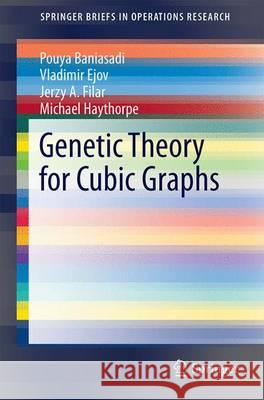
Pouya Baniasadi; Vladimir V. Ejov; Jerzy A. Filar
Genetic Theory for Cubic Graphs Pouya Baniasadi Vladimir V. Ejov Jerzy A. Filar 9783319196794 Springer - książkaWidoczna okładka, to zdjęcie poglądowe, a rzeczywista szata graficzna może różnić się od prezentowanej.

Genetic Theory for Cubic Graphs

ISBN-13: 9783319196794 / Angielski / Miękka / 2015 / 118 str.

Pouya Baniasadi; Vladimir V. Ejov; Jerzy A. Filar
cena 201,72 zł
(netto: 192,11 VAT:  5%)

Najniższa cena z 30 dni: 192,74 zł
Termin realizacji zamówienia:
ok. 22 dni roboczych
Bez gwarancji dostawy przed świętami

Darmowa dostawa!
Kategorie:
Nauka, Ekonomia i biznes
Kategorie BISAC:
Business & Economics > Operations Research
Mathematics > Graphic Methods
Business & Economics > Management Science
Wydawca:
Springer
Seria wydawnicza:
Springerbriefs in Operations Research
Język:
Angielski
ISBN-13:
9783319196794
Rok wydania:
2015
Wydanie:
2016
Numer serii:
000546574
Ilość stron:
118
Waga:
0.20 kg
Wymiary:
16.3 x 23.8 x 0.9
Oprawa:
Miękka
Wolumenów:
01


"This is a concise treatment of the theory. Its self-contained nature and its thoughtful organization will make it a useful reference for researchers in the field." (Hong-Jian Lai, zbMATH 1330.05003, 2016)

Genetic Theory for Cubic Graphs.- Inherited Properties of Descendants.- Uniqueness of Ancestor Genes.- Completed Proofs from Chapter 3.

Pouya Baniasadi is a doctoral student in mathematics at Flinders University, Australia. He is a recipient of the AF Pillow Applied Mathematics Scholarship from the AF Pillow Mathematics Trust, Australia.

Vladimir Ejov is the leader of the Mathematical Analysis research group within Flinders Mathematical Sciences Laboratory, Flinders University, Australia. His research interests are in the areas of several complex variables, geometry of Cauchy-Riemann manifolds, combinatorial optimisation, Markov decision processes and graph theory.

Jerzy A Filar is Director of Flinders Mathematical Sciences Laboratory, Flinders University, Australia, and is a Fellow of the Australian Mathematical Society. His research interests span both theoretical and applied topics in the fields of operations research, optimization, game theory, applied probability, and environmental modelling.

Michael Haythorpe is mathematician at Flinders University, Australia. His areas of research interest are numerical optimisation, computational mathematics, algorithm development and graph theory. He is a recipient of the AustMS Lift-off Fellowship Award 2010.

This book was motivated by the notion that some of the underlying difficulty in challenging instances of graph-based problems (e.g., the Traveling Salesman Problem) may be “inherited” from simpler graphs which – in an appropriate sense – could be seen as “ancestors” of the given graph instance. The authors propose a partitioning of the set of unlabeled, connected cubic graphs into two disjoint subsets named genes and descendants, where the cardinality of the descendants dominates that of the genes. The key distinction between the two subsets is the presence of special edge cut sets, called cubic crackers, in the descendants.

The book begins by proving that any given descendant may be constructed by starting from a finite set of genes and introducing the required cubic crackers through the use of six special operations, called breeding operations. It shows that each breeding operation is invertible, and these inverse operations are examined. It is therefore possible, for any given descendant, to identify a family of genes that could be used to generate the descendant. The authors refer to such a family of genes as a “complete family of ancestor genes” for that particular descendant. The book proves the fundamental, although quite unexpected, result that any given descendant has exactly one complete family of ancestor genes. This result indicates that the particular combination of breeding operations used strikes the right balance between ensuring that every descendant may be constructed while permitting only one generating set.

The result that any descendant can be constructed from a unique set of ancestor genes indicates that most of the structure in the descendant has been, in some way, inherited from that, very special, complete family of ancestor genes, with the remaining structure induced by the breeding operations. After establishing this, the authors proceed to investigate a number of graph theoretic properties: Hamiltonicity, bipartiteness, and planarity, and prove results linking properties of the descendant to those of the ancestor genes. They develop necessary (and in some cases, sufficient) conditions for a descendant to contain a property in terms of the properties of its ancestor genes. These results motivate the development of parallelizable heuristics that first decompose a graph into ancestor genes, and then consider the genes individually. In particular, they provide such a heuristic for the Hamiltonian cycle problem. Additionally, a framework for constructing graphs with desired properties is developed, which shows how many (known) graphs that constitute counterexamples of conjectures could be easily found.


Udostępnij

Facebook - konto krainaksiazek.pl


Opinie o Krainaksiazek.pl na Opineo.pl

Partner Mybenefit

Krainaksiazek.pl w programie rzetelna firma Krainaksiaze.pl - płatności przez paypal

Czytaj nas na:

Facebook - krainaksiazek.pl
  • książki na zamówienie
  • granty
  • książka na prezent
  • kontakt
  • pomoc
  • opinie
  • regulamin
  • polityka prywatności

Zobacz:

  • Księgarnia czeska

  • Wydawnictwo Książkowe Klimaty

1997-2025 DolnySlask.com Agencja Internetowa

© 1997-2022 krainaksiazek.pl
     
KONTAKT | REGULAMIN | POLITYKA PRYWATNOŚCI | USTAWIENIA PRYWATNOŚCI
Zobacz: Księgarnia Czeska | Wydawnictwo Książkowe Klimaty | Mapa strony | Lista autorów
KrainaKsiazek.PL - Księgarnia Internetowa

Polityka prywatnosci - link
Krainaksiazek.pl - płatnośc Przelewy24
Przechowalnia Przechowalnia






