• Wyszukiwanie zaawansowane
  • Kategorie
  • Kategorie BISAC
  • Książki na zamówienie
  • Promocje
  • Granty
  • Książka na prezent
  • Opinie
  • Pomoc
  • Załóż konto
  • Zaloguj się

Gender and Sexuality in Islam CC 4v » książka


zaloguj się | załóż konto
Logo Krainaksiazek.pl

koszyk

konto

szukaj
topmenu
Księgarnia internetowa
Szukaj
Książki na zamówienie
Promocje
Granty
Książka na prezent
Moje konto
Pomoc
 
 
Wyszukiwanie zaawansowane
Pusty koszyk
Bezpłatna dostawa dla zamówień powyżej 20 złBezpłatna dostawa dla zamówień powyżej 20 zł

Kategorie główne

• Nauka
 [2949965]
• Literatura piękna
 [1857847]

  więcej...
• Turystyka
 [70818]
• Informatyka
 [151303]
• Komiksy
 [35733]
• Encyklopedie
 [23180]
• Dziecięca
 [617748]
• Hobby
 [139972]
• AudioBooki
 [1650]
• Literatura faktu
 [228361]
• Muzyka CD
 [398]
• Słowniki
 [2862]
• Inne
 [444732]
• Kalendarze
 [1620]
• Podręczniki
 [167233]
• Poradniki
 [482388]
• Religia
 [509867]
• Czasopisma
 [533]
• Sport
 [61361]
• Sztuka
 [243125]
• CD, DVD, Video
 [3451]
• Technologie
 [219309]
• Zdrowie
 [101347]
• Książkowe Klimaty
 [123]
• Zabawki
 [2362]
• Puzzle, gry
 [3791]
• Literatura w języku ukraińskim
 [253]
• Art. papiernicze i szkolne
 [7933]
Kategorie szczegółowe BISAC

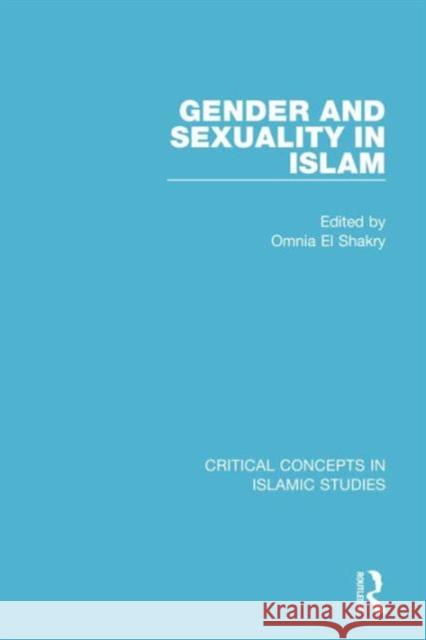
Gender and Sexuality in Islam CC 4v

ISBN-13: 9781138854123 / Angielski / Twarda / 2016 / 1628 str.
Omnia El Shakry
Gender and Sexuality in Islam CC 4v Omnia E 9781138854123 Routledge - książkaWidoczna okładka, to zdjęcie poglądowe, a rzeczywista szata graficzna może różnić się od prezentowanej.

Gender and Sexuality in Islam CC 4v

ISBN-13: 9781138854123 / Angielski / Twarda / 2016 / 1628 str.

Omnia El Shakry
cena 6097,22 zł
(netto: 5806,88 VAT:  5%)

Najniższa cena z 30 dni: 5792,99 zł
Termin realizacji zamówienia:
ok. 22 dni roboczych
Bez gwarancji dostawy przed świętami

Darmowa dostawa!

Exploring the multifaceted nature of gender and sexuality within Islamic societies in a trans-disciplinary and trans-regional fashion, this collection addresses the following questions: What are the principal methodologies for studying gender and sexuality in Islam? What is Islamic feminism? How do we understand the role of gender in the Islamic revival movements that have emerged since the last quarter of the twentieth century? How have historical forces and political projects colonialism, nationalism, and modernity constituted gender relations? How have sexual ideologies and practices transformed in Muslim majority societies in the modern era? What is the relationship between the global circulation of LGBTQ identities and queer and sexual counter-publics in the Islamic world?

"Gender and Sexuality in Islam" highlights methodologically innovative work while covering an expansive geographical range that includes the Middle East and North Africa, Sub-Saharan Africa, Central, South and Southeast Asia, and Europe and North America. The volumes cover: Gender and the Ethical Subject; Gender, Empire, and Nation; Sexualities, Intimacy, and the Body; and Gender, Sexuality, and Representation. The set will be of use to scholars, students, and general readers."


Kategorie:
Religia
Kategorie BISAC:
Religion > Islam - General
Wydawca:
Routledge
Seria wydawnicza:
Critical Concepts in Islamic Studies
Język:
Angielski
ISBN-13:
9781138854123
Rok wydania:
2016
Numer serii:
000326969
Ilość stron:
1628
Waga:
2.83 kg
Wymiary:
23.88 x 16.51 x 10.41
Oprawa:
Twarda
Wolumenów:
04
Dodatkowe informacje:
Wydanie ilustrowane

Volume I: Gender and the Ethical Subject Part 1: Foundational Texts, Legal Practices 1. Asma Barlas, ‘The Qur'an and Hermeneutics: Reading the Qur'an's Opposition to Patriarchy’, Journal of Qur'anic Studies 3, 2001, 15-38. 2. Amina Wadud, ‘Qur'ān, Gender and Interpretive Possibilities’, Hawwa, 2, 3, 2004, 316-336. 3. Sa’diyya Shaikh, ‘In Search of al-Insān: Sufism, Islamic Law, and Gender’, Journal of the American Academy of Religion, 77, 4, 2009, 781-822. 4. Kecia Ali, ‘If You Have Touched Women: Female Bodies and Male Agency in the Qur'an’, Sexual Ethics and Islam: Feminist Reflections on Qur'an, Hadith, and Jurisprudence (Oneworld Publications, 2006), pp. 112-134. 5. Scott C. Lucas, ‘"Perhaps You Only Kissed Her?" A Contrapuntal Reading of the Penalties for Illicit Sex in the Sunni Hadith Literature’, Journal of Religious Ethics, 39, 3, 2011, 399-415. 6. Judith Tucker, ‘Woman and Man as Divorced: Asserting Rights’, Women, Family, and Gender in Islamic law, Vol. 3 (Cambridge: Cambridge University Press, 2008), pp. 84-132. Part 2: Ethical Ideals 7. Barbara Daly Metcalf, ‘Islamic Reform and Islamic Women: Maulana Thanawi's Jewelry of Paradise’, Moral Conduct and Authority: The Place of Adab in South Asian Islam (University of California Press, 1984), pp. 184-195. 8. Ellen McLarney, ‘The Private is Political: Women and Family in Intellectual Islam’, Feminist Theory, 11, 2, 2010, 129-148. 9. Lara Deeb, ‘Emulating and/or Embodying the Ideal: The Gendering of Temporal Frameworks and Islamic Role Models in Shi ‘i Lebanon’, American Ethnologist, 36, 2, 2009, 242-257. 10. Maimuna Huq, ‘Talking Jihad and Piety: Reformist Exertions among Islamist Women in Bangladesh’, Journal of the Royal Anthropological Institute, 15, 1, 2009, S163-S182. 11. Magnus Marsden, ‘Women, Politics and Islamism in Northern Pakistan’, Modern Asian Studies, 42, 2-3, 2008, 405-429. Part 3: The Feminist Subject and the Question of Agency 12. Saba Mahmood, ‘Feminist Theory, Embodiment, and the Docile Agent: Some Reflections on the Egyptian Islamic Revival’, Cultural Anthropology, 16, 2, 2001, 202-236. 13. Rachel Rinaldo, ‘Pious and Critical: Muslim Women Activists and the Question of Agency’, Gender & Society, 28, 6, 2014, 824-846. 14. Valentine M. Moghadam, ‘Islamic Feminism and its Discontents: Toward a Resolution of the Debate’, Signs, 27, 4, 2002, 1135-1171. 15. Mayanthi L. Fernando, ‘Reconfiguring Freedom: Muslim Piety and the Limits of Secular Law and Public Discourse in France’, American Ethnologist, 37, 1, 2010, 19-35. 16. Inderpal Grewal, ‘Outsourcing Patriarchy: Feminist Encounters, Transnational Mediations and the Crime of "Honour Killings"’, International Feminist Journal of Politics, 15, 1, 1-19. Volume II: Gender, Empire, and Nation Part 4: Colonialism and Anticolonial Nationalism 17. Leila Ahmed, ‘The Discourse of the Veil’, in Women and Gender in Islam: Historical Roots of a Modern Debate (New Haven: Yale University Press, 1992), pp. 144-68. 18. Mahua Sarkar, ‘Muslim Women and the Politics of (In)visibility in Late Colonial Bengal’, Journal of Historical Sociology, 14, 2, 2001, 226-250. 19. Julia Ann Clancy-Smith, ‘The House of Zainab: Female Authority and Saintly Succession in Colonial Algeria’, in Nikki R. Keddie and Beth Baron (eds), Women in Middle Eastern History: Shifting Boundaries in Sex and Gender (New Haven: Yale University Press, 1991), pp. 254-274. 20. Frantz Fanon, ‘Algeria Unveiled’, in A Dying Colonialism (New York: Grove Press, 1967), pp. 35-76. 21. Lisa Pollard, ‘The Home, the Classroom, and the Cultivation of Egyptian Nationalism’, in Nurturing the Nation: The Family Politics of Modernizing, Colonizing and Liberating Egypt, 1805-1923 (Berkeley and Los Angeles: University of California Press, 2005), pp. 100-131, 236-243. 22. Elizabeth Thompson, ‘The Veil and the Dual Legal System’, in Colonial Citizens: Republican Rights, Paternal Privilege, and Gender in French Syria and Lebanon (Columbia University Press, 2013), pp. 127-140. Part 5: Postcolonial Formations 23. Nilüfer Göle, ‘The Gendered Nature of the Public Sphere’, Public Culture, 10, 1, 1997, 61-81. 24. Deniz Kandiyoti, ‘The Politics of Gender and the Soviet Paradox: Neither Colonized, nor Modern? Central Asian Survey, 26, 4, 2007, 601-623. 25. Sullivan Zohreh, ‘Eluding the Feminist, Overthrowing the Modern: Transformations in Twentieth-Century Iran," in Lila Abu-Lughod (ed.), Remaking Women: Feminism and Modernity in the Middle East (Princeton: Princeton University Press, 1998), pp. 215-242. 26. Zakia Pathak and Rajeswari Sunder Rajan, ‘Shahbano’, Signs, 1989, 558-582. 27. Amina Jamal, ‘Gender, Citizenship, and the Nation-State in Pakistan: Willful Daughters or Free Citizens?’ Signs, 31, 2, 2006. 28. Elora Shehabuddin, ‘Jamaat-i-Islami in Bangladesh: Women, Democracy and the Transformation of Islamist Politics’, Modern Asian Studies, 42, 2-3, 2008, 577-603. Part 6: Militarism, Counterinsurgency, and the War on Terror 29. Lila Abu‐Lughod, ‘Do Muslim Women Really Need Saving? Anthropological Reflections on Cultural Relativism and its Others’, American Anthropologist. 104, 3, 2002, 783-790. 30. Charles Hirschkind and Saba Mahmood, ‘Feminism, the Taliban, and Politics of Counter-Insurgency’, Anthropological Quarterly, 75, 2, 2002, 339-354. 31. Jasbir K. Puar and Amit Rai, ‘Monster, Terrorist, Fag: The War on Terrorism and the Production of Docile Patriots’, Social Text, 20, 3, 2002, 117-148. 32. Paul Amar, ‘Turning the Gendered Politics of the Security State Inside Out? Charging the Police with Sexual Harassment in Egypt’, International Feminist Journal of Politics, 13, 3, 2011, 299-328. 33. Cabeiri deBergh Robinson, ‘The Mujahid as Family Man: Sex, Death, and the Warrior's (Im)pure body’, Body of Victim, Body of Warrior: Refugee Families and the Making of Kashmiri Jihadists (Berkeley: University of California Press, 2013), pp. 201-228. Volume III: Sexualities, Intimacy, and the Body Part 7: Sexuality and the Body 34. Afsaneh Najmabadi, ‘Genus of Sex or the Sexing of Jins’, International Journal of Middle East Studies, 45, 2, 2013, 211-231. 35. Wilson Chacko Jacob, ‘Overcoming ‘Simply Being’: Straight Sex, Masculinity and Physical Culture in Modern Egypt’, Gender & History, 22, 3, 2010, 658-676. 36. Hanan Kholoussy, ‘Monitoring and Medicalising Male Sexuality in Semi-Colonial Egypt’, Gender & History, 22, 3, 2010, 677-691. 37. Corrie Decker, ‘Biology, Islam and the Science of Sex Education in Colonial Zanzibar’, Past & Present, 222, 2014, 215-247. Part 8: Intimate Ethics 38. Suad Joseph, ‘Brother/Sister Relationships: Connectivity, Love, and Power in the Reproduction of Patriarchy in Lebanon’, American Ethnologist, 21, 1, 1994, 50-73. 39. Sara Pursley, ‘Daughters of the Right Path: Family Law, Homosocial Publics, and the Ethics of Intimacy in the Works of Shi'i Revivalist Bint al-Huda’, Journal of Middle East Women's Studies, 8, 2, 2012, 51-77. 40. Samuli Schielke, ‘Love Troubles’, in Egypt in the Future Tense: Hope, Frustration, and Ambivalence Before and After 2011 (Bloomington: Indiana University Press, 2015), pp. 83-104. 41. Kathryn A. Rhine, ‘She Lives Dangerously: Intimate Ethics, Grammatical Personhood, and HIV/AIDS in Islamic Northern Nigeria’, Africa Today, 61, 4, 2015, 85-103. Part 9: Queer Imaginaries 42. Sahar Amer, ‘Medieval Arab Lesbians and Lesbian-like Women’, Journal of the History of Sexuality, 18, 2, 2009, 215-236. 43. Khaled El-Rouayheb, ‘The Love of Boys in Arabic Poetry of the Early Ottoman Period, 1500–1800’, Middle Eastern Literatures, 8, 1, 2005, 3-22. 44. Joseph Andoni Massad, ‘Re-orienting Desire: The Gay International and the Arab World’, Public Culture, 14, 2, 2002, 361-385. 45. Sima Shakhsari, ‘From Homoerotics of Exile to Homopolitics of Diaspora: Cyberspace, the War on Terror, and the Hypervisible Iranian Queer’, Journal of Middle East Women's Studies, 8, 3, 2012, 14-40. 46. Tom Boellstorff, ‘Between Religion and Desire: Being Muslim and Gay in Indonesia’, American Anthropologist, 107, 4, 2005, 575-585. 47. Scott Siraj al-Haqq Kugle, ‘Sexuality, Diversity, and Ethics in the Agenda of Progressive Muslims’, in Omid Safi (ed.), Progressive Muslims: On Justice, Gender and Pluralism (One World Publications, 2003), pp. 190-234. Volume IV: Gender, Sexuality, and Representation Part 10: Literature 48. Kamran Asdar Ali, ‘"Pulp Fictions": Reading Pakistani Domesticity’, Social Text 22, 1, 2004, 123-145. 49. Shaden M. Tageldin, ‘Which Qalam for Algeria?: Colonialism, Liberation, and Language in Djebar's L'Amour, la fantasia and Mustaghānimī's Dhākirat al-Jasad’, Comparative Literature Studies, 46, 3, 2009, 467-497. 50. Frédéric Lagrange, ‘Male Homosexuality in Modern Arabic Literature’, Imagined Masculinities: Male Identity and Culture in the Modern Middle East (London: Al Saqi, 2000), pp.169-198. 51. Michael Allan, ‘Queer Couplings: Formations of Religion and Sexuality in ʿAlaʾ Al-Aswani's ʿImarat Yaʿqubyan’, International Journal of Middle East Studies, 45, 2, 2013, 253-269. 52. Hanadi Al-Samman, ‘Remapping Arab Narrative and Sexual Desire in Salwā al-Naīmī’s Burhān al-asal (The Proof of the Honey)’, Journal of Arabic Literature, 43, 1, 2012, 60-79. 53. Marilyn Booth, ‘The Muslim Woman as Celebrity Author and the Politics of Translating Arabic: Girls of Riyadh Go on the Road’, Journal of Middle East Women’s Studies, 6, 3, 2010, 149-82. Part 11: Film and Visual Culture 54. Marc de Leeuw and Sonja van Wichelen, ‘"Please, Go Wake Up!" Submission, Hirsi Ali, and the "War on Terror" in the Netherlands’, Feminist Media Studies 5, 3, 2005, 325-340. 55. Iftikhar Dadi, ‘Shirin Neshat’s Photographs as Postcolonial Allegories’, Signs, 34, 1, 2008, 125-150. 56. Anna Ball, ‘Between a Postcolonial Nation and Fantasies of the Feminine: The Contested Visions of Palestinian Cinema’, Camera Obscura, 23, 3 69, 2008, 1-33. 57. James B. Hoesterey and Marshall Clark, ‘Film Islami: Gender, Piety and Pop Culture in Post-Authoritarian Indonesia’, Asian Studies Review, 36, 2, 2012, 207-226. Part 12: Fashion 58. Ellen McLarney, ‘The Burqa in Vogue: Fashioning Afghanistan’, Journal of Middle East Women's Studies, 5, 1, 2009, 1-23. 59. Amina Yaqin, ‘Islamic Barbie: The Politics of Gender and Performativity’, Fashion Theory, 11, 2, 2007, 173-188. 60. Dorothea E. Schulz, ‘Competing Sartorial Assertions of Femininity and Muslim Identity in Mali’, Fashion Theory, 11, 2, 2007, 253-279. 61. Noor Al-Qasimi, ‘Immodest Modesty: Accommodating Dissent and the 'Abaya-as-Fashion in the Arab Gulf States’, Journal of Middle East Women's Studies, 6, 1, 2010, 46-74.

Omnia El Shakry is Associate Professor of History at the University of California, Davis. She is the author of The Great Social Laboratory: Subjects of Knowledge in Colonial and Postcolonial Egypt, and articles on the history of the human sciences, gender politics, and visual cultures in Egypt. Her current book project is titled, ‘The Arabic Freud: Psychoanalysis and Islam in Modern Egypt’.

El Shakry, Omnia Omnia El Shakry is Assistant Professor of History ... więcej >


Udostępnij

Facebook - konto krainaksiazek.pl


Opinie o Krainaksiazek.pl na Opineo.pl

Partner Mybenefit

Krainaksiazek.pl w programie rzetelna firma Krainaksiaze.pl - płatności przez paypal

Czytaj nas na:

Facebook - krainaksiazek.pl
  • książki na zamówienie
  • granty
  • książka na prezent
  • kontakt
  • pomoc
  • opinie
  • regulamin
  • polityka prywatności

Zobacz:

  • Księgarnia czeska

  • Wydawnictwo Książkowe Klimaty

1997-2025 DolnySlask.com Agencja Internetowa

© 1997-2022 krainaksiazek.pl
     
KONTAKT | REGULAMIN | POLITYKA PRYWATNOŚCI | USTAWIENIA PRYWATNOŚCI
Zobacz: Księgarnia Czeska | Wydawnictwo Książkowe Klimaty | Mapa strony | Lista autorów
KrainaKsiazek.PL - Księgarnia Internetowa

Polityka prywatnosci - link
Krainaksiazek.pl - płatnośc Przelewy24
Przechowalnia Przechowalnia





