• Wyszukiwanie zaawansowane
  • Kategorie
  • Kategorie BISAC
  • Książki na zamówienie
  • Promocje
  • Granty
  • Książka na prezent
  • Opinie
  • Pomoc
  • Załóż konto
  • Zaloguj się

Gain-based Remedies for Breach of Contract: A Comparative Analysis of English and Polish Law » książka


zaloguj się | załóż konto
Logo Krainaksiazek.pl

koszyk

konto

szukaj
topmenu
Księgarnia internetowa
Szukaj
Książki na zamówienie
Promocje
Granty
Książka na prezent
Moje konto
Pomoc
 
 
Wyszukiwanie zaawansowane
Pusty koszyk
Bezpłatna dostawa dla zamówień powyżej 20 złBezpłatna dostawa dla zamówień powyżej 20 zł

Kategorie główne

• Nauka
 [2946600]
• Literatura piękna
 [1856966]

  więcej...
• Turystyka
 [72221]
• Informatyka
 [151456]
• Komiksy
 [35826]
• Encyklopedie
 [23190]
• Dziecięca
 [619653]
• Hobby
 [140543]
• AudioBooki
 [1577]
• Literatura faktu
 [228355]
• Muzyka CD
 [410]
• Słowniki
 [2874]
• Inne
 [445822]
• Kalendarze
 [1744]
• Podręczniki
 [167141]
• Poradniki
 [482898]
• Religia
 [510455]
• Czasopisma
 [526]
• Sport
 [61590]
• Sztuka
 [243598]
• CD, DVD, Video
 [3423]
• Technologie
 [219201]
• Zdrowie
 [101638]
• Książkowe Klimaty
 [124]
• Zabawki
 [2473]
• Puzzle, gry
 [3898]
• Literatura w języku ukraińskim
 [254]
• Art. papiernicze i szkolne
 [8170]
Kategorie szczegółowe BISAC

Gain-based Remedies for Breach of Contract: A Comparative Analysis of English and Polish Law

ISBN-13: 9783031254512 / Angielski / Twarda / 2023 / 167 str.
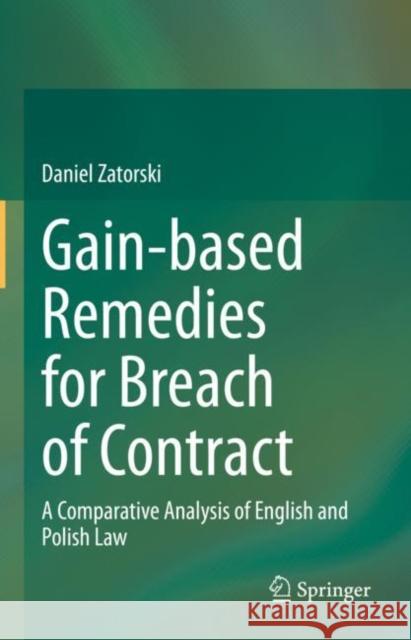
Daniel Zatorski
Gain-based Remedies for Breach of Contract: A Comparative Analysis of English and Polish Law Daniel Zatorski 9783031254512 Springer - książkaWidoczna okładka, to zdjęcie poglądowe, a rzeczywista szata graficzna może różnić się od prezentowanej.

Gain-based Remedies for Breach of Contract: A Comparative Analysis of English and Polish Law

ISBN-13: 9783031254512 / Angielski / Twarda / 2023 / 167 str.

Daniel Zatorski
cena 524,53 zł
(netto: 499,55 VAT:  5%)

Najniższa cena z 30 dni: 501,19 zł
Termin realizacji zamówienia:
ok. 22 dni roboczych
Bez gwarancji dostawy przed świętami

Darmowa dostawa!
inne wydania

This book focuses on an emerging problem in English contract law: what should be done when a party has been unjustly enriched as the result of a breach of contract but there is no measurable loss suffered by said party? Two rulings are at the heart of the book: Wrotham Park Estate v Parkside Homes and Attorney-General v Blake. These two cases can be said to have established gain-based remedies in English contract law. However, the principles that underpin these remedies are not entirely clear and are subject to debate.This book analyses these principles through the lens of compensatory and restitutionary approaches. Moreover, it applies a comparative analysis of these approaches through the lens of the civil law jurisdiction in Poland.Since the term ‘compensation’ is not a universal concept, the book distinguishes between two rationales in the compensatory analysis. The first, reparative compensation, is defined as a form of monetary recompense for loss or damage actually suffered. The second, substitutive compensation, represents a monetary equivalent to a right that a person has been deprived of or denied. Both rationales require the application of a broad notion of loss in order to make gain-based remedies workable in both English and Polish law.In contrast, ‘restitution’ states that a person cannot be permitted to profit from their own wrongdoing. Based on this principle, the book argues that gain-based remedies could be applied under Polish law through the rules of unjust enrichment. However, in order to do so, a broader understanding of the subtraction prerequisite (the enrichment being at the aggrieved party’s expense) would have to be adopted. The book concludes that unjust enrichment is a more natural way of implementing gain-based remedies in civil law jurisdictions.


This book focuses on an emerging problem in English contract law: what should be done when a party has been unjustly enriched as the result of a breach of contract but there is no measurable loss suffered by said party? Two rulings are at the heart of the book: Wrotham Park Estate v Parkside Homes and Attorney-General v Blake. These two cases can be said to have established gain-based remedies in English contract law. However, the principles that underpin these remedies are not entirely clear and are subject to debate.This book analyses these principles through the lens of compensatory and restitutionary approaches. Moreover, it applies a comparative analysis of these approaches through the lens of the civil law jurisdiction in Poland.
Since the term ‘compensation’ is not a universal concept, the book distinguishes between two rationales in the compensatory analysis. The first, reparative compensation, is defined as a form of monetary recompense for loss or damage actually suffered. The second, substitutive compensation, represents a monetary equivalent to a right that a person has been deprived of or denied. Both rationales require the application of a broad notion of loss in order to make gain-based remedies workable in both English and Polish law.
In contrast, ‘restitution’ states that a person cannot be permitted to profit from their own wrongdoing. Based on this principle, the book argues that gain-based remedies could be applied under Polish law through the rules of unjust enrichment. However, in order to do so, a broader understanding of the subtraction prerequisite (the enrichment being at the aggrieved party’s expense) would have to be adopted. The book concludes that unjust enrichment is a more natural way of implementing gain-based remedies in civil law jurisdictions.

Kategorie:
Nauka, Prawo i administracja
Kategorie BISAC:
Law > International
Law > Contracts
Law > Civil Law
Wydawca:
Springer
Język:
Angielski
ISBN-13:
9783031254512
Rok wydania:
2023
Dostępne języki:
Ilość stron:
167
Waga:
0.44 kg
Wymiary:
23.5 x 15.5
Oprawa:
Twarda
Dodatkowe informacje:
Wydanie ilustrowane

1. Introduction and Methodology.- 2. Gain-based Remedies for Breach of Contract in General.- 3. Finding Gain-based Remedies under the Compensatory Principles.- 4. Finding Gain-Based Remedies under Restitutionary Principles.- 5. Summary and Conclusions.- 6. Bibliography.


Daniel Zatorski holds a master's and a doctoral degree from the Jagiellonian University in Kraków. He obtained a Graduate Diploma in Law from the University of Law in London and a LL.M. degree from the Catholic University of America. He is a fully-qualified Polish attorney-at-law and has published several papers related to comparative law and international trade.

He has worked in both the public sector and the private sector in areas dealing with, among others, dispute resolution, international trade or general commercial law.

This book focuses on an emerging problem in English contract law: what should be done when a party has been unjustly enriched as the result of a breach of contract but there is no measurable loss suffered by said party? Two rulings are at the heart of the book: Wrotham Park Estate v Parkside Homes and Attorney-General v Blake. These two cases can be said to have established gain-based remedies in English contract law. However, the principles that underpin these remedies are not entirely clear and are subject to debate.

This book analyses these principles through the lens of compensatory and restitutionary approaches. Moreover, it applies a comparative analysis of these approaches through the lens of the civil law jurisdiction in Poland.

Since the term ‘compensation’ is not a universal concept, the book distinguishes between two rationales in the compensatory analysis. The first, reparative compensation, is defined as a form of monetary recompense for loss or damage actually suffered. The second, substitutive compensation, represents a monetary equivalent to a right that a person has been deprived of or denied. Both rationales require the application of a broad notion of loss in order to make gain-based remedies workable in both English and Polish law.

In contrast, ‘restitution’ states that a person cannot be permitted to profit from their own wrongdoing. Based on this principle, the book argues that gain-based remedies could be applied under Polish law through the rules of unjust enrichment. However, in order to do so, a broader understanding of the subtraction prerequisite (the enrichment being at the aggrieved party’s expense) would have to be adopted. The book concludes that unjust enrichment is a more natural way of implementing gain-based remedies in civil law jurisdictions.




Udostępnij

Facebook - konto krainaksiazek.pl


Opinie o Krainaksiazek.pl na Opineo.pl

Partner Mybenefit

Krainaksiazek.pl w programie rzetelna firma Krainaksiaze.pl - płatności przez paypal

Czytaj nas na:

Facebook - krainaksiazek.pl
  • książki na zamówienie
  • granty
  • książka na prezent
  • kontakt
  • pomoc
  • opinie
  • regulamin
  • polityka prywatności

Zobacz:

  • Księgarnia czeska

  • Wydawnictwo Książkowe Klimaty

1997-2025 DolnySlask.com Agencja Internetowa

© 1997-2022 krainaksiazek.pl
     
KONTAKT | REGULAMIN | POLITYKA PRYWATNOŚCI | USTAWIENIA PRYWATNOŚCI
Zobacz: Księgarnia Czeska | Wydawnictwo Książkowe Klimaty | Mapa strony | Lista autorów
KrainaKsiazek.PL - Księgarnia Internetowa

Polityka prywatnosci - link
Krainaksiazek.pl - płatnośc Przelewy24
Przechowalnia Przechowalnia




