• Wyszukiwanie zaawansowane
  • Kategorie
  • Kategorie BISAC
  • Książki na zamówienie
  • Promocje
  • Granty
  • Książka na prezent
  • Opinie
  • Pomoc
  • Załóż konto
  • Zaloguj się

Fuzzy Cognitive Maps for Applied Sciences and Engineering: From Fundamentals to Extensions and Learning Algorithms » książka


zaloguj się | załóż konto
Logo Krainaksiazek.pl

koszyk

konto

szukaj
topmenu
Księgarnia internetowa
Szukaj
Książki na zamówienie
Promocje
Granty
Książka na prezent
Moje konto
Pomoc
 
 
Wyszukiwanie zaawansowane
Pusty koszyk
Bezpłatna dostawa dla zamówień powyżej 20 złBezpłatna dostawa dla zamówień powyżej 20 zł

Kategorie główne

• Nauka
 [2946600]
• Literatura piękna
 [1856966]

  więcej...
• Turystyka
 [72221]
• Informatyka
 [151456]
• Komiksy
 [35826]
• Encyklopedie
 [23190]
• Dziecięca
 [619653]
• Hobby
 [140543]
• AudioBooki
 [1577]
• Literatura faktu
 [228355]
• Muzyka CD
 [410]
• Słowniki
 [2874]
• Inne
 [445822]
• Kalendarze
 [1744]
• Podręczniki
 [167141]
• Poradniki
 [482898]
• Religia
 [510455]
• Czasopisma
 [526]
• Sport
 [61590]
• Sztuka
 [243598]
• CD, DVD, Video
 [3423]
• Technologie
 [219201]
• Zdrowie
 [101638]
• Książkowe Klimaty
 [124]
• Zabawki
 [2473]
• Puzzle, gry
 [3898]
• Literatura w języku ukraińskim
 [254]
• Art. papiernicze i szkolne
 [8170]
Kategorie szczegółowe BISAC

Fuzzy Cognitive Maps for Applied Sciences and Engineering: From Fundamentals to Extensions and Learning Algorithms

ISBN-13: 9783642397387 / Angielski / Twarda / 2013 / 395 str.
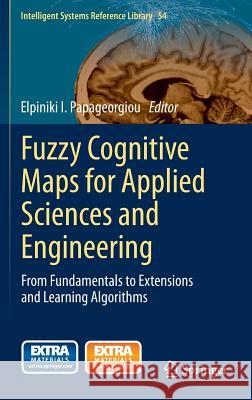
Elpiniki I. Papageorgiou
Fuzzy Cognitive Maps for Applied Sciences and Engineering: From Fundamentals to Extensions and Learning Algorithms Papageorgiou, Elpiniki I. 9783642397387 Springer - książkaWidoczna okładka, to zdjęcie poglądowe, a rzeczywista szata graficzna może różnić się od prezentowanej.

Fuzzy Cognitive Maps for Applied Sciences and Engineering: From Fundamentals to Extensions and Learning Algorithms

ISBN-13: 9783642397387 / Angielski / Twarda / 2013 / 395 str.

Elpiniki I. Papageorgiou
cena 403,47 zł
(netto: 384,26 VAT:  5%)

Najniższa cena z 30 dni: 385,52 zł
Termin realizacji zamówienia:
ok. 22 dni roboczych
Bez gwarancji dostawy przed świętami

Darmowa dostawa!

Fuzzy Cognitive Maps (FCM) constitute cognitive models in the form of fuzzy directed graphs consisting of two basic elements: the nodes, which basically correspond to "concepts" bearing different states of activation depending on the knowledge they represent, and the "edges" denoting the causal effects that each source node exercises on the receiving concept expressed through weights. Weights take values in the interval -1,1], which denotes the positive, negative or neutral causal relationship between two concepts. An FCM can be typically obtained through linguistic terms, inherent to fuzzy systems, but with a structure similar to the neural networks, which facilitates data processing, and has capabilities for training and adaptation.During the last 10 years, an exponential growth of published papers in FCMs was followed showing great impact potential. Different FCM structures and learning schemes have been developed, while numerous studies report their use in many contexts with highly successful modeling results. The aim of this book is to fill the existing gap in the literature concerning fundamentals, models, extensions and learning algorithms for FCMs in knowledge engineering. It comprehensively covers the state-of-the-art FCM modeling and learning methods, with algorithms, codes and software tools, and provides a set of applications that demonstrate their various usages in applied sciences and engineering.


Kategorie:
Informatyka
Kategorie BISAC:
Computers > Artificial Intelligence - General
Technology & Engineering > Engineering (General)
Wydawca:
Springer
Seria wydawnicza:
Intelligent Systems Reference Library
Język:
Angielski
ISBN-13:
9783642397387
Rok wydania:
2013
Wydanie:
2014
Numer serii:
000385804
Ilość stron:
395
Waga:
0.76 kg
Wymiary:
23.39 x 15.6 x 2.39
Oprawa:
Twarda
Wolumenów:
01
Dodatkowe informacje:
Wydanie ilustrowane

Methods and Algorithms for Fuzzy Cognitive Map-based Modeling.- Fuzzy Cognitive Maps as representations of mental models and group beliefs.- FCM Relationship Modeling for Engineering Systems.- Using RuleML for Representing and Prolog for Simulating Fuzzy Cognitive Maps.- Fuzzy Web Knowledge Aggregation, Representation, and Reasoning for Online Privacy and Reputation Management.- Decision Making by Rule-Based Fuzzy Cognitive Maps: An Approach to Implement Student-Centered Education.- Extended Evolutionary Learning of Fuzzy Cognitive Maps for the Prediction of Multivariate Time-Series.- Synthesis and Analysis of Multi-Step Algorithms of Fuzzy Cognitive Maps Learning.- Designing and Training Relational Fuzzy Cognitive Maps.- Cooperative Autonomous Agents Based On Dynamical Fuzzy Cognitive Maps.- FCM-GUI: A graphical user interface for Big Bang-Big.- Crunch Learning for FCM and Evaluation.- JFCM - A Java library for Fuzzy Cognitive Maps.- Use and evaluation of FCM as a tool for long term socio ecological research.- Application of Fuzzy Grey Cognitive Maps for process problems in industry Papageorgiou.- Use and Perspectives of Fuzzy Cognitive Maps in Robotics.- Fuzzy Cognitive Maps for Structural Damage Detection.- Fuzzy cognitive strategic maps for business management.- The Complex Nature of Migration at a Conceptual Level.- Overlook to the Internal Migration Experience in Gebze through Fuzzy Cognitive Mapping Method.- Understanding Public Participation and Combining Perceptions of Stakeholders’ for a Better Management in Danube Delta Biosphere Reserve.- Employing Fuzzy Cognitive Map for Periodontal Disease Assessment.

Fuzzy Cognitive Maps (FCM) constitute cognitive models in the form of fuzzy directed graphs consisting of two basic elements: the nodes, which basically correspond to “concepts” bearing different states of activation depending on the knowledge they represent, and the “edges” denoting the causal effects that each source node exercises on the receiving concept expressed through weights. Weights take values in the interval [-1,1], which denotes the positive, negative or neutral causal relationship between two concepts. An FCM can be typically obtained through linguistic terms, inherent to fuzzy systems, but with a structure similar to the neural networks, which facilitates data processing, and has capabilities for training and adaptation.

During the last 10 years, an exponential growth of published papers in FCMs was followed showing great impact potential. Different FCM structures and learning schemes have been developed, while numerous studies report their use in many contexts with highly successful modeling results.


The aim of this book is to fill the existing gap in the literature concerning fundamentals, models, extensions and learning algorithms for FCMs in knowledge engineering. It comprehensively covers the state-of-the-art FCM modeling and learning methods, with algorithms, codes and software tools, and provides a set of applications that demonstrate their various usages in applied sciences and engineering.




Udostępnij

Facebook - konto krainaksiazek.pl


Opinie o Krainaksiazek.pl na Opineo.pl

Partner Mybenefit

Krainaksiazek.pl w programie rzetelna firma Krainaksiaze.pl - płatności przez paypal

Czytaj nas na:

Facebook - krainaksiazek.pl
  • książki na zamówienie
  • granty
  • książka na prezent
  • kontakt
  • pomoc
  • opinie
  • regulamin
  • polityka prywatności

Zobacz:

  • Księgarnia czeska

  • Wydawnictwo Książkowe Klimaty

1997-2025 DolnySlask.com Agencja Internetowa

© 1997-2022 krainaksiazek.pl
     
KONTAKT | REGULAMIN | POLITYKA PRYWATNOŚCI | USTAWIENIA PRYWATNOŚCI
Zobacz: Księgarnia Czeska | Wydawnictwo Książkowe Klimaty | Mapa strony | Lista autorów
KrainaKsiazek.PL - Księgarnia Internetowa

Polityka prywatnosci - link
Krainaksiazek.pl - płatnośc Przelewy24
Przechowalnia Przechowalnia



