• Wyszukiwanie zaawansowane
  • Kategorie
  • Kategorie BISAC
  • Książki na zamówienie
  • Promocje
  • Granty
  • Książka na prezent
  • Opinie
  • Pomoc
  • Załóż konto
  • Zaloguj się

Fundamentals of Quantum Computing: Theory and Practice » książka

zaloguj się | załóż konto
Logo Krainaksiazek.pl

koszyk

konto

szukaj
topmenu
Księgarnia internetowa
Szukaj
Książki na zamówienie
Promocje
Granty
Książka na prezent
Moje konto
Pomoc
 
 
Wyszukiwanie zaawansowane
Pusty koszyk
Bezpłatna dostawa dla zamówień powyżej 20 złBezpłatna dostawa dla zamówień powyżej 20 zł

Kategorie główne

• Nauka
 [2952079]
• Literatura piękna
 [1850969]

  więcej...
• Turystyka
 [71058]
• Informatyka
 [151066]
• Komiksy
 [35579]
• Encyklopedie
 [23181]
• Dziecięca
 [620496]
• Hobby
 [139036]
• AudioBooki
 [1646]
• Literatura faktu
 [228729]
• Muzyka CD
 [379]
• Słowniki
 [2932]
• Inne
 [445708]
• Kalendarze
 [1409]
• Podręczniki
 [164793]
• Poradniki
 [480107]
• Religia
 [510956]
• Czasopisma
 [511]
• Sport
 [61267]
• Sztuka
 [243299]
• CD, DVD, Video
 [3411]
• Technologie
 [219640]
• Zdrowie
 [100984]
• Książkowe Klimaty
 [124]
• Zabawki
 [2281]
• Puzzle, gry
 [3363]
• Literatura w języku ukraińskim
 [258]
• Art. papiernicze i szkolne
 [8020]
Kategorie szczegółowe BISAC

Fundamentals of Quantum Computing: Theory and Practice

ISBN-13: 9783030636883 / Angielski / Twarda / 2021 / 463 str.
Venkateswaran Kasirajan
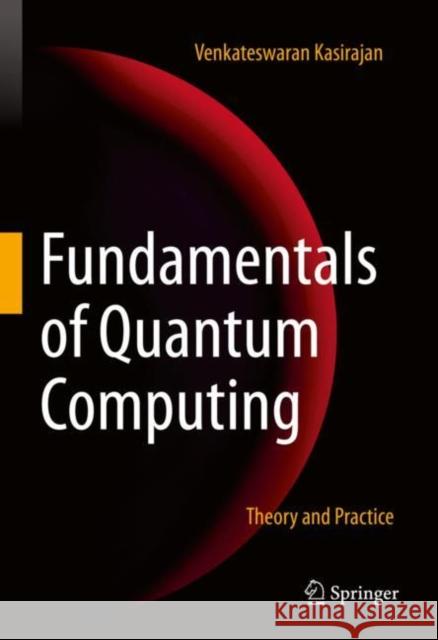
Fundamentals of Quantum Computing: Theory and Practice Venkateswaran Kasirajan 9783030636883 Springer - książkaWidoczna okładka, to zdjęcie poglądowe, a rzeczywista szata graficzna może różnić się od prezentowanej.

Fundamentals of Quantum Computing: Theory and Practice

ISBN-13: 9783030636883 / Angielski / Twarda / 2021 / 463 str.

Venkateswaran Kasirajan
cena 363,12
(netto: 345,83 VAT:  5%)

Najniższa cena z 30 dni: 346,96
Termin realizacji zamówienia:
ok. 22 dni roboczych.

Darmowa dostawa!
Kategorie:
Informatyka, Bazy danych
Kategorie BISAC:
Computers > Computer Science
Science > Fizyka kwantowa
Computers > Programming - Algorithms
Wydawca:
Springer
Język:
Angielski
ISBN-13:
9783030636883
Rok wydania:
2021
Wydanie:
2021
Ilość stron:
463
Waga:
1.06 kg
Wymiary:
25.4 x 17.78 x 2.69
Oprawa:
Twarda
Wolumenów:
01
Dodatkowe informacje:
Wydanie ilustrowane


"The book represents a new and fresh approach to quantum computing, starting with theoretical physical knowledge that is highlighted by beautiful figures. Then, quantum computing is explained by quantum programing languages and extensive languages. It is recommended to everyone interested in quantum computing. It is easy to follow through a beautiful and clear presentation, programming examples and additional exercises." (Andreas Wichert, zbMATH 1477.68005, 2022)

PART ONE

1 Foundations of Quantum Mechanics
1.1 Matter
1.2 Atoms, Elementary Particles, and Molecules
1.3 Light and Quantization of Energy
1.4 Electron Configuration
1.5 Wave-Particle Duality and Probabilistic Nature
1.6 Wavefunctions and Probability Amplitudes
1.7 Some exotic states of matter
1.8 Summary
1.9 Practice Problems
1.10 References and further reading
2 Dirac’s bra-ket notation and Hermitian Operators
2.1 Scalars
2.2 Complex Numbers
2.3 Vectors
2.4 Matrices
2.5 Linear Vector Spaces
2.6 Using Dirac’s bra-ket notation
2.7 Expectation Values and Variances
2.8 Eigenstates, Eigenvalues and Eigenfunctions
2.9 Characteristic Polynomial
2.10 Definite Symmetric Matrices
2.11 Tensors
2.12 Statistics and Probability
2.13 Summary
2.14 Practice problems
2.15 References and further reading
3 The Quantum Superposition Principle and Bloch Sphere Representation
3.1 Euclidian Space
3.2 Metric Space
3.3 Hilbert space.
3.4 Schrodinger Equation
3.5 Postulates of Quantum Mechanics
3.6 Quantum Tunneling
3.7 Stern and Gerlach Experiment
3.8 Bloch sphere representation
3.9 Projective Measurements
3.10 Qudits
3.11 Summary
3.12 Practice Problems
3.13 References and further reading
PART TWO
4 Qubit Modalities
4.1 The vocabulary of quantum computing
4.2 Classical Computers – a recap
4.3 Qubits and usability
4.4 Noisy Intermediate Scale Quantum Technology
4.5 Qubit Metrics
4.6 Leading Qubit Modalities
4.7 A note on the dilution refrigerator
4.8 Summary
4.9 Practice Problems
4.10 References and further reading
5 Quantum Circuits and DiVincenzo Criteria
5.1 Setting up the development environment
5.2 Learning Quantum Programming Languages
5.3 Introducing Quantum Circuits
5.4 Quantum Gates
5.5 The Compute Stage
5.6 Quantum Entanglement
5.7 No-Cloning theorem
5.8 Quantum Teleportation
5.9 Superdense coding
5.10 Greenberger–Horne–Zeilinger state (GHZ state)
5.11 Walsh-Hadamard Transform
5.12 Quantum Interference
5.13 Phase kickback
5.14 DiVincenzo’s criteria for quantum computation
5.15 Summary
5.16 Practice Problems
5.17 References and further reading
6 Quantum Communications
6.1 EPR Paradox
6.2 Density Matrix Formalism
6.3 Von Neumann Entropy
6.4 Photons
6.5 Quantum Communication
6.6 The Quantum Channel
6.7 Quantum Communication Protocols
6.8 RSA Security
6.9 Summary
6.10 Practice Problems
6.11 References and further reading
7 Quantum Algorithms
7.1 Quantum Ripple Adder Circuit
7.2 Quantum Fourier Transformation
7.3 Deutsch-Jozsa oracle
7.4 The Bernstein-Vazirani Oracle
7.5 Simon’s algorithm
7.6 Quantum arithmetic using QFT
7.7 Modular exponentiation
7.8 Grover’s search algorithm
7.9 Shor’s algorithm
7.10 A quantum algorithm for k-means
7.11 Quantum Phase Estimation (QPE)
7.12 HHL algorithm for solving linear equations
7.13 Quantum Complexity Theory
7.14 Summary
7.15 Practice Problems
7.16 References and further reading
8 Adiabatic Optimization and Quantum Annealing
8.1 Adiabatic evolution
8.2 Proof of the Adiabatic Theorem
8.3 Adiabatic optimization
8.4 Quantum Annealing
8.5 Summary
8.6 Practice Problems
8.7 References and further reading
9 Quantum Error Correction
9.1 Classical Error Correction
9.2 Quantum Error Codes
9.3 Stabilizer formalism
9.4 The path forward – fault-tolerant quantum computing
9.5 Surface codes
9.6 Protected qubits
9.7 Practice Problems
9.8 References and further reading
10 Conclusion
10.1 How many qubits do we need?
10.2 Classical simulation
10.3 Backends today
10.4 Future state
10.5 References

Venkateswaran Kasirajan (Venkat) is an Engineering Director at Trimble, Inc., overseeing a high-profile engineering team. By being a part of two startups, Venkat had the opportunity to work on several core technologies and booted the career of hundreds of engineers. He was also involved in several patents. 


Before studying computer science and taking up a software engineering career, Venkat studied physics; and currently continues his interest in condensed matter physics. He also researches quantum algorithms and topology, and serves as an internal champion for quantum computing at Trimble Inc. When not working, Venkat is either listening to country music or teaching his daughter while living with his family in Colorado, USA.

This introductory book on quantum computing includes an emphasis on the development of algorithms.  Appropriate for both university students as well as software developers interested in programming a quantum computer, this practical approach to modern quantum computing takes the reader through the required background and up to the latest developments.

Beginning with introductory chapters on the required math and quantum mechanics, Fundamentals of Quantum Computing proceeds to describe four leading qubit modalities and explains the core principles of quantum computing in detail. Providing a step-by-step derivation of math and source code, some of the well-known quantum algorithms are explained in simple ways so the reader can try them either on IBM Q or Microsoft QDK. The book also includes a chapter on adiabatic quantum computing and modern concepts such as topological quantum computing and surface codes.

Features:

o   Foundational chapters that build the necessary background on math and quantum mechanics.

o   Examples and illustrations throughout provide a practical approach to quantum programming with end-of-chapter exercises.

o   Detailed treatment on four leading qubit modalities -- trapped-ion, superconducting transmons, topological qubits, and quantum dots -- teaches how qubits work so that readers can understand how quantum computers work under the hood and devise efficient algorithms and error correction codes. Also introduces protected qubits - 0-π qubits, fluxon parity protected qubits, and charge-parity protected qubits.

o   Principles of quantum computing such as quantum entanglement, no-cloning theorem, quantum teleportation, quantum interference, superdense coding, quantum parallelism, and adiabatic quantum computing.


Udostępnij

Facebook - konto krainaksiazek.pl


Opinie o Krainaksiazek.pl na Opineo.pl

Partner Mybenefit

Krainaksiazek.pl w programie rzetelna firma Krainaksiaze.pl - płatności przez paypal

Czytaj nas na:

Facebook - krainaksiazek.pl
  • książki na zamówienie
  • granty
  • książka na prezent
  • kontakt
  • pomoc
  • opinie
  • regulamin
  • polityka prywatności

Zobacz:

  • Księgarnia czeska

  • Wydawnictwo Książkowe Klimaty

1997-2025 DolnySlask.com Agencja Internetowa

© 1997-2022 krainaksiazek.pl
     
KONTAKT | REGULAMIN | POLITYKA PRYWATNOŚCI | USTAWIENIA PRYWATNOŚCI
Zobacz: Księgarnia Czeska | Wydawnictwo Książkowe Klimaty | Mapa strony | Lista autorów
KrainaKsiazek.PL - Księgarnia Internetowa

Polityka prywatnosci - link
Krainaksiazek.pl - płatnośc Przelewy24
Przechowalnia Przechowalnia






