• Wyszukiwanie zaawansowane
  • Kategorie
  • Kategorie BISAC
  • Książki na zamówienie
  • Promocje
  • Granty
  • Książka na prezent
  • Opinie
  • Pomoc
  • Załóż konto
  • Zaloguj się

Fundamentals of Organic Neuromorphic Systems » książka

zaloguj się | załóż konto
Logo Krainaksiazek.pl

koszyk

konto

szukaj
topmenu
Księgarnia internetowa
Szukaj
Książki na zamówienie
Promocje
Granty
Książka na prezent
Moje konto
Pomoc
 
 
Wyszukiwanie zaawansowane
Pusty koszyk
Bezpłatna dostawa dla zamówień powyżej 20 złBezpłatna dostawa dla zamówień powyżej 20 zł

Kategorie główne

• Nauka
 [2946350]
• Literatura piękna
 [1816154]

  więcej...
• Turystyka
 [70666]
• Informatyka
 [151172]
• Komiksy
 [35576]
• Encyklopedie
 [23172]
• Dziecięca
 [611458]
• Hobby
 [135995]
• AudioBooki
 [1726]
• Literatura faktu
 [225763]
• Muzyka CD
 [378]
• Słowniki
 [2917]
• Inne
 [444280]
• Kalendarze
 [1179]
• Podręczniki
 [166508]
• Poradniki
 [469467]
• Religia
 [507199]
• Czasopisma
 [496]
• Sport
 [61352]
• Sztuka
 [242330]
• CD, DVD, Video
 [3348]
• Technologie
 [219391]
• Zdrowie
 [98638]
• Książkowe Klimaty
 [124]
• Zabawki
 [2382]
• Puzzle, gry
 [3525]
• Literatura w języku ukraińskim
 [259]
• Art. papiernicze i szkolne
 [7107]
Kategorie szczegółowe BISAC

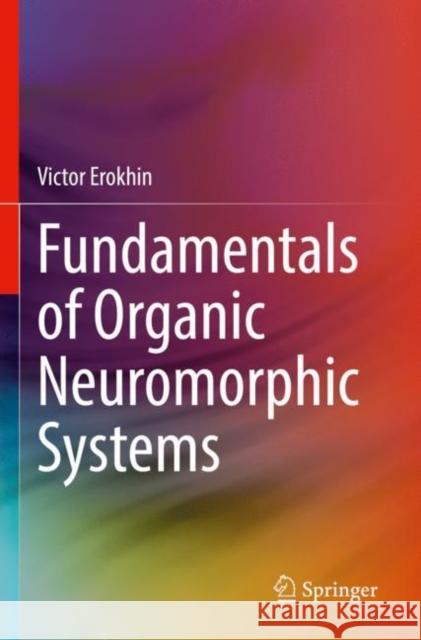
Fundamentals of Organic Neuromorphic Systems

ISBN-13: 9783030794941 / Angielski / Miękka / 2022
Victor Erokhin
Fundamentals of Organic Neuromorphic Systems Victor Erokhin 9783030794941 Springer International Publishing - książkaWidoczna okładka, to zdjęcie poglądowe, a rzeczywista szata graficzna może różnić się od prezentowanej.

Fundamentals of Organic Neuromorphic Systems

ISBN-13: 9783030794941 / Angielski / Miękka / 2022

Victor Erokhin
cena 342,14
(netto: 325,85 VAT:  5%)

Najniższa cena z 30 dni: 327,68
Termin realizacji zamówienia:
ok. 16-18 dni roboczych.

Darmowa dostawa!

This book describes the essential requirements for the realization of neuromorphic systems, where memristive devices play a key role. A comprehensive description to organic memristive devices, including working principles and models of the function, preparation methods, properties and different applications is presented. A comparative analysis of organic and inorganic systems is given. The author discusses all aspects of current research in organic memristive devices: fabrication techniques, properties, synapse mimicking circuits, and neuromorphic systems (including perceptrons), etc.

  • Describes requirements of electronic circuits and systems to be considered as neuromorphic systems;
  • Provides a single-source reference to the state-of-the-art in memristive devices as key elements of neuromorphic systems;
  • Provides a comparative analysis of advantages and drawbacks between organic and inorganic devices and systems;
  • Includes a systematic overview of organic memristive devices, including fabrication methods, properties, synapse mimicking circuits, and neuromorphic systems;
  • Discusses a variety of unconventional applications, based on bio-inspired circuits and neuromorphic systems.


Kategorie:
Technologie
Kategorie BISAC:
Technology & Engineering > Electronics - Circuits - General
Technology & Engineering > Biomedical
Wydawca:
Springer International Publishing
Język:
Angielski
ISBN-13:
9783030794941
Rok wydania:
2022
Waga:
0.43 kg
Wymiary:
23.5 x 15.5
Oprawa:
Miękka
Dodatkowe informacje:
Wydanie ilustrowane

Introduction

Chapter 1: Memristive devices and circuits

Determination of memristor

Mnemotrix

First mention about the experimental realization of memristor

Inorganic memristive devices

Memristive devices with organic materials 

Chapter 2: Organic memristive device

Basic materials

Structure and working principle of the device

Electrical characteristics of the device

Device working mechanism

Spectroscopy

X-ray fluorescence

Electrical characteristics in a pulse mode

Optimization of properties and stability of the device

Stability of organic memristive device properties

Optimization of the device architecture

Role of the electrolyte

Organic memristive devices with channels, formed by Layer-by-Layer technique

Chapter 3: Oscillators based on organic memristive devices

Chapter 4: Models

Phenomenological model

Simplified model of the organic memristive device function

Electrochemical model

Optical monitoring of the resistive states

Chapter 5: Logic elements and neuron networks

Logic elements with memory

Element “OR” with memory

Element “AND” with memory

Element “NOT” with memory

Comparison of logic elements with memory, based on organic and inorganic memristive devices

Perceptrons

Single layer perceptron

Double layer perceptron

Chapter 6: Neuromorphic systems

Learning of circuits, based on a single memristive device

DC mode

Pulse mode

Training of networks with several memristive elements

Training algorithms

Electronic analog of the part of the nervous system of pond snail Lymnaea stanìgnalis

Biological benchmark

Experimentally realized circuit, mimicking the architecture and properties of the pond snail nervous system part

Cross-talk of memristive devices during pathways formation process

Effect of noise

Frequency driven short-term memory and long-term potentiation

Spike Timing Dependent Plasticity (STDP) learning in memristive systems

STDP in circuits with polyaniline-based memristive devices

STDP in circuits with parylene-based memristive devices

Classic conditioning of polyaniline-based memristive devices systems

Classic conditioning of parylene-based memristive devices systems

Coupling with living beings

Chapter 7: 3D systems with stochastic architecture

Free-standing fibrillar systems

Stochastic networks on frames with developed structure

3D stochastic networks, based on phase separation of materials

Stabilized gold nanoparticles

Block copolymer

Fabrication of 3D stochastic network

Training of stochastic 3D network, based on phase separation of materials

Evidence of 3D nature of the realized stochastic system

Modeling of adaptive electrical characteristics of stochastic 3D network

Single memristive device

Structure of the network

Network dynamics

Modeling of experimental results, obtained on 3D stochastic networks

Conclusions

References

Victor Erokhin received his MS degree in physics and engineering in 1983 in Moscow Institute of Physics and Technology; PhD in Physical and Mathematical Sciences in 1990 in the Institute of Crystallography, Russian Academy of Sciences. After MS degree (1983-1987) he worked as an engineer in the applied research institute “Delta” (Moscow, Russia). In the period 1990-1992 (after PhD thesis) he was a researcher in the Institute of Crystallography, Russian Academy of Sciences. In 1992 he was invited to work in Genoa University (Italy) and during the period 1992-2003 he worked in different industry-oriented companies, nucleated around Genoa University (initially, senior scientist, later head of research units). After the Genoa period, during 2003-2011 he was leading scientist in INFM (National Institute of Physics of Matter) and visiting professor of Parma University (Italy). Since 2011 he works in the Institute of Materials for Electronics and Magnetism, Italian National Research Council (Parma, Italy). His current position is Director of Research and Head of the Research unit “Smart and Neuromorphic Biointerfacing Systems” in the same institute. Victor Erokhin is an author of more than 200 research papers in international referred scientific journals, 19 book chapters and 13 patents. He is an editor-in-chief of BioNanoScience (Springer Nature); member of editorial board: International Journal of Parallel, Emergent and Distributed Systems; Electronics. Victor Erokhin was principal investigator in numerous national and international research projects, chairman and co-chairman of International Symposia, and member of numerous national and international committees, including evaluation panels of ESRF (European Synchrotron Radiation Facilities, Grenoble, France) and Nano-Tera Projects (Switzerland).

This book describes the essential requirements for the realization of neuromorphic systems, where memristive devices play a key role. A comprehensive description to organic memristive devices, including working principles and models of the function, preparation methods, properties and different applications is presented. A comparative analysis of organic and inorganic systems is given. The author discusses all aspects of current research in organic memristive devices: fabrication techniques, properties, synapse mimicking circuits, and neuromorphic systems (including perceptrons), etc.

  • Describes requirements of electronic circuits and systems to be considered as neuromorphic systems;
  • Provides a single-source reference to the state-of-the-art in memristive devices as key elements of neuromorphic systems;
  • Provides a comparative analysis of advantages and drawbacks between organic and inorganic devices and systems;
  • Includes a systematic overview of organic memristive devices, including fabrication methods, properties, synapse mimicking circuits, and neuromorphic systems;
  • Discusses a variety of unconventional applications, based on bio-inspired circuits and neuromorphic systems.




Udostępnij

Facebook - konto krainaksiazek.pl


Opinie o Krainaksiazek.pl na Opineo.pl

Partner Mybenefit

Krainaksiazek.pl w programie rzetelna firma Krainaksiaze.pl - płatności przez paypal

Czytaj nas na:

Facebook - krainaksiazek.pl
  • książki na zamówienie
  • granty
  • książka na prezent
  • kontakt
  • pomoc
  • opinie
  • regulamin
  • polityka prywatności

Zobacz:

  • Księgarnia czeska

  • Wydawnictwo Książkowe Klimaty

1997-2026 DolnySlask.com Agencja Internetowa

© 1997-2022 krainaksiazek.pl
     
KONTAKT | REGULAMIN | POLITYKA PRYWATNOŚCI | USTAWIENIA PRYWATNOŚCI
Zobacz: Księgarnia Czeska | Wydawnictwo Książkowe Klimaty | Mapa strony | Lista autorów
KrainaKsiazek.PL - Księgarnia Internetowa

Polityka prywatnosci - link
Krainaksiazek.pl - płatnośc Przelewy24
Przechowalnia Przechowalnia





