• Wyszukiwanie zaawansowane
  • Kategorie
  • Kategorie BISAC
  • Książki na zamówienie
  • Promocje
  • Granty
  • Książka na prezent
  • Opinie
  • Pomoc
  • Załóż konto
  • Zaloguj się

Fundamentals of Earthquake Engineering: From Source to Fragility » książka


zaloguj się | załóż konto
Logo Krainaksiazek.pl

koszyk

konto

szukaj
topmenu
Księgarnia internetowa
Szukaj
Książki na zamówienie
Promocje
Granty
Książka na prezent
Moje konto
Pomoc
 
 
Wyszukiwanie zaawansowane
Pusty koszyk
Bezpłatna dostawa dla zamówień powyżej 20 złBezpłatna dostawa dla zamówień powyżej 20 zł

Kategorie główne

• Nauka
 [2952079]
• Literatura piękna
 [1850969]

  więcej...
• Turystyka
 [71058]
• Informatyka
 [151066]
• Komiksy
 [35579]
• Encyklopedie
 [23181]
• Dziecięca
 [620496]
• Hobby
 [139036]
• AudioBooki
 [1646]
• Literatura faktu
 [228729]
• Muzyka CD
 [379]
• Słowniki
 [2932]
• Inne
 [445708]
• Kalendarze
 [1409]
• Podręczniki
 [164793]
• Poradniki
 [480107]
• Religia
 [510956]
• Czasopisma
 [511]
• Sport
 [61267]
• Sztuka
 [243299]
• CD, DVD, Video
 [3411]
• Technologie
 [219640]
• Zdrowie
 [100984]
• Książkowe Klimaty
 [124]
• Zabawki
 [2281]
• Puzzle, gry
 [3363]
• Literatura w języku ukraińskim
 [258]
• Art. papiernicze i szkolne
 [8020]
Kategorie szczegółowe BISAC

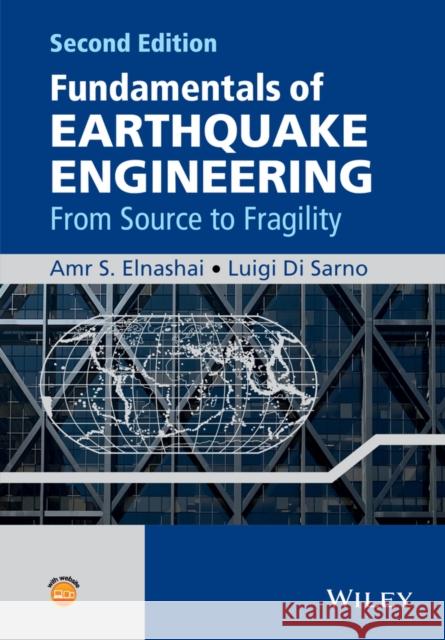
Fundamentals of Earthquake Engineering: From Source to Fragility

ISBN-13: 9781118678923 / Angielski / Twarda / 2015 / 496 str.
Amr Elnashai; Luigi Di Sarno
Fundamentals of Earthquake Engineering: From Source to Fragility Elnashai, Amr S. 9781118678923 John Wiley & Sons - książkaWidoczna okładka, to zdjęcie poglądowe, a rzeczywista szata graficzna może różnić się od prezentowanej.

Fundamentals of Earthquake Engineering: From Source to Fragility

ISBN-13: 9781118678923 / Angielski / Twarda / 2015 / 496 str.

Amr Elnashai; Luigi Di Sarno
cena 466,03
(netto: 443,84 VAT:  5%)

Najniższa cena z 30 dni: 462,21
Termin realizacji zamówienia:
ok. 30 dni roboczych.

Darmowa dostawa!

Fundamentals of Earthquake Engineering: From Source to Fragility, Second Edition combines aspects of engineering seismology, structural and geotechnical earthquake engineering to assemble the vital components required for a deep understanding of response of structures to earthquake ground motion, from the seismic source to the evaluation of actions and deformation required for design, and culminating with probabilistic fragility analysis that applies to individual as well as groups of buildings. Basic concepts for accounting for the effects of soil-structure interaction effects in seismic design and assessment are also provided in this second edition. The nature of earthquake risk assessment is inherently multi-disciplinary. Whereas this book addresses only structural safety assessment and design, the problem is cast in its appropriate context by relating structural damage states to societal consequences and expectations, through the fundamental response quantities of stiffness, strength and ductility. This new edition includes material on the nature of earthquake sources and mechanisms, various methods for the characterization of earthquake input motion, effects of soil-structure interaction, damage observed in reconnaissance missions, modeling of structures for the purposes of response simulation, definition of performance limit states, fragility relationships derivation, features and effects of underlying soil, structural and architectural systems for optimal seismic response, and action and deformation quantities suitable for design. Key features:

  • Unified and novel approach: from source to fragility
  • Clear conceptual framework for structural response analysis, earthquake input characterization, modelling of soil-structure interaction and derivation of fragility functions
  • Theory and relevant practical applications are merged within each chapter
  • Contains a new chapter on the derivation of fragility
  • Accompanied by a website containing illustrative slides, problems with solutions and worked-through examples
Fundamentals of Earthquake Engineering: From Source to Fragility, Second Edition is designed to support graduate teaching and learning, introduce practising structural and geotechnical engineers to earthquake analysis and design problems, as well as being a reference book for further studies.

Kategorie:
Technologie
Kategorie BISAC:
Science > Mechanics - General
Technology & Engineering > Civil - General
Wydawca:
John Wiley & Sons
Język:
Angielski
ISBN-13:
9781118678923
Rok wydania:
2015
Ilość stron:
496
Waga:
0.88 kg
Wymiary:
17.53 x 24.38 x 2.79
Oprawa:
Twarda
Wolumenów:
01
Dodatkowe informacje:
Bibliografia

Preface xi

Foreword xii

Acknowledgements xiii

Introduction xiv

List of Abbreviations xix

List of Symbols xxii

1 Earthquake Characteristics 1

1.1 Causes of Earthquakes 1

1.1.1 Plate Tectonics Theory 1

1.1.2 Faulting 7

1.1.3 Seismic Waves 11

1.2 Measuring Earthquakes 17

1.2.1 Intensity 17

1.2.2 Magnitude 21

1.2.3 Intensity–Magnitude Relationships 26

1.3 Source]to]Site Effects 29

1.3.1 Directional Effects 30

1.3.2 Site Effects 32

1.3.3 Dispersion and Incoherence 35

1.4 Effects of Earthquakes 36

1.4.1 Damage to Buildings and Lifelines 39

1.4.2 Effects on the Ground 41

1.4.2.1 Surface Rupture 43

1.4.2.2 Settlement and Uplift 43

1.4.2.3 Liquefaction 44

1.4.2.4 Landslides 44

1.4.3 Human and Financial Losses 47

References 51

2 Response of Structures 54

2.1 General 54

2.2 Conceptual Framework 55

2.2.1 Definitions 55

2.2.2 Strength] versus Ductility]Based Response 56

2.2.3 Member] versus System]Level Consideration 58

2.2.4 Nature of Seismic Effects 60

2.2.5 Fundamental Response Quantities 60

2.2.6 Social and Economic Limit States 62

2.3 Structural Response Characteristics 63

2.3.1 Stiffness 63

2.3.1.1 Factors Influencing Stiffness 65

2.3.1.2 Effects on Action and Deformation Distributions 71

2.3.1.3 Non]structural Damage Control 80

2.3.2 Strength 82

2.3.2.1 Factors Influencing Strength 84

2.3.2.2 Effects on Load Path 90

2.3.2.3 Structural Damage Control 94

2.3.3 Ductility 97

2.3.3.1 Factors Influencing Ductility 100

2.3.3.2 Effects on Action Redistribution 111

2.3.3.3 Structural Collapse Prevention 113

2.3.4 Overstrength 116

2.3.5 Damping 122

2.3.6 Relationship between Strength, Overstrength and Ductility: Force Reduction Factor ‘Supply’ 128

References 132

3 Earthquake Input Motion 136

3.1 General 136

3.2 Earthquake Occurrence and Return Period 136

3.3 Ground]Motion Models (Attenuation Relationships) 140

3.3.1 Features of Strong]Motion Data for Attenuation Relationships 143

3.3.2 Attenuation Relationship for Europe 144

3.3.3 Attenuation Relationship for Japan 145

3.3.4 Attenuation Relationships for North America 146

3.3.4.1 Central and Eastern United States 146

3.3.4.2 Western North America 147

3.3.5 Worldwide Attenuation Relationships 148

3.4 Earthquake Spectra 149

3.4.1 Factors Influencing Response Spectra 149

3.4.2 Elastic and Inelastic Spectra 151

3.4.3 Simplified Spectra 158

3.4.3.1 Spectra from Attenuation Relationships 159

3.4.3.2 Spectra from Ground]Motion Parameters 165

3.4.4 Force Reduction Factors (Demand) 167

3.4.4.1 Newmark and Hall (1982) 168

3.4.4.2 Krawinkler and Nassar (1992) 169

3.4.4.3 Miranda and Bertero (1994) 169

3.4.4.4 Vidic et al. (1994) 170

3.4.4.5 Borzi and Elnashai (2000) 171

3.4.4.6 Comparison between Response Modification Factor Models 173

3.4.5 Design Spectra 174

3.4.6 Vertical Component of Ground Motion 176

3.4.7 Vertical Motion Spectra 178

3.5 Earthquake Records 180

3.5.1 Natural Records 180

3.5.1.1 Regional Differences 180

3.5.1.2 Selection Criteria 182

3.5.2 Artificial Records 184

3.5.3 Records Based on Mathematical Formulations 185

3.5.4 Scaling of Earthquake Records 187

3.5.4.1 Scaling Based on Peak Ground Parameters 187

3.5.4.2 Scaling Based on Spectrum Intensity 188

3.6 Duration and Number of Cycles of Earthquake Ground Motions 194

3.7 Use of Earthquake Databases 199

3.8 Software for Deriving Spectra and Generation of Ground]Motion Records 200

3.8.1 Derivation of Earthquake Spectra 200

3.8.2 Generation of Ground]Motion Records 202

References 203

4 Response Evaluation 211

4.1 General 211

4.2 Conceptual Framework 211

4.3 Ground Motion and Load Modelling 214

4.4 Seismic Load Combinations 215

4.5 Structural Modelling 218

4.5.1 Materials 222

4.5.1.1 Metals 222

4.5.1.2 Reinforced Concrete 224

4.5.2 Sections 227

4.5.3 Components and Systems for Structural Modelling 231

4.5.3.1 Beams and Columns 233

4.5.3.2 Connections 237

4.5.3.3 Diaphragms 238

4.5.3.4 Infills 240

4.5.3.5 Frames 241

4.5.3.6 Structural Walls 245

4.5.4 Masses 248

4.6 Methods of Analysis 250

4.6.1 Dynamic Analysis 252

4.6.1.1 Modal and Spectral Analyses 254

4.6.1.2 Response]History Analysis 260

4.6.1.3 Incremental Dynamic Analysis 262

4.6.2 Static Analysis 265

4.6.2.1 Equivalent Static Analysis 265

4.6.2.2 Pushover Analysis 266

4.6.3 Simplified Code Method 272

4.7 Performance Levels and Objectives 278

4.8 Output for Assessment 285

4.8.1 Actions 287

4.8.2 Deformations 287

References 294

5 Fragility Relationships for Structures 300

5.1 General 300

5.2 Theory and Applications 301

5.3 Empirical Functions 313

5.4 Analytical Functions 321

References 335

6 Seismic Soil–Structure Interaction 340

6.1 General 340

6.2 Effects of SSI on Structural Response 342

6.3 Modelling Methods for the Soil–Foundation System 344

6.3.1 Lumped Elastic Springs and Dampers 344

6.3.2 Frequency]Dependent Stiffness and Damping 346

6.3.3 Inelastic Elements for Near]Field Soil 349

6.3.4 Modelling of Pile and Pile Group Foundations 350

6.3.5 Lumped Spring–Mass–Damper System 351

6.3.6 Time Series Representation of Foundation Reaction 352

6.4 Analysis Methods 354

6.4.1 Frequency]Domain Analyses 355

6.4.2 Direct Approach 355

6.4.3 Multistep Approach 357

6.5 Application Examples 359

6.5.1 Pile–Soil Interaction Analysis 360

6.5.1.1 Site Properties 361

6.5.1.2 Finite Element Model 361

6.5.1.3 Analysis and Results 362

6.5.2 Meloland Road Overcrossing – Embankment–Structure Interaction 363

6.5.2.1 Bridge and Site Properties 364

6.5.2.2 Embankment and Foundation Model 364

6.5.2.3 Soil–Structure]Interaction Analysis Configuration 366

6.5.2.4 Dynamic Properties of the Embankment–Bridge System 366

6.5.2.5 Time]History Analysis Results 368

6.5.3 Caruthersville Bridge 368

References 372

Concluding Remarks 377

Appendix A – Structural Configurations and Systems for Effective Earthquake Resistance 379

A.1 Structural Configurations 379

A.1.1 Plan Regularity 383

A.1.2 Elevation Regularity 387

A.2 Structural Systems 391

A.2.1 Horizontal Systems 391

A.2.2 Vertical Systems 393

A.2.2.1 Moment]Resisting Frames 395

A.2.2.2 Braced Frames 396

A.2.2.3 Structural Walls 399

A.2.2.4 Hybrid Frames 401

A.2.2.5 Tube Systems 403

References 407

Appendix B – Damage to Structures 409

B.1 Structural Deficiencies 409

B.1.1 Buildings 409

B.1.2 Bridges 411

B.2 Examples of Damage to Buildings 411

B.2.1 RC Buildings 412

B.2.1.1 Beams 412

B.2.1.2 Columns 413

B.2.1.3 Beam]to]Column Joints 417

B.2.1.4 Frames 419

B.2.1.5 Walls 427

B.2.2 Masonry Buildings 428

B.2.2.1 Failure in Load]Bearing Walls 429

B.2.2.2 Failure in Non]bearing Walls 431

B.2.2.3 Failure of Wall Connections 432

B.2.3 Steel and Composite Buildings 432

B.2.3.1 Member Failures 433

B.2.3.2 Connection Failures 435

B.2.3.3 System Failures 439

B.3 Examples of Damage to Bridges 440

B.3.1 Span Failure 441

B.3.2 Abutment Failure 444

B.3.3 Pier Failure 445

B.3.3.1 Column Flexural Failure 446

B.3.3.2 Column Shear Failure 447

B.3.3.3 Column Buckling and Fractures 447

B.3.4 Joint Failure 450

B.3.5 Footing Failure 450

B.3.6 Geotechnical Effects 454

B.4 Lessons Learnt from Previous Earthquakes 455

B.4.1 Requisites of RC Structures 455

B.4.2 Requisites of Masonry Structures 456

B.4.3 Requisites of Steel and Composite Structures 457

References 457

Index 459

Amr S. Elnashai Pennsylvania State University, USA

Luigi Di Sarno
University of Sannio, Italy

Fundamentals of Earthquake Engineering: From Source to Fragility, Second Edition combines aspects of engineering seismology, structural and geotechnical earthquake engineering to assemble the vital components required for a deep understanding of the response of structures to earthquake ground motion, from the seismic source to the evaluation of actions and deformation required for design, and culminating with probabilistic fragility analysis that applies to individual as well as groups of buildings. Basic concepts accounting for the effects of soil–structure interactions in seismic design and assessment are also provided in this second edition.

The nature of earthquake risk assessment is inherently multidisciplinary. While this book addresses only structural safety assessment and design, the problem is cast in its appropriate context by relating structural damage states to societal consequences and expectations, through the fundamental response quantities of stiffness, strength and ductility.

This new edition includes material on the nature of earthquake sources and mechanisms, various methods for the characterisation of earthquake input motion, effects of soil–structure interaction, damage observed in reconnaissance missions, modelling of structures for the purposes of response simulation, definition of performance limit states, fragility relationships derivation, features and effects of underlying soil, structural and architectural systems for optimal seismic response, and action and deformation quantities suitable for design.

Key features:

• Unified and novel approach: from source to fragility

• Clear conceptual framework for structural response analysis, earthquake input characterisation, modelling of soil–structure interaction and derivation of fragility functions

• Theory and relevant practical applications are merged within each chapter

• Contains a new chapter on the derivation of fragility

• Accompanied by a website containing illustrative slides, problems with solutions and worked–through examples

Fundamentals of Earthquake Engineering: From Source to Fragility, Second Edition is designed to support graduate teaching and learning, introduce practising structural and geotechnical engineers to earthquake analysis and design problems, as well as being a reference book for further studies.

Elnashai, Amr Textbook author.... więcej >


Udostępnij

Facebook - konto krainaksiazek.pl


Opinie o Krainaksiazek.pl na Opineo.pl

Partner Mybenefit

Krainaksiazek.pl w programie rzetelna firma Krainaksiaze.pl - płatności przez paypal

Czytaj nas na:

Facebook - krainaksiazek.pl
  • książki na zamówienie
  • granty
  • książka na prezent
  • kontakt
  • pomoc
  • opinie
  • regulamin
  • polityka prywatności

Zobacz:

  • Księgarnia czeska

  • Wydawnictwo Książkowe Klimaty

1997-2026 DolnySlask.com Agencja Internetowa

© 1997-2022 krainaksiazek.pl
     
KONTAKT | REGULAMIN | POLITYKA PRYWATNOŚCI | USTAWIENIA PRYWATNOŚCI
Zobacz: Księgarnia Czeska | Wydawnictwo Książkowe Klimaty | Mapa strony | Lista autorów
KrainaKsiazek.PL - Księgarnia Internetowa

Polityka prywatnosci - link
Krainaksiazek.pl - płatnośc Przelewy24
Przechowalnia Przechowalnia






