• Wyszukiwanie zaawansowane
  • Kategorie
  • Kategorie BISAC
  • Książki na zamówienie
  • Promocje
  • Granty
  • Książka na prezent
  • Opinie
  • Pomoc
  • Załóż konto
  • Zaloguj się

From Tool to Partner: The Evolution of Human-Computer Interaction » książka


zaloguj się | załóż konto
Logo Krainaksiazek.pl

koszyk

konto

szukaj
topmenu
Księgarnia internetowa
Szukaj
Książki na zamówienie
Promocje
Granty
Książka na prezent
Moje konto
Pomoc
 
 
Wyszukiwanie zaawansowane
Pusty koszyk
Bezpłatna dostawa dla zamówień powyżej 20 złBezpłatna dostawa dla zamówień powyżej 20 zł

Kategorie główne

• Nauka
 [2946912]
• Literatura piękna
 [1852311]

  więcej...
• Turystyka
 [71421]
• Informatyka
 [150889]
• Komiksy
 [35717]
• Encyklopedie
 [23177]
• Dziecięca
 [617324]
• Hobby
 [138808]
• AudioBooki
 [1671]
• Literatura faktu
 [228371]
• Muzyka CD
 [400]
• Słowniki
 [2841]
• Inne
 [445428]
• Kalendarze
 [1545]
• Podręczniki
 [166819]
• Poradniki
 [480180]
• Religia
 [510412]
• Czasopisma
 [525]
• Sport
 [61271]
• Sztuka
 [242929]
• CD, DVD, Video
 [3371]
• Technologie
 [219258]
• Zdrowie
 [100961]
• Książkowe Klimaty
 [124]
• Zabawki
 [2341]
• Puzzle, gry
 [3766]
• Literatura w języku ukraińskim
 [255]
• Art. papiernicze i szkolne
 [7810]
Kategorie szczegółowe BISAC

From Tool to Partner: The Evolution of Human-Computer Interaction

ISBN-13: 9783031010903 / Angielski / Miękka / 2017 / 184 str.
Jonathan Grudin
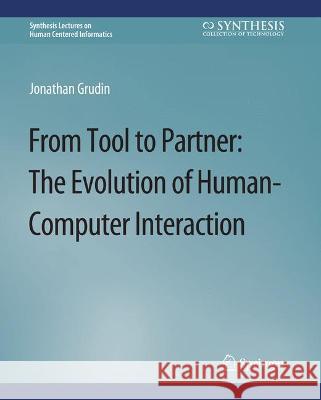
From Tool to Partner: The Evolution of Human-Computer Interaction JONATHAN GRUDIN   9783031010903 Springer International Publishing AG - książkaWidoczna okładka, to zdjęcie poglądowe, a rzeczywista szata graficzna może różnić się od prezentowanej.

From Tool to Partner: The Evolution of Human-Computer Interaction

ISBN-13: 9783031010903 / Angielski / Miękka / 2017 / 184 str.

Jonathan Grudin
cena 212,82
(netto: 202,69 VAT:  5%)

Najniższa cena z 30 dni: 204,31
Termin realizacji zamówienia:
ok. 22 dni roboczych
Dostawa w 2026 r.

Darmowa dostawa!

This is the first comprehensive history of human-computer interaction (HCI). Whether you are a user-experience professional or an academic researcher, whether you identify with computer science,human factors, information systems, information science, design, or communication, you can discover how your experiences fit into the expanding field of HCI. You can determine where to look for relevant information in other fields-and where you won't find it. This book describes the different fields that have participated in improving our digital tools.It is organized chronologically, describing major developments across fields in each period. Computer use has changed radically, but many underlying forces are constant. Technology has changed rapidly, human nature very little. An irresistible force meets an immovable object. The exponential rate of technological change gives us little time to react before technology moves on. Patterns and trajectories described in this book provide your best chance to anticipate what could come next. We have reached a turning point. Tools that we built for ourselves to use are increasingly influencing how we use them, in ways that are planned and sometimes unplanned. The book ends with issues worthy of consideration as we explore the new world that we and our digital partners are shaping.


Kategorie:
Informatyka
Kategorie BISAC:
Computers > Human-Computer Interaction (HCI)
Computers > History
Computers > Artificial Intelligence - General
Wydawca:
Springer International Publishing AG
Język:
Angielski
ISBN-13:
9783031010903
Rok wydania:
2017
Dostępne języki:
Ilość stron:
184
Waga:
0.32 kg
Wymiary:
23.5 x 19.05 x 0.99
Oprawa:
Miękka
Dodatkowe informacje:
Glosariusz/słownik
Wydanie ilustrowane

Preface.- Acknowledgments.- Preamble: History in a Time of Rapid Change.- Human-Tool Interaction and Information Processing at the Dawn of Computing.- 1945-1955: Managing Vacuum Tubes.- 1955-1965: Transistors, New Vistas.- 1965-1980: HCI Prior to Personal Computing.- Hardware Generations.- 1980-1985: Discretionary Use Comes into Focus.- 1985-1995: Graphical User Interfaces Succeed.- 1995-2005: The Internet Era Arrives and Survives a Bubble.- 2005-2015: Scaling.- Reflection: Cultures and Bridges.- A New Era.- Conclusion: Ubiquitous Human-Computer Interaction.- Appendix A: Personal Observations.- AppendixB A Toolkit for Writing a Conceptual History.- Glossary.- Bibliography.- Author Biography.- Index.

Jonathan Grudin connected to computer history on a school field trip, when he played blackjack against a huge computer at Battelle Laboratories in Columbus, Ohio. Perhaps a vacuum tube had burned out. The computer claimed to have won when it had not, convincing Jonathan that computers were impressive but not infallible. While in high school, he taught himself to write programs, enter them on punch cards, and run them on a nearby college's sole computer, unused in the evenings and on weekends. His first program found twin primes; his second constructed random bridge hands. Jonathan majored in mathematics-physics at Reed College and obtained an M.S. in mathematics at Purdue University. After working as a programmer at Wang Laboratories and Stanford University, he obtained a Ph.D. in cognitive psychology, working with Don Norman at the University of California, San Diego and spending two of his summers at the MIT Artificial Intelligence Laboratory. During a two-year postdoc at the Medical Research Council Applied Psychology Unit in Cambridge, he conducted his first human-computer interaction studies with Phil Barnard and Allan MacLean. He returned to work as a software engineer at Wang Laboratories and team leader at the artificial intelligence-oriented Microelectronics and Computer Technology Corporation consortium in Austin, Texas. From 1989 to 1991, he was a visiting professor at Aarhus University. His first exploration of the field's history, in the library next to his office, was to determine the origin of the waterfall model of software development. From 1992 to 1998, he was a professor of information and computer science at the University of California, Irvine. He spent six-month sabbaticals at Keio University and the University of Oslo. In 1998, he joined Microsoft and became an affiliate professor at the University of Washington Information School. Jonathan is an ACM Fellow and member of ACM SIGCHI's CHI Academy. He has participated in CHI and CSCW since their first conferences. His CSCW 1988 paper on the challenges in designing technology to support groups won the first CSCW Lasting Impact Award in 2014.


Udostępnij

Facebook - konto krainaksiazek.pl


Opinie o Krainaksiazek.pl na Opineo.pl

Partner Mybenefit

Krainaksiazek.pl w programie rzetelna firma Krainaksiaze.pl - płatności przez paypal

Czytaj nas na:

Facebook - krainaksiazek.pl
  • książki na zamówienie
  • granty
  • książka na prezent
  • kontakt
  • pomoc
  • opinie
  • regulamin
  • polityka prywatności

Zobacz:

  • Księgarnia czeska

  • Wydawnictwo Książkowe Klimaty

1997-2025 DolnySlask.com Agencja Internetowa

© 1997-2022 krainaksiazek.pl
     
KONTAKT | REGULAMIN | POLITYKA PRYWATNOŚCI | USTAWIENIA PRYWATNOŚCI
Zobacz: Księgarnia Czeska | Wydawnictwo Książkowe Klimaty | Mapa strony | Lista autorów
KrainaKsiazek.PL - Księgarnia Internetowa

Polityka prywatnosci - link
Krainaksiazek.pl - płatnośc Przelewy24
Przechowalnia Przechowalnia





