• Wyszukiwanie zaawansowane
  • Kategorie
  • Kategorie BISAC
  • Książki na zamówienie
  • Promocje
  • Granty
  • Książka na prezent
  • Opinie
  • Pomoc
  • Załóż konto
  • Zaloguj się

From Extractive to Abstractive Summarization: A Journey » książka

zaloguj się | załóż konto
Logo Krainaksiazek.pl

koszyk

konto

szukaj
topmenu
Księgarnia internetowa
Szukaj
Książki na zamówienie
Promocje
Granty
Książka na prezent
Moje konto
Pomoc
 
 
Wyszukiwanie zaawansowane
Pusty koszyk
Bezpłatna dostawa dla zamówień powyżej 20 złBezpłatna dostawa dla zamówień powyżej 20 zł

Kategorie główne

• Nauka
 [2946600]
• Literatura piękna
 [1856966]

  więcej...
• Turystyka
 [72221]
• Informatyka
 [151456]
• Komiksy
 [35826]
• Encyklopedie
 [23190]
• Dziecięca
 [619653]
• Hobby
 [140543]
• AudioBooki
 [1577]
• Literatura faktu
 [228355]
• Muzyka CD
 [410]
• Słowniki
 [2874]
• Inne
 [445822]
• Kalendarze
 [1744]
• Podręczniki
 [167141]
• Poradniki
 [482898]
• Religia
 [510455]
• Czasopisma
 [526]
• Sport
 [61590]
• Sztuka
 [243598]
• CD, DVD, Video
 [3423]
• Technologie
 [219201]
• Zdrowie
 [101638]
• Książkowe Klimaty
 [124]
• Zabawki
 [2473]
• Puzzle, gry
 [3898]
• Literatura w języku ukraińskim
 [254]
• Art. papiernicze i szkolne
 [8170]
Kategorie szczegółowe BISAC

From Extractive to Abstractive Summarization: A Journey

ISBN-13: 9789811389368 / Angielski / Miękka / 2020 / 116 str.
Parth Mehta;Prasenjit Majumder
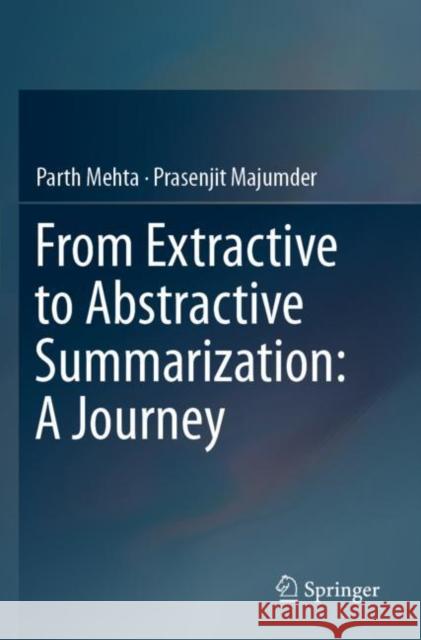
From Extractive to Abstractive Summarization: A Journey Mehta, Parth, Prasenjit Majumder 9789811389368 Springer Singapore - książkaWidoczna okładka, to zdjęcie poglądowe, a rzeczywista szata graficzna może różnić się od prezentowanej.

From Extractive to Abstractive Summarization: A Journey

ISBN-13: 9789811389368 / Angielski / Miękka / 2020 / 116 str.

Parth Mehta;Prasenjit Majumder
cena 403,47 zł
(netto: 384,26 VAT:  5%)

Najniższa cena z 30 dni: 385,52 zł
Termin realizacji zamówienia:
ok. 22 dni roboczych
Bez gwarancji dostawy przed świętami

Darmowa dostawa!
inne wydania

This book describes recent advances in text summarization, identifies remaining gaps and challenges, and proposes ways to overcome them. It begins with one of the most frequently discussed topics in text summarization –  ‘sentence extraction’ –, examines the effectiveness of current techniques in domain-specific text summarization, and proposes several improvements. 
In turn, the book describes the application of summarization in the legal and scientific domains, describing two new corpora that consist of more than 100 thousand court judgments and more than 20 thousand scientific articles, with the corresponding manually written summaries. The availability of these large-scale corpora opens up the possibility of using the now popular data-driven approaches based on deep learning. The book then highlights the effectiveness of neural sentence extraction approaches, which perform just as well as rule-based approaches, but without the need for any manual annotation. As a next step, multiple techniques for creating ensembles of sentence extractors – which deliver better and more robust summaries – are proposed. In closing, the book presents a neural network-based model for sentence compression. Overall the book takes readers on a journey that begins with simple sentence extraction and ends in abstractive summarization, while also covering key topics like ensemble techniques and domain-specific summarization, which have not been explored in detail prior to this.


Kategorie:
Informatyka, Bazy danych
Kategorie BISAC:
Computers > Networking - Hardware
Computers > Information Technology
Computers > Computer Science
Wydawca:
Springer Singapore
Język:
Angielski
ISBN-13:
9789811389368
Rok wydania:
2020
Wydanie:
2019
Ilość stron:
116
Waga:
0.18 kg
Wymiary:
23.37 x 19.56 x 0.25
Oprawa:
Miękka
Wolumenów:
01

​1 Introduction


1.1 Extractive Summarization
1.2 Information Fusion and Ensemble Techniques
1.3 Abstractive Summarization
1.4 Main contributions
1.5 Organization

2 Related Work

2.1 Extractive Summarization
2.1.1 Legal Document Summarization
2.1.2 Scientific article Summarization
2.2 Ensemble techniques for extractive summarization
2.3 Sentence compression

3 Domain specific Extractive Summarization

3.1 Corpora
3.2 Legal document Summarization
3.2.1 Boosting legal vocabulary using a lexicon
3.2.2 Weighted TextRank and LexRank
3.2.3 Automatic key phrase identification
3.2.4 Attention based sentence extractor
3.3 Scientific article summarization
3.4 Experiment Details
3.4.1 Results
3.5 Conclusion

4 Improving extractive techniques through rank aggregation

4.1 Motivation for rank aggregation
4.2 Analysis of existing extractive systems
4.2.1 Experimental Setup
4.3 Ensemble of extractive summarization systems
4.3.1 Effect of Informed fusion
4.4 Discussion
4.4.1 Determining the robustness of candidate systems
4.4.2 Qualitative analysis of summaries

5 Leveraging content similarity in summaries for generating better ensembles

5.1 Limitations of consensus based aggregation
5.2 Proposed approach for content based aggregation
5.3 Document level aggregation
5.3.1 Experimental results
5.4 Sentence Level aggregation
5.4.1 SentRank
5.4.2 GlobalRank
5.4.3 LocalRank
5.4.4 HybridRank
5.4.5 Experimental Results
5.5 Conclusion

6 Neural model for sentence compression

6.1 Sentence compression by deletion
6.2 Sentence compression using Sequence to Sequence model
6.2.1 Sentence Encoder
6.2.2 Context Encoder
6.2.3 Decoder
6.2.4 Attention module
6.3 Exploiting SMT techniques for sentence compression
6.4 Results for sentence compression
6.5 Limitations of sentence compression techniques
6.6 Overall System

7 Conclusion and Future Work

Dr. Parth Mehta completed his M.Tech. in Machine Intelligence and his Ph.D. in Text Summarization at Dhirubhai Ambani Institute of ICT (DA-IICT), Gandhinagar, India. At the DA-IICT he was part of the Information Retrieval and Natural Language Processing Lab. He was also involved in the national project “Cross Lingual Information Access”, funded by the Govt. of India, which focused on building a cross-lingual search engine for nine Indian languages. 
Dr. Mehta has served as reviewer for the journals Information Processing and Management and Forum for Information Retrieval Evaluation. Apart from several journal and conference papers, he has also co-edited a book on text processing published by Springer. 
Prof. Prasenjit Majumder is an Associate Professor at Dhirubhai Ambani Institute of ICT (DA-IICT), Gandhinagar and a Visiting Professor at the Indian Institute of Information Technology, Vadodara (IIIT-V). Prof. Majumder completed his Ph.D. at Jadavpur University in 2008 and worked as a postdoctoral fellow at the University College Dublin, prior to joining the DA-IICT, where he currently heads the Information Retrieval and Language Processing Lab. His research interests lie at the intersection of Information Retrieval, Cognitive Science and Human Computing Interaction. He has headed several projects sponsored by the Govt. of India. 
He is one of the pioneers of the Forum for Information Retrieval Evaluation (FIRE), which assesses research on Information Retrieval and related areas for South Asian languages. Since being founded in 2008, FIRE has grown to become a respected conference, drawing participants from across the globe. Prof. Majumder has authored several journal and conference papers, and co-edited two special issues of Transactions in Information Systems (ACM). He has co-edited two books: ‘Multi Lingual Information Access in South Asian Languages’ and ‘Text Processing,’ both published by Springer.

This book describes recent advances in text summarization, identifies remaining gaps and challenges, and proposes ways to overcome them. It begins with one of the most frequently discussed topics in text summarization –  ‘sentence extraction’ –, examines the effectiveness of current techniques in domain-specific text summarization, and proposes several improvements. 
In turn, the book describes the application of summarization in the legal and scientific domains, describing two new corpora that consist of more than 100 thousand court judgments and more than 20 thousand scientific articles, with the corresponding manually written summaries. The availability of these large-scale corpora opens up the possibility of using the now popular data-driven approaches based on deep learning. The book then highlights the effectiveness of neural sentence extraction approaches, which perform just as well as rule-based approaches, but without the need for any manual annotation. As a next step, multiple techniques for creating ensembles of sentence extractors – which deliver better and more robust summaries – are proposed. In closing, the book presents a neural network-based model for sentence compression. Overall the book takes readers on a journey that begins with simple sentence extraction and ends in abstractive summarization, while also covering key topics like ensemble techniques and domain-specific summarization, which have not been explored in detail prior to this.




Udostępnij

Facebook - konto krainaksiazek.pl


Opinie o Krainaksiazek.pl na Opineo.pl

Partner Mybenefit

Krainaksiazek.pl w programie rzetelna firma Krainaksiaze.pl - płatności przez paypal

Czytaj nas na:

Facebook - krainaksiazek.pl
  • książki na zamówienie
  • granty
  • książka na prezent
  • kontakt
  • pomoc
  • opinie
  • regulamin
  • polityka prywatności

Zobacz:

  • Księgarnia czeska

  • Wydawnictwo Książkowe Klimaty

1997-2025 DolnySlask.com Agencja Internetowa

© 1997-2022 krainaksiazek.pl
     
KONTAKT | REGULAMIN | POLITYKA PRYWATNOŚCI | USTAWIENIA PRYWATNOŚCI
Zobacz: Księgarnia Czeska | Wydawnictwo Książkowe Klimaty | Mapa strony | Lista autorów
KrainaKsiazek.PL - Księgarnia Internetowa

Polityka prywatnosci - link
Krainaksiazek.pl - płatnośc Przelewy24
Przechowalnia Przechowalnia




