• Wyszukiwanie zaawansowane
  • Kategorie
  • Kategorie BISAC
  • Książki na zamówienie
  • Promocje
  • Granty
  • Książka na prezent
  • Opinie
  • Pomoc
  • Załóż konto
  • Zaloguj się

Fraud Analytics Using Descriptive, Predictive, and Social Network Techniques: A Guide to Data Science for Fraud Detection » książka


zaloguj się | załóż konto
Logo Krainaksiazek.pl

koszyk

konto

szukaj
topmenu
Księgarnia internetowa
Szukaj
Książki na zamówienie
Promocje
Granty
Książka na prezent
Moje konto
Pomoc
 
 
Wyszukiwanie zaawansowane
Pusty koszyk
Bezpłatna dostawa dla zamówień powyżej 20 złBezpłatna dostawa dla zamówień powyżej 20 zł

Kategorie główne

• Nauka
 [2948695]
• Literatura piękna
 [1824038]

  więcej...
• Turystyka
 [70868]
• Informatyka
 [151073]
• Komiksy
 [35227]
• Encyklopedie
 [23181]
• Dziecięca
 [621575]
• Hobby
 [138961]
• AudioBooki
 [1642]
• Literatura faktu
 [228651]
• Muzyka CD
 [371]
• Słowniki
 [2933]
• Inne
 [445341]
• Kalendarze
 [1243]
• Podręczniki
 [164416]
• Poradniki
 [479493]
• Religia
 [510449]
• Czasopisma
 [502]
• Sport
 [61384]
• Sztuka
 [243086]
• CD, DVD, Video
 [3417]
• Technologie
 [219673]
• Zdrowie
 [100865]
• Książkowe Klimaty
 [124]
• Zabawki
 [2168]
• Puzzle, gry
 [3372]
• Literatura w języku ukraińskim
 [260]
• Art. papiernicze i szkolne
 [7838]
Kategorie szczegółowe BISAC

Fraud Analytics Using Descriptive, Predictive, and Social Network Techniques: A Guide to Data Science for Fraud Detection

ISBN-13: 9781119133124 / Angielski / Twarda / 2015 / 400 str.
Wouter Verbeke
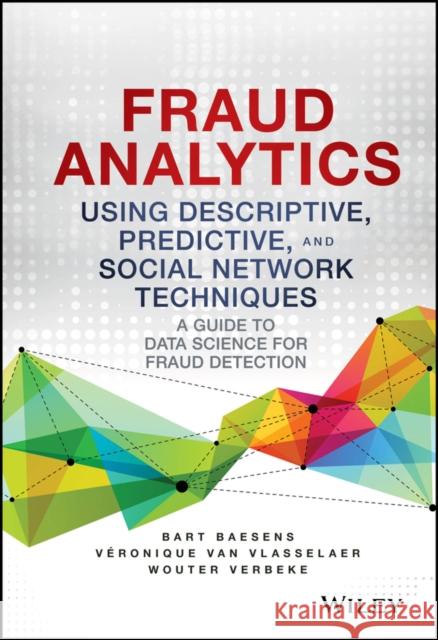
Fraud Analytics Using Descriptive, Predictive, and Social Network Techniques: A Guide to Data Science for Fraud Detection Wouter Verbeke 9781119133124 John Wiley & Sons Inc - książkaWidoczna okładka, to zdjęcie poglądowe, a rzeczywista szata graficzna może różnić się od prezentowanej.

Fraud Analytics Using Descriptive, Predictive, and Social Network Techniques: A Guide to Data Science for Fraud Detection

ISBN-13: 9781119133124 / Angielski / Twarda / 2015 / 400 str.

Wouter Verbeke
cena 196,26
(netto: 186,91 VAT:  5%)

Najniższa cena z 30 dni: 195,79
Termin realizacji zamówienia:
ok. 8-10 dni roboczych.

Darmowa dostawa!

Detect fraud earlier to mitigate loss and prevent cascading damage Fraud Analytics Using Descriptive, Predictive, and Social Network Techniques is an authoritative guidebook for setting up a comprehensive fraud detection analytics solution. Early detection is a key factor in mitigating fraud damage, but it involves more specialized techniques than detecting fraud at the more advanced stages. This invaluable guide details both the theory and technical aspects of these techniques, and provides expert insight into streamlining implementation. Coverage includes data gathering, preprocessing, model building, and post-implementation, with comprehensive guidance on various learning techniques and the data types utilized by each. These techniques are effective for fraud detection across industry boundaries, including applications in insurance fraud, credit card fraud, anti-money laundering, healthcare fraud, telecommunications fraud, click fraud, tax evasion, and more, giving you a highly practical framework for fraud prevention. It is estimated that a typical organization loses about 5% of its revenue to fraud every year. More effective fraud detection is possible, and this book describes the various analytical techniques your organization must implement to put a stop to the revenue leak.

  • Examine fraud patterns in historical data
  • Utilize labeled, unlabeled, and networked data
  • Detect fraud before the damage cascades
  • Reduce losses, increase recovery, and tighten security
The longer fraud is allowed to go on, the more harm it causes. It expands exponentially, sending ripples of damage throughout the organization, and becomes more and more complex to track, stop, and reverse. Fraud prevention relies on early and effective fraud detection, enabled by the techniques discussed here. Fraud Analytics Using Descriptive, Predictive, and Social Network Techniques helps you stop fraud in its tracks, and eliminate the opportunities for future occurrence.

Kategorie:
Inne
Kategorie BISAC:
Computers > Security - General
Computers > Data Science - Data Analytics
Wydawca:
John Wiley & Sons Inc
Seria wydawnicza:
Wiley And Sas Business Series
Język:
Angielski
ISBN-13:
9781119133124
Rok wydania:
2015
Ilość stron:
400
Waga:
0.63 kg
Wymiary:
16.7 x 23.7 x 3.4
Oprawa:
Twarda
Wolumenów:
01
Dodatkowe informacje:
Bibliografia

List of Figures xv

Foreword xxiii

Preface xxv

Acknowledgments xxix

Chapter 1 Fraud: Detection, Prevention, and Analytics! 1

Introduction 2

Fraud! 2

Fraud Detection and Prevention 10

Big Data for Fraud Detection 15

Data–Driven Fraud Detection 17

Fraud–Detection Techniques 19

Fraud Cycle 22

The Fraud Analytics Process Model 26

Fraud Data Scientists 30

A Fraud Data Scientist Should Have Solid Quantitative Skills 30

A Fraud Data Scientist Should Be a Good Programmer 31

A Fraud Data Scientist Should Excel in

Communication and Visualization Skills 31

A Fraud Data Scientist Should Have a Solid Business Understanding 32

A Fraud Data Scientist Should Be Creative 32

A Scientific Perspective on Fraud 33

References 35

Chapter 2 Data Collection, Sampling, and Preprocessing 37

Introduction 38

Types of Data Sources 38

Merging Data Sources 43

Sampling 45

Types of Data Elements 46

Visual Data Exploration and Exploratory Statistical Analysis 47

Benford s Law 48

Descriptive Statistics 51

Missing Values 52

Outlier Detection and Treatment 53

Red Flags 57

Standardizing Data 59

Categorization 60

Weights of Evidence Coding 63

Variable Selection 65

Principal Components Analysis 68

RIDITs 72

PRIDIT Analysis 73

Segmentation 74

References 75

Chapter 3 Descriptive Analytics for Fraud Detection 77

Introduction 78

Graphical Outlier Detection Procedures 79

Statistical Outlier Detection Procedures 83

Break–Point Analysis 84

Peer–Group Analysis 85

Association Rule Analysis 87

Clustering 89

Introduction 89

Distance Metrics 90

Hierarchical Clustering 94

Example of Hierarchical Clustering Procedures 97

k–Means Clustering 104

Self–Organizing Maps 109

Clustering with Constraints 111

Evaluating and Interpreting Clustering Solutions 114

One–Class SVMs 117

References 118

Chapter 4 Predictive Analytics for Fraud Detection 121

Introduction 122

Target Definition 123

Linear Regression 125

Logistic Regression 127

Basic Concepts 127

Logistic Regression Properties 129

Building a Logistic Regression Scorecard 131

Variable Selection for Linear and Logistic Regression 133

Decision Trees 136

Basic Concepts 136

Splitting Decision 137

Stopping Decision 140

Decision Tree Properties 141

Regression Trees 142

Using Decision Trees in Fraud Analytics 143

Neural Networks 144

Basic Concepts 144

Weight Learning 147

Opening the Neural Network Black Box 150

Support Vector Machines 155

Linear Programming 155

The Linear Separable Case 156

The Linear Nonseparable Case 159

The Nonlinear SVM Classifier 160

SVMs for Regression 161

Opening the SVM Black Box 163

Ensemble Methods 164

Bagging 164

Boosting 165

Random Forests 166

Evaluating Ensemble Methods 167

Multiclass Classification Techniques 168

Multiclass Logistic Regression 168

Multiclass Decision Trees 170

Multiclass Neural Networks 170

Multiclass Support Vector Machines 171

Evaluating Predictive Models 172

Splitting Up the Data Set 172

Performance Measures for Classification Models 176

Performance Measures for Regression Models 185

Other Performance Measures for Predictive Analytical Models 188

Developing Predictive Models for Skewed Data Sets 189

Varying the Sample Window 190

Undersampling and Oversampling 190

Synthetic Minority Oversampling Technique (SMOTE) 192

Likelihood Approach 194

Adjusting Posterior Probabilities 197

Cost–sensitive Learning 198

Fraud Performance Benchmarks 200

References 201

Chapter 5 Social Network Analysis for Fraud Detection 207

Networks: Form, Components, Characteristics, and Their Applications 209

Social Networks 211

Network Components 214

Network Representation 219

Is Fraud a Social Phenomenon? An Introduction to Homophily 222

Impact of the Neighborhood: Metrics 227

Neighborhood Metrics 228

Centrality Metrics 238

Collective Inference Algorithms 246

Featurization: Summary Overview 254

Community Mining: Finding Groups of Fraudsters 254

Extending the Graph: Toward a Bipartite Representation 266

Multipartite Graphs 269

Case Study: Gotcha! 270

References 277

Chapter 6 Fraud Analytics: Post–Processing 279

Introduction 280

The Analytical Fraud Model Life Cycle 280

Model Representation 281

Traffic Light Indicator Approach 282

Decision Tables 283

Selecting the Sample to Investigate 286

Fraud Alert and Case Management 290

Visual Analytics 296

Backtesting Analytical Fraud Models 302

Introduction 302

Backtesting Data Stability 302

Backtesting Model Stability 305

Backtesting Model Calibration 308

Model Design and Documentation 311

References 312

Chapter 7 Fraud Analytics: A Broader Perspective 313

Introduction 314

Data Quality 314

Data–Quality Issues 314

Data–Quality Programs and Management 315

Privacy 317

The RACI Matrix 318

Accessing Internal Data 319

Label–Based Access Control (LBAC) 324

Accessing External Data 325

Capital Calculation for Fraud Loss 326

Expected and Unexpected Losses 327

Aggregate Loss Distribution 329

Capital Calculation for Fraud Loss Using Monte Carlo Simulation 331

An Economic Perspective on Fraud Analytics 334

Total Cost of Ownership 334

Return on Investment 335

In Versus Outsourcing 337

Modeling Extensions 338

Forecasting 338

Text Analytics 340

The Internet of Things 342

Corporate Fraud Governance 344

References 346

About the Authors 347

Index 349

BART BAESENS is a full professor at KU Leuven, and a lecturer at the University of Southampton. He has done extensive research on analytics, customer relationship management, web analytics, fraud detection, and credit risk management. He regularly advises and provides consulting support to international firms with respect to their analytics and credit risk management strategy.

VÉRONIQUE VAN VLASSELAER is a PhD researcher in the Department of Decision Sciences and Information Management at KU Leuven. Her research focuses on the development of new techniques for fraud detection by combining predictive and network analytics.

WOUTER VERBEKE is an assistant professor at Vrije Universiteit Brussel (Brussels, Belgium). His research is situated in the field of predictive analytics and complex network analysis with applications in fraud, marketing, credit risk, human resources management, and mobility.

THE DEFINITIVE GUIDE TO THE DETECTION AND PREVENTION OF FRAUD THROUGH DATA ANALYTICS

Catch fraud early! Fraud Analytics Using Descriptive, Predictive, and Social Network Techniques shows you how with a thorough overview of how to prevent losses and recover quickly as well as the security issues you need to address now. Exploring how auditors, corporate security prevention managers, and fraud prevention professionals can stay one step ahead of cyber criminals, this book addresses the different types of analytics in detecting fraud, including descriptive analytics, predictive analytics, and social network analysis.

Fraud Analytics Using Descriptive, Predictive, and Social Network Techniques offers a current, state–of–the–art detection and prevention methodology, describing the data necessary to detect fraud. Taking you from the basics of fraud detection data analytics, through advanced pattern recognition methodology, to cutting–edge social network analysis and fraud ring detection, this book presents essential coverage of:

  • The fraud analytics process model
  • Big data
  • Break point/peer group analysis
  • Anomaly detection
  • Linear/logistic regression
  • Neural networks
  • Ensemble methods
  • Social network metrics
  • Bipartite graphs
  • Community mining
  • Visual analytics
  • Model monitoring and backtesting

Insightful and clearly written, this hands–on guide reveals what you need to know about fraud analytics and the secret to putting historical data to work in the fight against fraud.


Udostępnij

Facebook - konto krainaksiazek.pl


Opinie o Krainaksiazek.pl na Opineo.pl

Partner Mybenefit

Krainaksiazek.pl w programie rzetelna firma Krainaksiaze.pl - płatności przez paypal

Czytaj nas na:

Facebook - krainaksiazek.pl
  • książki na zamówienie
  • granty
  • książka na prezent
  • kontakt
  • pomoc
  • opinie
  • regulamin
  • polityka prywatności

Zobacz:

  • Księgarnia czeska

  • Wydawnictwo Książkowe Klimaty

1997-2026 DolnySlask.com Agencja Internetowa

© 1997-2022 krainaksiazek.pl
     
KONTAKT | REGULAMIN | POLITYKA PRYWATNOŚCI | USTAWIENIA PRYWATNOŚCI
Zobacz: Księgarnia Czeska | Wydawnictwo Książkowe Klimaty | Mapa strony | Lista autorów
KrainaKsiazek.PL - Księgarnia Internetowa

Polityka prywatnosci - link
Krainaksiazek.pl - płatnośc Przelewy24
Przechowalnia Przechowalnia






