• Wyszukiwanie zaawansowane
  • Kategorie
  • Kategorie BISAC
  • Książki na zamówienie
  • Promocje
  • Granty
  • Książka na prezent
  • Opinie
  • Pomoc
  • Załóż konto
  • Zaloguj się

Fractal Modelling: Growth and Form in Biology » książka


zaloguj się | załóż konto
Logo Krainaksiazek.pl

koszyk

konto

szukaj
topmenu
Księgarnia internetowa
Szukaj
Książki na zamówienie
Promocje
Granty
Książka na prezent
Moje konto
Pomoc
 
 
Wyszukiwanie zaawansowane
Pusty koszyk
Bezpłatna dostawa dla zamówień powyżej 20 złBezpłatna dostawa dla zamówień powyżej 20 zł

Kategorie główne

• Nauka
 [2949965]
• Literatura piękna
 [1857847]

  więcej...
• Turystyka
 [70818]
• Informatyka
 [151303]
• Komiksy
 [35733]
• Encyklopedie
 [23180]
• Dziecięca
 [617748]
• Hobby
 [139972]
• AudioBooki
 [1650]
• Literatura faktu
 [228361]
• Muzyka CD
 [398]
• Słowniki
 [2862]
• Inne
 [444732]
• Kalendarze
 [1620]
• Podręczniki
 [167233]
• Poradniki
 [482388]
• Religia
 [509867]
• Czasopisma
 [533]
• Sport
 [61361]
• Sztuka
 [243125]
• CD, DVD, Video
 [3451]
• Technologie
 [219309]
• Zdrowie
 [101347]
• Książkowe Klimaty
 [123]
• Zabawki
 [2362]
• Puzzle, gry
 [3791]
• Literatura w języku ukraińskim
 [253]
• Art. papiernicze i szkolne
 [7933]
Kategorie szczegółowe BISAC

Fractal Modelling: Growth and Form in Biology

ISBN-13: 9783642634024 / Angielski / Miękka / 2012 / 209 str.
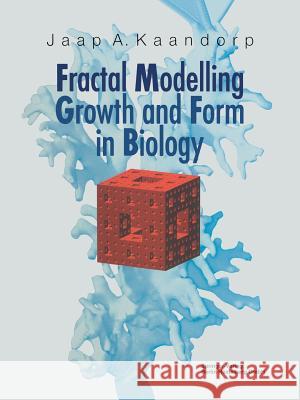
Jaap A. Kaandorp; P. Prusinkiewicz
Fractal Modelling: Growth and Form in Biology Prusinkiewicz, P. 9783642634024 Springer - książkaWidoczna okładka, to zdjęcie poglądowe, a rzeczywista szata graficzna może różnić się od prezentowanej.

Fractal Modelling: Growth and Form in Biology

ISBN-13: 9783642634024 / Angielski / Miękka / 2012 / 209 str.

Jaap A. Kaandorp; P. Prusinkiewicz
cena 443,82 zł
(netto: 422,69 VAT:  5%)

Najniższa cena z 30 dni: 424,07 zł
Termin realizacji zamówienia:
ok. 22 dni roboczych
Bez gwarancji dostawy przed świętami

Darmowa dostawa!

New developments in computer science, biology, mathematics and physics offer possibilities to obtain deeper understanding of growth and forms of organisms. It is now possible to carry out simulation experiments in which the growth process can be simulated in virtual computer objects. In this book, methods from fractal geometry are applied to model growth forms. As a case study, a type of growth process is used which can be found among various taxonomic classes of organisms such as sponges and corals. The growth of these organisms is simulated with 2D and 3D geometrical objects. The models presented in the book provide a rendering method for natural objects which is based on the actual growth process. The models can be used, for example, to understand the amazing variety of forms to be found in a coral reef. Models which mimic the growth of forms and the environmental influence on the growth process are also useful for ecologists. A combination of simulation models and the actual growth forms can be used to detect the effects of slow changes in the environment.


Kategorie:
Nauka
Kategorie BISAC:
Science > Botanika
Science > Life Sciences - Ecology
Mathematics > Matematyka stosowana
Wydawca:
Springer
Język:
Angielski
ISBN-13:
9783642634024
Rok wydania:
2012
Wydanie:
Softcover Repri
Ilość stron:
209
Waga:
0.57 kg
Wymiary:
27.7 x 21.0
Oprawa:
Miękka
Wolumenów:
01

1 Introduction.- 1.1 Structure of the Book.- 2 Methods for Modelling Biological Objects.- 2.1 Reaction Diffusion Mechanisms.- 2.2 Iteration Processes and Fractals.- 2.3 Generation of Objects Using Formal Languages.- 2.4 Diffusion Limited Aggregation Models.- 2.5 Generation of Fractal Objects Using Iterated Function Systems.- 2.6 Iterative Geometric Constructions.- 2.6.1 Geometric Production Rules in 2D Modelling.- 2.6.2 The Geometric Modelling System for 2D Objects.- 2.6.3 Modelling a Growth Process in 2D with Iterative Geometric Constructions.- 2.7 A Review of the Methods.- 3 2D Models of Growth Forms.- 3.1 Modular Growth.- 3.2 Radiate Accretive Growth.- 3.3 Growth Forms of Modular Organisms and the Physical Environment.- 3.4 Description of the Internal Architecture of the Autotrophic Example: Montastrea annularis.- 3.5 Description of the Internal Architecture of the Heterotrophic Example: Haliclona oculata.- 3.6 An Iterative Geometric Construction Simulating the Radiate Accretive Growth Process of a Branching Organism.- 3.6.1 The Basic Construction: the generator.- 3.6.2 Modelling the Coherence of the Skeleton.- 3.6.3 Introduction of the Smallest Skeleton Element in the Model.- 3.6.4 Modelling the “Widening Effect”.- 3.6.5 Formation of New Growth Axes.- 3.6.6 Disturbance of the Growth Process, Formation of Plates.- 3.6.7 Additional Rules for the Formation of Branches and Plates.- 3.6.8 Formation of Branches.- 3.6.9 A Combination of the Previous Models.- 3.7 A Model of the Physical Environment.- 3.7.1 The Light Model.- 3.7.2 A Combination of the Geometric Model and the Concentration Gradient Model.- 3.8 Conclusions and Restrictions of the 2D Model.- 3.9 List of Symbols Used in this Chapter.- 4 A Comparison of Forms.- 4.1 A Comparison of a Range of Forms.- 4.1.1 A Comparison of a Range of Actual Forms and the Virtual Objects.- 4.1.2 A Comparison of the Growth Forms of Haliclona oculata Collected in Different Localities.- 4.1.3 Determination of the Fractal Dimensions in a Range of Forms.- 4.2 An Experimental Verification of the Model.- 4.2.1 The Simulation Experiments.- 4.2.2 The Transplantation Experiments.- 4.2.3 Comparison of Growth Forms of the Transplants and Simulation Experiments.- 4.3 Conclusions.- 5 3D Models of Growth Forms.- 5.1 Constructions in Space, a 3D Modelling System for Iterative Constructions.- 5.2 Description of an Organism with Radiate Accretive Growth and a Triangular Tessellation of the Surface.- 5.3 Representation of a Triangular Tessellation.- 5.4 Representation of a Multi-Layer Triangular Tessellation.- 5.5 The Lattice Representation of a Volume Tessellated with Triangles.- 5.5.1 The Lattice Model.- 5.5.2 The Virtual Lattice, a Subdivision of Space.- 5.6 An Iterative Geometric Construction Simulating the Radiate Accretive Growth Process of a Branching Organism.- 5.6.1 The Initiator.- 5.6.2 The Basic Construction: the Generator.- 5.6.3 Isotropic Growth and the Insertion of New Elements.- 5.6.4 Anisotropic Growth and the Insertion of New Elements.- 5.6.5 Formation of Branches.- 5.6.6 The Coherence Conserving Rules.- 5.6.7 More Evolved Branching Objects and Collision Detection.- 5.6.8 A Model of the Influence of Light Intensity on the Growth Process.- 5.6.9 A Model of the Influence of Nutrient Distribution on the Growth Process.- 5.7 Conclusions and Restrictions of the Presented 3D Models.- 5.8 List of Symbols Used in Sects. 5.3 to 5.7.- 6 Final Conclusions.- 6.1 The 2D and 3D Simulation Models.- 6.2 Application of the Simulation Models in Ecology.- References.


Udostępnij

Facebook - konto krainaksiazek.pl


Opinie o Krainaksiazek.pl na Opineo.pl

Partner Mybenefit

Krainaksiazek.pl w programie rzetelna firma Krainaksiaze.pl - płatności przez paypal

Czytaj nas na:

Facebook - krainaksiazek.pl
  • książki na zamówienie
  • granty
  • książka na prezent
  • kontakt
  • pomoc
  • opinie
  • regulamin
  • polityka prywatności

Zobacz:

  • Księgarnia czeska

  • Wydawnictwo Książkowe Klimaty

1997-2025 DolnySlask.com Agencja Internetowa

© 1997-2022 krainaksiazek.pl
     
KONTAKT | REGULAMIN | POLITYKA PRYWATNOŚCI | USTAWIENIA PRYWATNOŚCI
Zobacz: Księgarnia Czeska | Wydawnictwo Książkowe Klimaty | Mapa strony | Lista autorów
KrainaKsiazek.PL - Księgarnia Internetowa

Polityka prywatnosci - link
Krainaksiazek.pl - płatnośc Przelewy24
Przechowalnia Przechowalnia





