Foundations of Robotics: A Multidisciplinary Approach with Python and Ros » książka





Foundations of Robotics: A Multidisciplinary Approach with Python and Ros
ISBN-13: 9789811919824 / Angielski / Twarda / 2022 / 554 str.
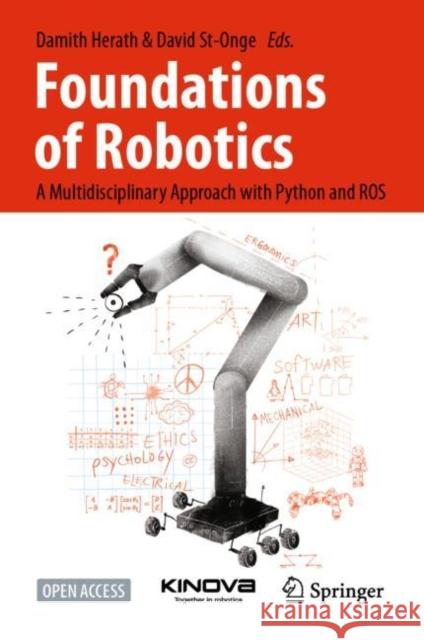
Foundations of Robotics: A Multidisciplinary Approach with Python and Ros
ISBN-13: 9789811919824 / Angielski / Twarda / 2022 / 554 str.
(netto: 191,66 VAT: 5%)
Najniższa cena z 30 dni: 192,74
ok. 16-18 dni roboczych.
Darmowa dostawa!
PART I: Contextual Design
Nicolas Reeves and David St-Onge
1.1 What is a robot?
1.2 A mythical origin
1.3 Early automata
1.4 Anatomical analogies: understanding through replication1.5 Industrial (r)evolutions
1.6 Modern robotics
1.7 SOCIAL ROBOTICS1.8 Robotic futures and transrobotics
- Teaching and learning robotics: A pedagogical perspective
Eleni Petraki and Damith Herath
2.1 Learning objective
2.2 Introduction
2.3 Defining the body of knowledge of the robotics field
2.4 Review of research on pedagogies and practices in robotics education
2.5 Assessment practices
2.6 Paving the way for innovative pedagogies and assessment in robotics education
2.7 Chapter summary
2.8 Quiz2.9 References
- Design Thinking: from Empathy to Ideation
Fanke Peng
3.1 Learning objectives
3.2 Introduction
3.3 Design Thinking Process: Discover, Define, Develop and Deliver
3.4 Conclusion
3.5 Quiz
3.6 References
- Software building blocks: From Python to Version control
Damith Herath, Adam Haskard and Niranjan Shukla
4.1 Learning Objectives
4.2 Introduction
4.3 Python and basics of programming
4.4 Object-Oriented Programming
4.5 Error handling
4.6 Secure Coding
4.7 Case study – Writing your first program in Python
4.8 Version control basics
4.9 Containerising applications4.10 Chapter summary
4.11 Revision questions
4.12 Further reading
4.13 References
- The Robot Operating System (ROS1&2): programming paradigms and deployment
David St-Onge and Damith Herath
5.1 Learning Objectives
5.2 Introduction
5.3 Why ROS?
5.4 What is ROS?
5.5 Key features from the core
5.6 Additional useful features
5.7 Linux for robotics
5.8 Chapter Summary
5.9 Revision Questions
5.10 Further reading
5.11 References
- Mathematical building blocks: From geometry to quaternions to Bayesian
Rebecca Stower, Bruno Belzile and David St-Onge
6.1 Learning Objectives
6.2 Introduction
6.3 Basic Geometry and Linear Algebra
6.4 Geometric Transformations
6.5 Basic Probability
6.6 Derivatives
6.7 Basic Statistics
6.8 Chapter Summary
6.9 Revision Questions
6.10 Further Reading
6.11 References
PART II: Embedded Design
- What makes robots? Sensors, Actuators and Algorithms
Jiefei Wang and Damith Herath
7.1 Learning Objectives
7.2 Introduction
7.3 Sense: Sensing the world with sensors
7.4 Think: Algorithms
7.5 Act: Moving about with actuators
7.6 Computer vision in robotics
7.7 Review questions
7.8 Further reading
7.9 References
Jiefei Wang and Damith Herath
8.1 Learning Objectives
8.2 Introduction
8.3 Mobile robots
8.4 Controlling robots
8.5 Path planning
8.6 Obstacle avoidance
8.7 Chapter Summary
8.8 Review Questions
8.9 Further Reading
8.10 References
- Lost in space! Localisation and Mapping
Damith Herath
9.1 Learning Objectives
9.2 Introduction
9.3 Robot localisation problem
9.4 The Robot Mapping Problem
9.5 The Simultaneous Localisation and Mapping (SLAM) problem
9.6 The Kalman Filter
9.7 A Case Study: Robot Localisation using the Extended Kalman Filter
9.8 Summary
9.9 Review Questions
9.10 Further Reading
9.11 References
- How to manipulate? Kinematics, dynamics and architecture of robot arms
Bruno Belzile and David St-Onge
10.1 Learning Objectives
10.2 Introduction
10.3 Architectures
10.4 Kinematics of Serial Manipulators
10.5 Kinematics of Parallel Manipulators
10.6 Dynamics
10.7 Chapter Summary
10.8 Revision Questions
10.9 Further Reading
10.10 References
- Get together! Multi-robot systems: bio-inspired concepts and deployment challenges
Vivek Shankar Varadharajan and Giovanni Beltrame
11.1 Objectives of the chapter
11.2 Introduction
11.3 Types of multi-robot systems
11.4 Swarm Programming
11.5 Deployment of real world swarm systems
11.6 Chapter Summary
11.7 Chapter Revision
11.8 Further reading
11.9 References
- The Embedded design process: CAD/CAM and prototyping
Eddi Pianca
12.1 Learning Objectives
12.2 Introduction
12.3 The design process and CAD
12.4 The Design Process vs Design Thinking
12.5 CAD systems
12.6 CAD file types
12.7 CAD parametric modelling - Assembly and part files
12.8 CAD parametric modelling - Drawing Files
12.9 CAD File Transfer
12.10 VR and AR for CAD
12.11 CAM and CNC
12.12 Workshop
12.13 Case study - hexapod robot project12.14 Revision questions
12.15 References
PART II: Interaction Design
- Social robots: Principles of interaction design and user studies
Janie Busby Grant & Damith Herath
13.1 Learning Objectives
13.2 Introduction
13.3 Cobots, Social Robots and Human Robot Interaction
13.4 Why conduct research?
13.5 Deciding on your research variables
13.6 Sampling, reliability & validity
13.7 Ethics
13.8 Chapter Summary
13.9 Revision Questions
13.10 References
- Safety first: On the safe deployment of robotic systems
Bruno Belzile and David St-Onge
14.1 Learning Objectives
14.2 Introduction
14.3 Standards
14.4 Industrial Risk Assessment and Mitigation
14.5 Cobots
14.6 Mobile Robots
14.7 Chapter Summary
14.8 Revision Questions
14.9 Further Reading
14.10 References
- Managing the world complexity: from linear regression to deep learning
Yann Bouteiller
15.1 Objectives of the chapter
15.2 Introduction
15.3 Definitions
15.4 From linear regression to deep learning
15.5 Policy search for robotic control
15.6 Wrapping it up: how to deeply understand the world
15.7 Summary
15.8 Quiz
15.9 Further reading
- Robot ethics: Ethical design considerations
Dylan Cawthorne
16.1 Learning Objectives
16.2 Introduction
16.3 Ethics
16.4 The non-neutrality of technology
16.5 Technological determinism and multiple futures
16.6 Human values in design
16.7 Value sensitive design
16.8 Ethics tools
16.9 Case study: VSD of a Danish healthcare drone
16.10 Responsible research and innovation
16.11 Chapter summary
16.12 Revision questions
16.13 ReferencesAPPENDIX: Projects
- Robot Hexapod Build Labs
David Hinwood and Damith Herath
17.1 Introduction
17.2 Project One: Defining the Robot System
17.3 Project Two: Modelling the Position Kinematics
17.4 Project Three: Modelling the Velocity Kinematics with Python17.5 Project Four: Building Communication Protocols
17.6 Some Final Thoughts
17.7 References
- ROS Mobile Manipulator labs
David St-Onge, Corentin Boucher and Bruno Belzile
18.1 Introduction
18.2 Project 1: Discovering ROS and the Dingo
18.3 Project 2: Kalman for differential drive
18.4 Project 3: 3-DoF Kinematics
18.5 Project 4: Let's bring it back together!
18.6 Project 5: Save the day!
Damith Herath (Ph.D., Robotics) is an Associate Professor in Robotics and Art at the University of Canberra. Damith is a multi-award winning entrepreneur and a roboticist with extensive experience leading multidisciplinary research teams on complex robotic integration, industrial and research projects for over two decades. He founded Australia’s first collaborative robotics startup in 2011 and was named one of the most innovative young tech companies in Australia in 2014. Teams he led in 2015 and 2016 consecutively became finalists and, in 2016, a top-ten category winner in the coveted Amazon Robotics Challenge - an industry-focussed competition amongst the robotics research elite. In addition, Damith has chaired several international workshops on Robots and Art and is the lead editor of the book "Robots and Art: Exploring an Unlikely Symbiosis" - the first significant work to feature leading roboticists and artists together in the field of Robotic Art.
David St-Onge (Ph.D., Mech. Eng.) is an Associate Professor in the Mechanical Engineering Department at the École de technologie supérieure and director of the INIT Robots Lab (initrobots.ca). David’s research focuses on human-swarm collaboration more specifically with respect to operators’ cognitive load and motion-based interactions. He has over 10 years’ experience in the field of interactive media (structure, automatization and sensing) as workshop production director and as R&D engineer. He is an active member of national clusters centered on human-robot interaction (REPARTI) and art-science collaborations (Hexagram). He participates in national training programs for highly qualified personnel for drone services (UTILI), as well as for the deployment of industrial cobots (CoRoM). He led the team effort to present the first large-scale symbiotic integration of robotic art at the IEEE International Conference on Robotics and Automation (ICRA 2019).
This open access book introduces key concepts in robotics in an easy to understand language using an engaging project-based approach. It covers contemporary topics in robotics, providing an accessible entry point to fundamentals in all the major domains. A section is dedicated to introducing programming concepts using Python, which has become a language of choice in robotics and AI. The book also introduces the reader to the Robot Operating System (ROS), the ubiquitous software and algorithmic framework used by researchers and the industry. The book provides an inspired, up-to-date and multidisciplinary introduction to robotics in its many forms, including emerging topics related to robotics on Machine Learning, ethics, Human-Robot Interaction, and Design Thinking. The book also includes interviews with industry experts, providing an additional layer of insight into the world of robotics. The book is made open access through the generous support from Kinova Robotics. The book is suitable as an undergraduate textbook in a relevant engineering course. It is also suitable for students in art and design, high school students, and self-learners who would like to explore foundational concepts in robotics.
“This book provides the ‘foundation’ for understanding how robots work. It is the accessible introduction that artists and engineers have been waiting for.”
- Ken Goldberg, William S. Floyd Jr. Distinguished Chair in Engineering, UC Berkeley.




Czytaj nas na:
1997-2026 DolnySlask.com Agencja Internetowa
KrainaKsiazek.PL - Księgarnia Internetowa


