• Wyszukiwanie zaawansowane
  • Kategorie
  • Kategorie BISAC
  • Książki na zamówienie
  • Promocje
  • Granty
  • Książka na prezent
  • Opinie
  • Pomoc
  • Załóż konto
  • Zaloguj się

Foundations of Elastoplasticity: Subloading Surface Model » książka


zaloguj się | załóż konto
Logo Krainaksiazek.pl

koszyk

konto

szukaj
topmenu
Księgarnia internetowa
Szukaj
Książki na zamówienie
Promocje
Granty
Książka na prezent
Moje konto
Pomoc
 
 
Wyszukiwanie zaawansowane
Pusty koszyk
Bezpłatna dostawa dla zamówień powyżej 20 złBezpłatna dostawa dla zamówień powyżej 20 zł

Kategorie główne

• Nauka
 [2946350]
• Literatura piękna
 [1816154]

  więcej...
• Turystyka
 [70666]
• Informatyka
 [151172]
• Komiksy
 [35576]
• Encyklopedie
 [23172]
• Dziecięca
 [611458]
• Hobby
 [135995]
• AudioBooki
 [1726]
• Literatura faktu
 [225763]
• Muzyka CD
 [378]
• Słowniki
 [2917]
• Inne
 [444280]
• Kalendarze
 [1179]
• Podręczniki
 [166508]
• Poradniki
 [469467]
• Religia
 [507199]
• Czasopisma
 [496]
• Sport
 [61352]
• Sztuka
 [242330]
• CD, DVD, Video
 [3348]
• Technologie
 [219391]
• Zdrowie
 [98638]
• Książkowe Klimaty
 [124]
• Zabawki
 [2382]
• Puzzle, gry
 [3525]
• Literatura w języku ukraińskim
 [259]
• Art. papiernicze i szkolne
 [7107]
Kategorie szczegółowe BISAC

Foundations of Elastoplasticity: Subloading Surface Model

ISBN-13: 9783030931377 / Angielski / Twarda / 2023 / 812 str.
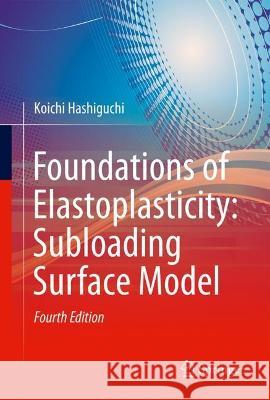
Koichi Hashiguchi
Foundations of Elastoplasticity: Subloading Surface Model Koichi Hashiguchi 9783030931377 Springer - książkaWidoczna okładka, to zdjęcie poglądowe, a rzeczywista szata graficzna może różnić się od prezentowanej.

Foundations of Elastoplasticity: Subloading Surface Model

ISBN-13: 9783030931377 / Angielski / Twarda / 2023 / 812 str.

Koichi Hashiguchi
cena 1127,15
(netto: 1073,48 VAT:  5%)

Najniższa cena z 30 dni: 963,86
Termin realizacji zamówienia:
ok. 16-18 dni roboczych.

Darmowa dostawa!
inne wydania

This book is the standard text book for elastoplasticity which is explained comprehensively covering the rate-independent to -dependent finite deformations, soils, polymers, crystal plasticity, etc. and the friction phenomenon. Concise explanations on vector-tensor analysis and continuum mechanics are provided first, covering the underlying physical concepts, e.g.various time-derivatives, pull-backandpush-forward operations, work-conjugacyandmultiplicative decomposition of deformation gradient tensor. Then, the rigorous elastoplastic/viscoplastic models are explained comprehensively, which are based on the subloading surface modelincorporating the crucially important variable “normal-yield ratio” in order to describe the continuous development of the plastic/viscoplastic strain rate with the approach to the yield stress, while these deformations can never be described pertinently by the other plasticity models, e.g. the Chaboche-Ohno and the Dafalias-Yoshida models assuming the purely-elastic domain. The mains of these models are as follows:1)      Thesubloading surfaceconcept underling the cyclic plasticity is introduced, which insists that the plastic deformation develops as the stress approaches the yield surface. Thus, thesmooth elastic-plastic transitionleading to the continuous variation of the tangent stiffness modulus is described always.2)      Thesubloading-overstress modelis formulated by which the elastoplastic deformation during the quasi-static loading and the viscoplastic deformation during the dynamic and impact loading can be described by the unified equation. Then, only this model can be used to describe the deformation in the general rate of deformation, disusing the elastoplastic constitutive equation.3)    Thehyperelastic-based (visco)plasticitybased on themultiplicative decomposition of deformation gradient tensorand the subloading surface model is formulated for the exact descriptions of the finite elastic and (visco)plastic deformations.4)    Thesubloading-friction modelis formulated for the exact description of the dry and the fluid (lubricated) frictions at the general rate of sliding from the static to the impact sliding.Thus, all the elastic and inelastic deformation/sliding phenomena of solids can be described accurately in the unified equation by the subloading-overstress model. The subloading surface model will be engraved as thegoverning law of irreversible deformation of solidsin the history of solid mechanics.

This book is the standard text book for elastoplasticity which is explained comprehensively covering the rate-independent to -dependent finite deformations, soils, polymers, crystal plasticity, etc. and the friction phenomenon. Concise explanations on vector-tensor analysis and continuum mechanics are provided first, covering the underlying physical concepts, e.g. various time-derivatives, pull-back and push-forward operations, work-conjugacy and multiplicative decomposition of deformation gradient tensor. Then, the rigorous elastoplastic/viscoplastic models are explained comprehensively, which are based on the subloading surface model incorporating the crucially important variable “normal-yield ratio” in order to describe the continuous development of the plastic/viscoplastic strain rate with the approach to the yield stress, while these deformations can never be described pertinently by the other plasticity models, e.g. the Chaboche-Ohno and the Dafalias-Yoshida models assuming the purely-elastic domain. The mains of these models are as follows: 1)      The subloading surface concept underling the cyclic plasticity is introduced, which insists that the plastic deformation develops as the stress approaches the yield surface. Thus, the smooth elastic-plastic transition leading to the continuous variation of the tangent stiffness modulus is described always.2)      The subloading-overstress model is formulated by which the elastoplastic deformation during the quasi-static loading and the viscoplastic deformation during the dynamic and impact loading can be described by the unified equation. Then, only this model can be used to describe the deformation in the general rate of deformation, disusing the elastoplastic constitutive equation.3)    The hyperelastic-based (visco)plasticity based on the multiplicative decomposition of deformation gradient tensor and the subloading surface model is formulated for the exact descriptions of the finite elastic and (visco)plastic deformations.4)    The subloading-friction model is formulated for the exact description of the dry and the fluid (lubricated) frictions at the general rate of sliding from the static to the impact sliding.Thus, all the elastic and inelastic deformation/sliding phenomena of solids can be described accurately in the unified equation by the subloading-overstress model. The subloading surface model will be engraved as the governing law of irreversible deformation of solids in the history of solid mechanics.
 

Kategorie:
Technologie
Kategorie BISAC:
Science > Mechanics - Solids
Wydawca:
Springer
Język:
Angielski
ISBN-13:
9783030931377
Rok wydania:
2023
Dostępne języki:
Ilość stron:
812
Oprawa:
Twarda
Dodatkowe informacje:
Wydanie ilustrowane

Mathematical Preliminaries: Vector and Tensor Analysis.- Description of Motion.- Description of Tensor (Rate) in Convected Coordinate System.- Deformation/Rotation Tensors.- Stress Tensors and Conservation Laws.- Objectivity and Objective (Rate) Tensors.- Elastic Constitutive Equations.- Elastoplastic Constitutive Equations.- Unconventional Elastoplasticity Model: Subloading Surface model.- Cyclic Plasticity Model: Critical Reviews and Assessments.- Extended Subloading Surface Model.- Constitutive Equations of Metals.- Constitutive Equations of Soils.- Subloading-overstress model.- Subloading-Damage Model.- Subloading Phase-transformation Model.- Multiplicative Hyperelastic-based Plasticity with Subloading Surface Concept.- Viscoelastic-viscoplastic Model of Polymers.- Corotational Rate Tensors.- Localization of Deformation.- Hypoelastic- and Multiplicative Hyperelastic-based Crystal Plasticity.- Constitutive Equation for Friction: Subloading-friction Model.

Dr. Koichi Hashiguchi is currently a head of solids and structure solutions, Ltd. and an Emeritus Professor at Kyushu University. He is the author of over 300 peer-reviewed journal papers, fellows of the Japan Society of Mechanical Engineers and of Civil Engineers, an Honorary Member of the Japanese Geotechnical Society, and also a Member of the Engineering Academy of Japan. He has additionally authored 6 books and co-authored one book on elasto-plasticity/viscoplasticity for finite deformation.

This book is the standard text book for elastoplasticity which is explained comprehensively covering the rate-independent to -dependent finite deformations, soils, polymers, crystal plasticity, etc. and the friction phenomenon. Concise explanations on vector-tensor analysis and continuum mechanics are provided first, covering the underlying physical concepts, e.g. various time-derivatives, pull-back and push-forward operations, work-conjugacy and multiplicative decomposition of deformation gradient tensor. Then, the rigorous elastoplastic/viscoplastic models are explained comprehensively, which are based on the subloading surface model incorporating the crucially important variable “normal-yield ratio” in order to describe the continuous development of the plastic/viscoplastic strain rate with the approach to the yield stress but can never be described by the other plasticity models, e.g. the Chaboche-Ohno and the Dafalias-Yoshida models assuming the purely-elastic domain. The main of them are as follows:

1) The subloading surface concept underling the cyclic plasticity is introduced, which insists that the plastic deformation develops as the stress approaches the yield surface. Thus, the smooth elastic-plastic transition leading to the continuous variation of the tangent stiffness modulus is described always.

2) The subloading-overstress model is formulated by which the elastoplastic deformation during the quasi-static loading and the viscoplastic deformation during the dynamic and impact loading can be described by the unified equation. Then, only this model can be used to describe the deformation in the general rate of deformation, disusing the elastoplastic constitutive equation.

3) The hyperelastic-based (visco)plasticity based on the multiplicative decomposition of deformation gradient tensor and the subloading surface model is formulated for the exact descriptions of the finite elastic and (visco)plastic deformations.

4) The subloading-friction model is formulated for the exact description of the dry and the fluid (lubricated) frictions at the general rate of sliding from the static to the impact sliding.

Thus, all the elastic and inelastic deformation/sliding phenomena of solids can be described accurately in the unified equation by the subloading-overstress model. The subloading surface model will be engraved as the governing law of irreversible deformation of solids in the history of solid mechanics.




Udostępnij

Facebook - konto krainaksiazek.pl


Opinie o Krainaksiazek.pl na Opineo.pl

Partner Mybenefit

Krainaksiazek.pl w programie rzetelna firma Krainaksiaze.pl - płatności przez paypal

Czytaj nas na:

Facebook - krainaksiazek.pl
  • książki na zamówienie
  • granty
  • książka na prezent
  • kontakt
  • pomoc
  • opinie
  • regulamin
  • polityka prywatności

Zobacz:

  • Księgarnia czeska

  • Wydawnictwo Książkowe Klimaty

1997-2026 DolnySlask.com Agencja Internetowa

© 1997-2022 krainaksiazek.pl
     
KONTAKT | REGULAMIN | POLITYKA PRYWATNOŚCI | USTAWIENIA PRYWATNOŚCI
Zobacz: Księgarnia Czeska | Wydawnictwo Książkowe Klimaty | Mapa strony | Lista autorów
KrainaKsiazek.PL - Księgarnia Internetowa

Polityka prywatnosci - link
Krainaksiazek.pl - płatnośc Przelewy24
Przechowalnia Przechowalnia






