• Wyszukiwanie zaawansowane
  • Kategorie
  • Kategorie BISAC
  • Książki na zamówienie
  • Promocje
  • Granty
  • Książka na prezent
  • Opinie
  • Pomoc
  • Załóż konto
  • Zaloguj się

Foundations of Deep Learning » książka


zaloguj się | załóż konto
Logo Krainaksiazek.pl

koszyk

konto

szukaj
topmenu
Księgarnia internetowa
Szukaj
Książki na zamówienie
Promocje
Granty
Książka na prezent
Moje konto
Pomoc
 
 
Wyszukiwanie zaawansowane
Pusty koszyk
Bezpłatna dostawa dla zamówień powyżej 20 złBezpłatna dostawa dla zamówień powyżej 20 zł

Kategorie główne

• Nauka
 [2946600]
• Literatura piękna
 [1856966]

  więcej...
• Turystyka
 [72221]
• Informatyka
 [151456]
• Komiksy
 [35826]
• Encyklopedie
 [23190]
• Dziecięca
 [619653]
• Hobby
 [140543]
• AudioBooki
 [1577]
• Literatura faktu
 [228355]
• Muzyka CD
 [410]
• Słowniki
 [2874]
• Inne
 [445822]
• Kalendarze
 [1744]
• Podręczniki
 [167141]
• Poradniki
 [482898]
• Religia
 [510455]
• Czasopisma
 [526]
• Sport
 [61590]
• Sztuka
 [243598]
• CD, DVD, Video
 [3423]
• Technologie
 [219201]
• Zdrowie
 [101638]
• Książkowe Klimaty
 [124]
• Zabawki
 [2473]
• Puzzle, gry
 [3898]
• Literatura w języku ukraińskim
 [254]
• Art. papiernicze i szkolne
 [8170]
Kategorie szczegółowe BISAC

Foundations of Deep Learning

ISBN-13: 9789811682322 / Angielski
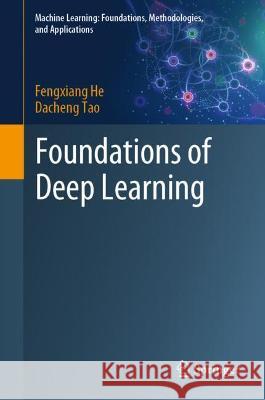
Fengxiang He; Dacheng Tao
Foundations of Deep Learning Fengxiang He Dacheng Tao 9789811682322 Springer - książkaWidoczna okładka, to zdjęcie poglądowe, a rzeczywista szata graficzna może różnić się od prezentowanej.

Foundations of Deep Learning

ISBN-13: 9789811682322 / Angielski

Fengxiang He; Dacheng Tao
cena 564,88 zł
(netto: 537,98 VAT:  5%)

Najniższa cena z 30 dni: 564,88 zł
Termin realizacji zamówienia:
ok. 22 dni roboczych
Bez gwarancji dostawy przed świętami

Darmowa dostawa!

Deep learning has significantly reshaped a variety of technologies, such as image processing, natural language processing, and audio processing. The excellent generalizability of deep learning is like a “cloud” to conventional complexity-based learning theory: the over-parameterization of deep learning makes almost all existing tools vacuous. This irreconciliation considerably undermines the confidence of deploying deep learning to security-critical areas, including autonomous vehicles and medical diagnosis, where small algorithmic mistakes can lead to fatal disasters. This book seeks to explaining the excellent generalizability, including generalization analysis via the size-independent complexity measures, the role of optimization in understanding the generalizability, and the relationship between generalizability and ethical/security issues.The efforts to understand the excellent generalizability are following two major paths: (1) developing size-independent complexity measures, which can evaluate the “effective” hypothesis complexity that can be learned, instead of the whole hypothesis space; and (2) modelling the learned hypothesis through stochastic gradient methods, the dominant optimizers in deep learning, via stochastic differential functions and the geometry of the associated loss functions. Related works discover that over-parameterization surprisingly bring many good properties to the loss functions. Rising concerns of deep learning are seen on the ethical and security issues, including privacy preservation and adversarial robustness. Related works also reveal an interplay between them and generalizability: a good generalizability usually means a good privacy-preserving ability; and more robust algorithms might have a worse generalizability.We expect readers can have a big picture of the current knowledge in deep learning theory, understand how the deep learning theory can guide new algorithm designing, and identify future research directions. Readers need knowledge of calculus, linear algebra, probability, statistics, and statistical learning theory.


Deep learning has significantly reshaped a variety of technologies, such as image processing, natural language processing, and audio processing. The excellent generalizability of deep learning is like a “cloud” to conventional complexity-based learning theory: the over-parameterization of deep learning makes almost all existing tools vacuous. This irreconciliation considerably undermines the confidence of deploying deep learning to security-critical areas, including autonomous vehicles and medical diagnosis, where small algorithmic mistakes can lead to fatal disasters. This book seeks to explaining the excellent generalizability, including generalization analysis via the size-independent complexity measures, the role of optimization in understanding the generalizability, and the relationship between generalizability and ethical/security issues. The efforts to understand the excellent generalizability are following two major paths: (1) developing size-independent complexity measures, which can evaluate the “effective” hypothesis complexity that can be learned, instead of the whole hypothesis space; and (2) modelling the learned hypothesis through stochastic gradient methods, the dominant optimizers in deep learning, via stochastic differential functions and the geometry of the associated loss functions. Related works discover that over-parameterization surprisingly bring many good properties to the loss functions. Rising concerns of deep learning are seen on the ethical and security issues, including privacy preservation and adversarial robustness. Related works also reveal an interplay between them and generalizability: a good generalizability usually means a good privacy-preserving ability; and more robust algorithms might have a worse generalizability. We expect readers can have a big picture of the current knowledge in deep learning theory, understand how the deep learning theory can guide new algorithm designing, and identify future research directions. Readers need knowledge of calculus, linear algebra, probability, statistics, and statistical learning theory.

Kategorie:
Informatyka, Bazy danych
Kategorie BISAC:
Computers > Artificial Intelligence - General
Computers > Mathematical & Statistical Software
Mathematics > Matematyka stosowana
Wydawca:
Springer
Seria wydawnicza:
Machine Learning: Foundations, Methodologies, and Applicatio
Język:
Angielski
ISBN-13:
9789811682322

1         Introduction

1.1  Definition and terminology

1.2  Advances of deep learning

1.3  Applications of deep learning

1.4  The status quo of deep learning theory


Part I                     Background


2         Conventional statistical learning theory

2.1   PAC learnability

2.2   VC dimension

2.3   Rademacher complexity

2.4   Other tools


3         Difficulty of conventional statistical learning theory

3.1    Sample size for guaranteed generalizability

3.2    Sample size vs. model size in deep learning


Part II                   Developing deep learning theory


4         Generalization bounds on hypothesis complexity

4.1     Generalization bounds on size-dependent complexity

4.2     Generalization bounds on depth-independent complexity

4.3     Generalization bounds on size-independent complexity


5         Interplay of optimization, Bayesian inference, and generalization

5.1     Stochastic gradient descent

5.2     Model SGD as dynamics

5.3     Historic cycle: Solving inference by optimization and model SGD as inference

5.4     Advances in optimization and generalization of SGD


6         Geometrical properties of loss surface

6.1     Does nonlinearity in activations matter?

6.2     Geometric structure of loss surface

6.3     Flatness and sharpness of local minima


7         The role of over-parametrization

7.1     Universal approximation theorem

7.2     Smooth the loss surface

7.3     Flatten the local minima

7.4     Double descent: Does variance-bias trade-off really exists?


Part III                 Rising concerns in ethics and security


8         Privacy preservation

8.1  The current statues of privacy preservation in deep learning

8.2  The relationship between privacy preservation and generalization


9         Fairness protection

9.1  The current statues of fairness protection in deep learning

9.2  The relationship between fairness protection and generalization


10      Algorithmic robustness

10.1  The current status of algorithmic robustness in deep learning

10.2  The relationship between algorithmic robustness and generalization


Appendix A         Background knowledge

A.1  Calculus and linear algebra

A.2  Probability and statistics

A.3  Stochastic differential equation


Deep learning has significantly reshaped a variety of technologies, such as image processing, natural language processing, and audio processing. The excellent generalizability of deep learning is like a “cloud” to conventional complexity-based learning theory: the over-parameterization of deep learning makes almost all existing tools vacuous. This irreconciliation considerably undermines the confidence of deploying deep learning to security-critical areas, including autonomous vehicles and medical diagnosis, where small algorithmic mistakes can lead to fatal disasters. This book seeks to explaining the excellent generalizability, including generalization analysis via the size-independent complexity measures, the role of optimization in understanding the generalizability, and the relationship between generalizability and ethical/security issues. 

The efforts to understand the excellent generalizability are following two major paths: (1) developing size-independent complexity measures, which can evaluate the “effective” hypothesis complexity that can be learned, instead of the whole hypothesis space; and (2) modelling the learned hypothesis through stochastic gradient methods, the dominant optimizers in deep learning, via stochastic differential functions and the geometry of the associated loss functions. Related works discover that over-parameterization surprisingly bring many good properties to the loss functions. Rising concerns of deep learning are seen on the ethical and security issues, including privacy preservation and adversarial robustness. Related works also reveal an interplay between them and generalizability: a good generalizability usually means a good privacy-preserving ability; and more robust algorithms might have a worse generalizability.


We expect readers can have a big picture of the current knowledge in deep learning theory, understand how the deep learning theory can guide new algorithm designing, and identify future research directions. Readers need knowledge of calculus, linear algebra, probability, statistics, and statistical learning theory.




Udostępnij

Facebook - konto krainaksiazek.pl


Opinie o Krainaksiazek.pl na Opineo.pl

Partner Mybenefit

Krainaksiazek.pl w programie rzetelna firma Krainaksiaze.pl - płatności przez paypal

Czytaj nas na:

Facebook - krainaksiazek.pl
  • książki na zamówienie
  • granty
  • książka na prezent
  • kontakt
  • pomoc
  • opinie
  • regulamin
  • polityka prywatności

Zobacz:

  • Księgarnia czeska

  • Wydawnictwo Książkowe Klimaty

1997-2025 DolnySlask.com Agencja Internetowa

© 1997-2022 krainaksiazek.pl
     
KONTAKT | REGULAMIN | POLITYKA PRYWATNOŚCI | USTAWIENIA PRYWATNOŚCI
Zobacz: Księgarnia Czeska | Wydawnictwo Książkowe Klimaty | Mapa strony | Lista autorów
KrainaKsiazek.PL - Księgarnia Internetowa

Polityka prywatnosci - link
Krainaksiazek.pl - płatnośc Przelewy24
Przechowalnia Przechowalnia



