• Wyszukiwanie zaawansowane
  • Kategorie
  • Kategorie BISAC
  • Książki na zamówienie
  • Promocje
  • Granty
  • Książka na prezent
  • Opinie
  • Pomoc
  • Załóż konto
  • Zaloguj się

Foundations of Constructive Mathematics: Metamathematical Studies » książka


zaloguj się | załóż konto
Logo Krainaksiazek.pl

koszyk

konto

szukaj
topmenu
Księgarnia internetowa
Szukaj
Książki na zamówienie
Promocje
Granty
Książka na prezent
Moje konto
Pomoc
 
 
Wyszukiwanie zaawansowane
Pusty koszyk
Bezpłatna dostawa dla zamówień powyżej 20 złBezpłatna dostawa dla zamówień powyżej 20 zł

Kategorie główne

• Nauka
 [2944077]
• Literatura piękna
 [1814251]

  więcej...
• Turystyka
 [70679]
• Informatyka
 [151074]
• Komiksy
 [35590]
• Encyklopedie
 [23169]
• Dziecięca
 [611005]
• Hobby
 [136031]
• AudioBooki
 [1718]
• Literatura faktu
 [225599]
• Muzyka CD
 [379]
• Słowniki
 [2916]
• Inne
 [443741]
• Kalendarze
 [1187]
• Podręczniki
 [166463]
• Poradniki
 [469211]
• Religia
 [506887]
• Czasopisma
 [481]
• Sport
 [61343]
• Sztuka
 [242115]
• CD, DVD, Video
 [3348]
• Technologie
 [219293]
• Zdrowie
 [98602]
• Książkowe Klimaty
 [124]
• Zabawki
 [2385]
• Puzzle, gry
 [3504]
• Literatura w języku ukraińskim
 [260]
• Art. papiernicze i szkolne
 [7151]
Kategorie szczegółowe BISAC

Foundations of Constructive Mathematics: Metamathematical Studies

ISBN-13: 9783642689543 / Angielski / Miękka / 2011 / 466 str.
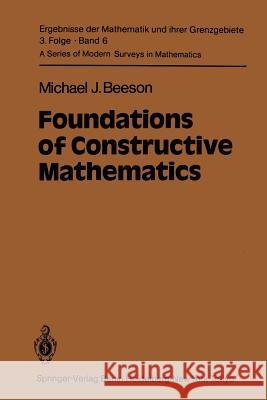
M. J. Beeson
Foundations of Constructive Mathematics: Metamathematical Studies Beeson, M. J. 9783642689543 Springer - książkaWidoczna okładka, to zdjęcie poglądowe, a rzeczywista szata graficzna może różnić się od prezentowanej.

Foundations of Constructive Mathematics: Metamathematical Studies

ISBN-13: 9783642689543 / Angielski / Miękka / 2011 / 466 str.

M. J. Beeson
cena 523,30
(netto: 498,38 VAT:  5%)

Najniższa cena z 30 dni: 501,19
Termin realizacji zamówienia:
ok. 22 dni roboczych.

Darmowa dostawa!

This book is about some recent work in a subject usually considered part of "logic" and the" foundations of mathematics," but also having close connec tions with philosophy and computer science. Namely, the creation and study of "formal systems for constructive mathematics." The general organization of the book is described in the" User's Manual" which follows this introduction, and the contents of the book are described in more detail in the introductions to Part One, Part Two, Part Three, and Part Four. This introduction has a different purpose; it is intended to provide the reader with a general view of the subject. This requires, to begin with, an elucidation of both the concepts mentioned in the phrase, "formal systems for constructive mathematics." "Con structive mathematics" refers to mathematics in which, when you prove that l a thing exists (having certain desired properties) you show how to find it. Proof by contradiction is the most common way of proving something exists without showing how to find it - one assumes that nothing exists with the desired properties, and derives a contradiction. It was only in the last two decades of the nineteenth century that mathematicians began to exploit this method of proof in ways that nobody had previously done; that was partly made possible by the creation and development of set theory by Georg Cantor and Richard Dedekind."


Kategorie:
Nauka, Matematyka
Kategorie BISAC:
Mathematics > Logic
Wydawca:
Springer
Seria wydawnicza:
Ergebnisse Der Mathematik Und Ihrer Grenzgebiete. 3. Folge a
Język:
Angielski
ISBN-13:
9783642689543
Rok wydania:
2011
Wydanie:
Softcover Repri
Numer serii:
000411026
Ilość stron:
466
Waga:
0.68 kg
Wymiary:
23.39 x 15.6 x 2.54
Oprawa:
Miękka
Wolumenów:
01

One. Practice and Philosophy of Constructive Mathematics.- I. Examples of Constructive Mathematics.- 1. The Real Numbers.- 2. Constructive Reasoning.- 3. Order in the Reals.- 4. Subfields of R with Decidable Order.- 5. Functions from Reals to Reals.- 6. Theorem of the Maximum.- 7. Intermediate Value Theorem.- 8. Sets and Metric Spaces.- 9. Compactness.- 10. Ordinary Differential Equations.- 11. Potential Theory.- 12. The Wave Equation.- 13. Measure Theory.- 14. Calculus of Variations.- 15. Plateau’s Problem.- 16. Rings, Groups, and Fields.- 17. Linear Algebra.- 18. Approximation Theory.- 19. Algebraic Topology.- 20. Standard Representations of Metric Spaces.- 21. Some Assorted Problems.- II. Informal Foundations of Constructive Mathematics.- 1. Numbers.- 2. Operations or Rules.- 3. Sets and Presets.- 4. Constructive Proofs.- 5. Witnesses and Evidence.- 6. Logic.- 7. Functions.- 8. Axioms of Choice.- 9. Ways of Constructing Sets.- 10. Definite Presets.- III. Some Different Philosophies of Constructive Mathematics.- 1. The Russian Constructivists.- 2. Recursive Analysis.- 3. Bishop’s Constructivism.- 4. Objective Intuitionism.- 5. Sets in Intuitionism.- 6. Brouwerian Intuitionism.- 7. Martin-Lof s Philosophy.- 8. Church’s Thesis.- IV. Recursive Mathematics: Living with Church’s Thesis.- 1. Constructive Recursion Theory.- 2. Diagonalization and “Weak Counterexamples”.- 3. Continuity of Effective Operations.- 4. Specker Sequences.- 5. Failure of Konig’s Lemma: Kleene’s Singular Tree.- 6. Singular Coverings.- 7. Non-Uniformly Continuous Functions.- 8. The Infimum of a Positive Function.- 9. Theorem of the Maximum Revisited.- 10. The Topology of the Disk in Recursive Mathematics.- 11. Pointwise Convergence Versus Uniform Convergence.- 12. Connectivity of Intervals.- 13. Another Surprise in Recursive Topology.- 14. A Counterexample in Descriptive Set Theory.- 15. Differential Equations with no Computable Solutions.- V. The Role of Formal Systems in Foundational Studies.- 1. The Axiomatic Method.- 2. Informal Versus Formal Axiomatics.- 3. Adequacy and Fidelity: Criteria for Formalization.- 4. Constructive and Classical Mathematics Compared.- 5. Arithmetic of Finite Types.- 6. Formalizing Constructive Mathematics in HA?.- Two. Formal Systems of the Seventies.- VI. Theories of Rules.- 1. The Logic of Partial Terms.- 2. Combinatory Algebras.- 3. Axiomatizing Recursive Mathematics.- 4. Term Reduction and the Church-Rosser Theorem Ill.- 5. Combinatory Logic and ?-Calculus.- 6. Term Models.- 7. Continuous Models.- 8. Finite Type Structures and Continuity in Combinatory Algebras.- 9. Set-Theoretic and Topological Models.- 10. Discussion: Adequacy and Fidelity of EON?.- VII. Readability.- 1. Definition and Soundness of Realizability.- 2. Realizability and Models.- 3. Some Simple Applications.- 4. Existence Properties.- 5. q-Realizability.- 6. Rules of Choice.- 7. Discussion: Numerical Meaning.- VIII. Constructive Set Theories.- 1. Intuitionistic Zermelo-Fraenkel Set Theory, IZF.- 2. Non-Extensional Set Theory.- 3. The Double-Negation Interpretation for IZF.- 4. Realizability for Set Theory Without Extensionality.- 5. Realizability and Models.- 6. Realizability for IZF.- 7. Connection with Realizability for Arithmetic.- 8. Consistency of Church’s Thesis with IZF.- 9. The Numerical Existence Property for IZF.- 10. Discussion.- 11. The Theory B.- 12. More Discussion.- 13. Intermediate Constructive Set Theories.- IX. The Existence Property in Constructive Set Theory.- 1. Introduction.- 2. The Set Existence Property for HAS.- 3. The Existence Property in Set Theories.- X. Theories of Rules, Sets, and Classes.- 1. The Theory FML.- 2. The Theories EM0 and EM0 +J.- 3. Models of Feferman’s Theories.- 4. Realizability.- 5. The Axiom of Choice.- 6. q-Realizability.- 7. Term Existence Property.- 8. Evaluation of Numerical Terms.- 9. Numerical Existence Property.- 10. Decidable Equality.- 11. Extensionality in Feferman’s Theories.- 12. Some Remarks on Formalizing Mathematics in FML + DC.- 13. Functions, Operations, and Axioms of Choice.- 14. The Theory SOF (Sets, Operations, Functions).- 15. Some Theorems of SOF.- 16. Realizability for SOF.- 17. Discussion.- XI. Constructive Type Theories.- 1. Forms of Judgment.- 2. Philosophical Remarks on Sets, Categories, and Canonical Elements.- 3. Hypothetical Judgments.- 4. Families of Sets.- 5. Disjoint Union and Existential Quantification.- 6. Abstraction.- 7. Cartesian Product and Conjunction.- 8. The Constant E and Projection Functions.- 9. Product and Universal Quantification.- 10. Implication.- 11. N, Nk, and R.- 12. Disjoint Union.- 13. The I-Rules.- 14. How Martin-Löf’s Rules Actually Define a Formal System.- 15. List of Rule Schemata of Martin-Löf’s System ML0.- 16. Other Formulations of ML0.- 17. Interpretation of HA? + AC + EXT in ML0.- 18. Formalizing Mathematics in ML0.- 19. Is the Theory HA? + EXT + AC Constructive?.- 20. The Realizability Model of ML0.- 21. Martin-Löf’s Universes.- 22. The Arithmetic Theorems of Martin-Lof’s Systems, and a New Realizability for Arithmetic.- 23. Discussion.- Three. Metamathematical Studies.- XII. Constructive Models of Set Theory.- 1. Aczel’s “Iterative Sets”.- 2. Interpreting Subtheories of Intuitionistic ZF in Feferman’s Theories.- XIII. Proof-Theoretic Strength.- 1. Definitions About Proof-Theoretic Strength.- 2. ?1/1-AC and ID1-.- 3. The Strength of Feferman’s Theory EM0 + J and Related Theories.- 4. The Strength of Constructive Set Theory T2.- 5. The Strength of Martin-Löf’s Theories.- 6. Theories with the Strength of Arithmetic.- 7. Conservative Extension Theorems.- XIV. Some Formalized Metamathematics and Church’s Rule.- 1. The Theories Tb and Ta.- 2. Formalization of Normal-Term Arguments.- 3. Formalized Models.- 4. Church’s Rule.- 5. Truth Definitions and Reflection Principles.- 6. Formalized Realizability and Existence Properties.- 7. Discussion.- XV. Forcing.- 1. Ordinary Forcing.- 2. Conservative Extension Results.- 3. Uniform Forcing.- XVI. Continuity.- 1. Continuity Principles.- 2. Continuity and Church’s Thesis.- 3. Consistency of Brouwer’s Principle and Uniform Continuity.- 4. Derived Rules Related to Continuity.- Four. Metaphilosophical Studies.- XVII. Theories of Rules and Proofs.- 1. Review of the Relevant Literature.- 2. The Main Issues.- 3. A Theory of Rules and Proofs.- 4. Undecidability of the Proof-Predicate in C.- 5. Consistency of C.- 6. Discussion.- 7. Frege Structures.- 8. Existence of Frege Structures.- 9. Set Theory and Frege Structures.- 10. A Theory of Rules, Proofs, and Sets.- Historical Appendix.- 1. From Gauss to Zermelo: The Origins of Non-Constructive Mathematics.- 2. From Kant to Hilbert: Logic and Philosophy.- 3. Brouwer and the Dutch Intuitionists.- 4. Early Formal Systems for Intuitionism.- 5. Kleene: The Marriage of Recursion Theory and Intuitionism.- 6. The Russian Constructivists and Recursive Analysis.- 7. Model Theory of Intuitionistic Systems.- 8. Logical Studies of Intuitionistic Systems.- 9. Bishop and his Followers.- 10. The Latest Decade.- References.- Index of Axioms, Abbreviations, and Theories.- Index of Names.- Index of Symbols.


Udostępnij

Facebook - konto krainaksiazek.pl


Opinie o Krainaksiazek.pl na Opineo.pl

Partner Mybenefit

Krainaksiazek.pl w programie rzetelna firma Krainaksiaze.pl - płatności przez paypal

Czytaj nas na:

Facebook - krainaksiazek.pl
  • książki na zamówienie
  • granty
  • książka na prezent
  • kontakt
  • pomoc
  • opinie
  • regulamin
  • polityka prywatności

Zobacz:

  • Księgarnia czeska

  • Wydawnictwo Książkowe Klimaty

1997-2026 DolnySlask.com Agencja Internetowa

© 1997-2022 krainaksiazek.pl
     
KONTAKT | REGULAMIN | POLITYKA PRYWATNOŚCI | USTAWIENIA PRYWATNOŚCI
Zobacz: Księgarnia Czeska | Wydawnictwo Książkowe Klimaty | Mapa strony | Lista autorów
KrainaKsiazek.PL - Księgarnia Internetowa

Polityka prywatnosci - link
Krainaksiazek.pl - płatnośc Przelewy24
Przechowalnia Przechowalnia






