Foundations of Colour Science: From Colorimetry to Perception » książka





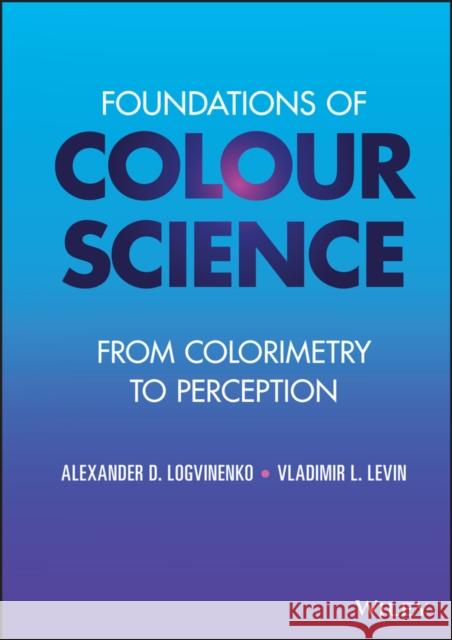
Foundations of Colour Science: From Colorimetry to Perception
ISBN-13: 9781119885917 / Angielski / Twarda / 2022 / 560 str.
Foundations of Colour Science: From Colorimetry to Perception
ISBN-13: 9781119885917 / Angielski / Twarda / 2022 / 560 str.
(netto: 673,75 VAT: 5%)
Najniższa cena z 30 dni: 700,22
ok. 30 dni roboczych.
Darmowa dostawa!
1 Outline for readers in a hurry 1I Light colour 812 Colour stimulus space and colour mechanisms 852.1 Grassmann structures and Grassmann colour codes 892.2 Continuous Grassmann structures and continuous Grassmann colour codes 973 Identification of Grassmann structures based on metameric matching 1013.1 Colourmatching functions 1023.2 Monochromatic primaries and colour matching functions in the trichromatic case (=3) 1093.3 Fundamental colour mechanisms in human colour vision 1123.3.1 K¨onig's approach to identification of the fundamental colourmechanisms 1203.3.2 Some estimates of the cone fundamentals used in colour research and applications 1234 Colour-signal cone 1294.1 Strong colour-signal-cone-boundary hypothesis 1334.2 Empirical status of the strong colour-signal-cone-boundary hypothesis 1384.3 Colour-signal-cone-boundary hypothesis 1454.4 The colour-signal cone of a 3-pigment Grassmann-Govardovskii structure 1495 Colour stimulus manifold 1535.1 Three-dimensional colour stimulusmanifold 1555.2 Non-linear colour stimulus map Colour stimulus transformation caused by themedium 1605.2.1 The colour stimulus shift caused by the medium variations 1615.2.2 Colour robustness tomediumvariations 1635.3 Causes of individual differences in trichromatic colour matching 1655.3.1 Effect of the photopigment peak sensitivity on the-coordinates 1665.3.2 Effect of the ocular media transmittance on -coordinates 1715.3.3 Trade-off between the ocular media spectral transmittance and the photopigment peak sensitivity in their effect on colour 1745.3.4 Dependence of the equivalent peak-wavelength shift on light Impossibility to overcome colour deficiency using a coloured filter 1765.3.5 Parametric identification of fundamental colour mechanisms 1806 Light metamerism 1836.1 Metamer sets 1846.2 Colour mechanisms' transformations preserving light metamerism 1886.3 Lightmetamerismindex 1907 Light metamer mismatching 1917.1 Metamer-mismatch regions 1917.2 Indices of lightmetamer mismatching 1977.3 Computing trichromaticmetamer-mismatch regions 2027.3.1 Effect of the spectral positioning of photopigments onmetamer mismatching 2067.3.2 Effect of the peak photopigment absorbance on metamer mismatching 2107.3.3 Metamer mismatching depending on the position in the chromaticity diagram 2117.3.4 Metamer mismatching induced by pre-receptoral filters 2117.3.5 Differences between cone fundamentals as revealed bymetamer mismatching 2177.3.6 Metamer mismatching for the 10o colour matching functions of Stiles and Burch 2217.3.7 Metamer mismatching induced by neutral density filters 2347.3.8 Metamer mismatching produced by camera sensors 2388 Light-colour perception 2438.1 Achromatic scales and achromatic codes 2488.1.1 Ordinal brightness scales 2498.1.2 Grassmann brightness code Luminance 2548.2 Hue, purity, and brightness fibre bundles Cylindrical and psychophysical colour coordinates 2628.3 Colour transformation caused by media and metamer mismatching, as expressed in the psychophysical colour coordinates 2708.4 Light-colour perception in dichromats 2738.5 Chromatic structures 2808.5.1 Partial hue-matching 2838.5.2 Experiment on partial hue-matching 2898.5.3 Colour categories 2928.5.4 Chromatically ordered structures 2978.5.5 Chromatic scales and chromatic codes 2998.5.6 Hue, purity and saturation in chromatic structures 3018.6 Light-colour manifold 3048.6.1 Hue cyclic order 3058.6.2 Light-colour manifold 3088.6.3 Circular Hering structures, their representation and experimental identification 3118.6.4 Light-colour manifold vs colour stimulus manifold 3219 Typology of light-colour perception Inter-individual differences 32910 Colour matching structures and matching metamerism 34110.1 Colourmatching structures 34710.2 Matchingmetamerism 35811 Identification of Grassmann structures induced by colour matching structures 36311.1 Colour matching set, threshold set, and sensitivity function 36411.2 Regular and strongly regular tolerance extensions 36811.3 Identification of Grassmann structures induced by colour matching tolerance relations 37111.3.1 Identification of the linear colour mechanism space as a subspace in the linear span of a given set of linearly independent functionals 37211.3.2 Deriving the linear colour mechanism space from the colour matching set (the method of tangential hyperplane 37811.3.3 Deriving the fundamental colour mechanisms from the colour matching set that they generate (the method of quadratic approximation) 38312 Identification of indiscriminate relations Colour detection and discrimination 39112.1 Colour detectionmodels 39412.1.1 Single-channel detectionmodels 39412.1.2 Fundamental colour mechanisms revisited 39712.1.3 Multi-channel detectionmodels 39912.2 Peak-detector model equivalent to a sublinear colour detectionmodel 40012.2.1 Sublinear colour detectionmodels 40112.2.2 Multi-channel sublinearmodels 40212.2.3 Themost sensitive colour mechanisms 40412.3 Colour discriminationmodels 40913 In search of colour mechanisms in the eye and the brain 41313.1 Do the cone photoreceptor responses encode the colour stimulus? 41313.1.1 Local non-linearity of the photoreceptor response 41413.1.2 Light adaptation in photoreceptors 41513.1.3 Spatial interaction between the cone photoreceptors 41713.1.4 Why the colour stimulus cannot be derived from the cone photoreceptor responses 41713.2 Do cone-opponent neural cells encode the opponent chromatic codes? 41813.3 Transition to a different paradigm 42513.3.1 From symmetric to asymmetric colour matching 42513.3.2 Fromlight stimulus to light-stimulus array 42813.3.3 On the notion of "neural image" 43013.4 Spatio-chromatic processing in the visual cortex 43613.4.1 Estimating luminance-pattern gradient using simple cortical cells 43613.4.2 Directional gradient-encoding with double-opponent cells 44613.4.3 Difference in spatial sensitivity of (M+L)-, (M-L)-, and S-(M+L)-cells, and its implication for colour perception 44913.4.4 Representation of the colour-signal surface in the form of its tangent bundle 450Object colour 45814 Object-colour solid 46514.1 General properties of the object-colour solid 46614.2 Optimal object stimuli 46814.3 Elementary step functions as optimal object stimuli 47014.4 Optimal object stimuli for trichromatic human observers 47214.5 Condition for all step functions of degree to be optimal object stimuli 47215 Trichromatic regular object-colour solid 47515.1 Meridians of the trichromatic regular object-colour solid 47515.2 Equator of the trichromatic object-colour solid and strictly optimal object stimuli 48116 Object-colour stimulus manifold 48916.1 Objectmetamerism 48916.2 Object atlas 49316.3 Object-colour stimulus manifold Illuminant-induced nonlinear object-colour stimulusmap 49616.4 Trichromatic object-colour stimulusmanifold 49716.4.1 Trichromatic regular object-colour stimulus manifold and its spherical representation 49716.4.2 Spherical representation of the trichromatic objectcolour stimulus manifold and the object-colour stimulus gamut 50216.4.3 Object-colour stimulus shift induced by the illuminant change 50417 Object-colour perception in a single-illuminant scene 50717.1 Perceptual object-colour coordinates 51317.2 Perceptual correlates of coordinates 51617.3 Effect of illumination on object-colour in a single-illuminant scene: Object-colour shift induced by illumination 52117.4 Object-colour perception by dichromats in a single-illuminant scene 52418 Object metamer mismatching 53518.1 Metamer-mismatch regions 53518.2 Numerical evaluation ofmetamer-mismatch regions 53918.3 Indices of objectmetamer mismatching 54218.4 Object-metamerism-preserving transformations of colour mechanisms 54519 Object-colour perception in a multiple-illuminant scene 54919.1 Object/light colour equivalence and its inseparability 55419.2 Object/light atlas 55619.3 Object/light colour stimulusmanifold 55719.3.1 Asymmetric colourmatching 55719.3.2 Material colour 56119.3.3 Lighting colour 56219.3.4 Object/light colour stimulus manifold Material and lighting components of object/light colour stimulus manifold Material- and lighting-colour coordinates 56419.4 Material colour shift induced by illumination change Implication for the problemof "colour constancy" 56920 Object-colour indeterminacy 57320.1 Trade-off between object and light components 57320.2 Trade-off betweenmaterial and lighting colours 57920.2.1 Invariant relationship between lightness and lighting brightness 58120.2.2 Invariant relationship between lightness, lighting brightness and shading brightness 58620.2.3 Shading as a sensory basis of shape 58820.2.4 Invariant relationship between material-colour image and lighting-colour image in the chromatic domain 59020.3 Object-colour indeterminacy in variegated scenes Impact of articulation 59120.4 Implication for measuring object-colour 59421 On perception in general: An outline of an alternative approach 60121.1 What is colour for? 60321.2 The need for a new approach to perception: Linguistic metaphor 60722 Epilogue 619References 623A Some auxiliary facts from functional analysis 649A.1 Banach spaces of measures and functions, and stimulus spaces 649A.2 Convex analysis 652B Proofs 657
Alexander D. Logvinenko is a Professor of Vision Science at Glasgow Caledonian University. His research interests deal with visual perception, psychophysics, and colour vision, with an emphasis on the application of mathematical methods to the vision sciences. For the last 25 years, he has been working on colour and human perception of colour.Vladimir L. Levin was a Professor of Mathematics at the Russian Academy of Sciences. Now deceased, Dr Levin's fields of interest included functional analysis, convex analysis of extremal problems, and set-valued analysis. He was awarded the Nemchinov Prize of the Russian Academy of Sciences in 2008.




Czytaj nas na:
1997-2026 DolnySlask.com Agencja Internetowa
KrainaKsiazek.PL - Księgarnia Internetowa


