• Wyszukiwanie zaawansowane
  • Kategorie
  • Kategorie BISAC
  • Książki na zamówienie
  • Promocje
  • Granty
  • Książka na prezent
  • Opinie
  • Pomoc
  • Załóż konto
  • Zaloguj się

Fostering Understanding of Complex Systems in Biology Education » książka


zaloguj się | załóż konto
Logo Krainaksiazek.pl

koszyk

konto

szukaj
topmenu
Księgarnia internetowa
Szukaj
Książki na zamówienie
Promocje
Granty
Książka na prezent
Moje konto
Pomoc
 
 
Wyszukiwanie zaawansowane
Pusty koszyk
Bezpłatna dostawa dla zamówień powyżej 20 złBezpłatna dostawa dla zamówień powyżej 20 zł

Kategorie główne

• Nauka
 [2948695]
• Literatura piękna
 [1824038]

  więcej...
• Turystyka
 [70868]
• Informatyka
 [151073]
• Komiksy
 [35227]
• Encyklopedie
 [23181]
• Dziecięca
 [621575]
• Hobby
 [138961]
• AudioBooki
 [1642]
• Literatura faktu
 [228651]
• Muzyka CD
 [371]
• Słowniki
 [2933]
• Inne
 [445341]
• Kalendarze
 [1243]
• Podręczniki
 [164416]
• Poradniki
 [479493]
• Religia
 [510449]
• Czasopisma
 [502]
• Sport
 [61384]
• Sztuka
 [243086]
• CD, DVD, Video
 [3417]
• Technologie
 [219673]
• Zdrowie
 [100865]
• Książkowe Klimaty
 [124]
• Zabawki
 [2168]
• Puzzle, gry
 [3372]
• Literatura w języku ukraińskim
 [260]
• Art. papiernicze i szkolne
 [7838]
Kategorie szczegółowe BISAC

Fostering Understanding of Complex Systems in Biology Education

ISBN-13: 9783030981464 / Angielski / Miękka / 2023
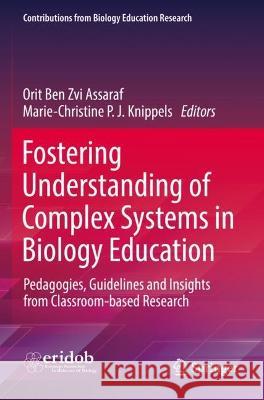
Fostering Understanding of Complex Systems in Biology Education  9783030981464 Springer International Publishing - książkaWidoczna okładka, to zdjęcie poglądowe, a rzeczywista szata graficzna może różnić się od prezentowanej.

Fostering Understanding of Complex Systems in Biology Education

ISBN-13: 9783030981464 / Angielski / Miękka / 2023

cena 562,23
(netto: 535,46 VAT:  5%)

Najniższa cena z 30 dni: 501,19
Termin realizacji zamówienia:
ok. 22 dni roboczych.

Darmowa dostawa!
inne wydania

This book synthesizes a wealth of international research on the critical topic of ‘fostering understanding of complex systems in biology education’. Complex systems are prevalent in many scientific fields, and at all scales, from the micro scale of a single cell or molecule to complex systems at the macro scale such as ecosystems. Understanding the complexity of natural systems can be extremely challenging, though crucial for an adequate understanding of what they are and how they work.The term “systems thinking” has become synonymous with developing a coherent understanding of complex biological processes and phenomena. For researchers and educators alike, understanding how students’ systems thinking develops is an essential prerequisite to develop and maintain pedagogical scaffolding that facilitates students’ ability to fully understand the system’s complexity. To that end, this book provides researchers and teachers with key insights from the current research community on how to support learners systems thinking in secondary and higher education. Each chapter in the book elaborates on different theoretical and methodological frameworks pertaining to complexity in biology education and a variety of biological topics are included from genetics, photosynthesis, and the carbon cycle to ecology and climate change. Specific attention is paid to design elements of computer-based learning environments to understand complexity in biology education.


Kategorie:
Nauka, Pedagogika i oświata
Kategorie BISAC:
Science > Study & Teaching
Education > Research
Social Science > Socjologia
Wydawca:
Springer International Publishing
Seria wydawnicza:
Contributions from Biology Education Research
Język:
Angielski
ISBN-13:
9783030981464
Rok wydania:
2023
Waga:
0.44 kg
Wymiary:
23.5 x 15.5
Oprawa:
Miękka
Dodatkowe informacje:
Wydanie ilustrowane


Chapter 1. Theoretical Perspectives on Complex Systems in Biology Education (Karyn Housh, Cindy E.  Hmelo-Silver and Susan Yoon)


Chapter 2. Long Term Ecological Research as a Learning Environment: Evaluating Its Impact in Developing the Understanding of Ecological Systems Thinking – A Case Study (Shayli Dor-Haim and Orit Ben-Zvi Assaraf)

Chapter 3. Involving teachers in the design process of a teaching and learning trajectory to foster students’ systems thinking (Melde Gilissen, Marie-Christine P.J. Knippels and Wouter R. van Joolingen)

Chapter 4. Supporting university student learning of complex systems: an example of teaching the interactive processes that constitute photosynthesis (Joseph Dauer, Jenny Dauer, Lyrica Lucas, Tomáš Helikar and Tammy Long)

Chapter 5. High school students’ causal reasoning and molecular mechanistic reasoning about gene-environment interplay after a semester-long course in genetics (Marcus Hammann and Sebastian Brandt)

Chapter 6. Systems Thinking in Ecological and Physiological Systems and the Role of Representations (Sophia Mambrey, Andrea Wellmanns, Justin Timm & Philipp Schmiemann)

Chapter 7. The Zoom-Map—Explaining Complex Biological Phenomena by Drawing Connections between and in Levels of Organization (Niklas Schneeweiß and Harald Gropengießer)

Chapter 8. Pre-service teachers’ coual schemata and system reasoning about the carbon cycle and climate change: an exploratory study of a learning framework for understanding complex systems (Gregor Torkar and Konstantinos Korfiatis)

Chapter 9. Teaching Students to Grasp Complexity in Biology Education using a “Body of Evidence” Approach (Tina A. Grotzer, Emily Gonzalez and Eileen McGivney)

Chapter 10. Science teachers' construction of knowledge about simulations and population size via performing inquiry with simulations of growing vs. descending levels of complexity (Billie Eilam and Seena Yaseen Omar)

Chapter 11. Designing Complex Systems Curricula for High School Biology: A Decade of work with the BioGraph Project (Susan A. Yoon)

Chapter 12. Lessons learned: Synthesizing approaches that foster understanding of complex biological phenomena (Orit Ben-Zvi Assaraf and Marie-Christine P.J. Knippels)

Prof. Orit Ben-Zvi Assaraf is former Chair of the Graduate Program for Science and Technology Education, at the Ben-Gurion University of the Negev Israel. Her work in science education focuses on issues such as: Design of informal outdoor learning environments; Cognitive based research into systems thinking in the field of Biology, Ecology and Earth sciences and development of environmental literacy and nature conservation within science education.

Dr. Marie-Christine Knippels is an Associate Professor in Science Education and former head of the Biology education team at the Freudenthal Institute, Utrecht University, the Netherlands. She is a biologist, holds a PhD in Genetics Education and completed a postdoc research project on moral reasoning in genomics-related dilemmas. Her research focuses on fostering metacognitive skills in biology education and promoting scientific literacy and citizenship, through design based research and Lesson study projects. She has (co)authored articles on ‘yo-yo thinking’, systems thinking, reasoning with models in biology education and socio-scientific issues. She has been involved in various European projects and networks, and led the EU-FP7 PARRISE project.

This book synthesizes a wealth of international research on the critical topic of ‘fostering understanding of complex systems in biology education’. Complex systems are prevalent in many scientific fields, and at all scales, from the micro scale of a single cell or molecule to complex systems at the macro scale such as ecosystems. Understanding the complexity of natural systems can be extremely challenging, though crucial for an adequate understanding of what they are and how they work.

The term “systems thinking” has become synonymous with developing a coherent understanding of complex biological processes and phenomena. For researchers and educators alike, understanding how students’ systems thinking develops is an essential prerequisite to develop and maintain pedagogical scaffolding that facilitates students’ ability to fully understand the system’s complexity. To that end, this book provides researchers and teachers with key insights from the current research community on how to support learners systems thinking in secondary and higher education. Each chapter in the book elaborates on different theoretical and methodological frameworks pertaining to complexity in biology education and a variety of biological topics are included from genetics, photosynthesis, and the carbon cycle to ecology and climate change. Specific attention is paid to design elements of computer-based learning environments to understand complexity in biology education.




Udostępnij

Facebook - konto krainaksiazek.pl


Opinie o Krainaksiazek.pl na Opineo.pl

Partner Mybenefit

Krainaksiazek.pl w programie rzetelna firma Krainaksiaze.pl - płatności przez paypal

Czytaj nas na:

Facebook - krainaksiazek.pl
  • książki na zamówienie
  • granty
  • książka na prezent
  • kontakt
  • pomoc
  • opinie
  • regulamin
  • polityka prywatności

Zobacz:

  • Księgarnia czeska

  • Wydawnictwo Książkowe Klimaty

1997-2026 DolnySlask.com Agencja Internetowa

© 1997-2022 krainaksiazek.pl
     
KONTAKT | REGULAMIN | POLITYKA PRYWATNOŚCI | USTAWIENIA PRYWATNOŚCI
Zobacz: Księgarnia Czeska | Wydawnictwo Książkowe Klimaty | Mapa strony | Lista autorów
KrainaKsiazek.PL - Księgarnia Internetowa

Polityka prywatnosci - link
Krainaksiazek.pl - płatnośc Przelewy24
Przechowalnia Przechowalnia



