Formation Control of Multiple Autonomous Vehicle Systems » książka





Formation Control of Multiple Autonomous Vehicle Systems
ISBN-13: 9781119263067 / Angielski / Twarda / 2018 / 272 str.
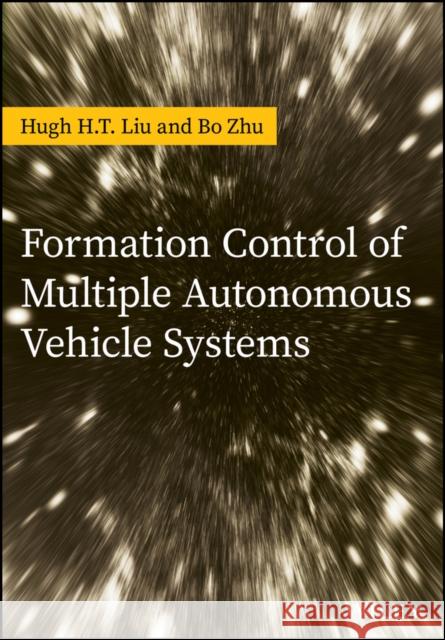
Formation Control of Multiple Autonomous Vehicle Systems
ISBN-13: 9781119263067 / Angielski / Twarda / 2018 / 272 str.
(netto: 623,32 VAT: 5%)
Najniższa cena z 30 dni: 646,50
ok. 30 dni roboczych.
Darmowa dostawa!
I Formation Control: Fundamental Topics 3
1 Preliminaries 1
1.1 Notations 1
1.2 Vectorial Kinematics 3
1.2.1 Frame Rotation 3
1.2.2 The Motion of a Vector 6
1.2.3 The First Time Derivative of a Vector 12
1.2.4 The Second Time Derivative of a Vector 13
1.2.5 The Motion with Respect to Multiple Frames 13
1.2.6 Problem Sets 16
2 Formation Dynamics of Motion Systems 19
2.1 Rigid Body Kinematics and Dynamics (Multi–body Dynamics) 20
2.1.1 The Motion of a Vector 20
2.1.2 Euler Parameters and Unit Quaternion 21
2.2 Virtual Structure 24
2.2.1 Formation Control Problem Statement 27
2.2.2 Extended Formation Control Problem 31
2.3 Behaviour–Based Formation Dynamics 36
2.4 Leader–Follower Formation Dynamics 38
3 Fundamental formation control 39
3.1 A Unified Problem Description 40
3.1.1 Some Key Definitions for Formation Control 40
3.1.2 A Simple Illustrative Example 42
3.2 Information Interaction Conditions 44
3.2.1 Algebraic Graph Theory 44
3.2.2 Conditions for the Case without a Leader 46
3.2.3 Conditions for the Case with a Leader 48
3.3 Synchronization Errors 50
3.3.1 Local Synchronization Error: Type I 52
3.3.2 Local Synchronization Error: Type II 53
3.3.3 Local Synchronization Error: Type III 56
3.4 Velocity Synchronization Control 59
3.4.1 Velocity Synchronization without a Leader 59
3.4.2 Velocity Synchronization with a Leader 60
3.5 Angular–Position Synchronization Control 63
3.5.1 Synchronization without a Position Reference 63
3.5.2 Synchronization to a Position Reference 66
3.6 Formation via Synchronized Tracking 68
3.6.1 Formation Control Solution 1 70
3.6.2 Formation Control Solution 2 71
3.7 Simulation 72
3.7.1 Veri—cation of Theorem 3.12 72
3.7.2 Verification of Theorem 3.13 76
3.7.3 Verification of Theorem 3.14 79
3.8 A Summary 82
II Formation Control: Advanced Topics 91
4 Output–Feedback Solutions to Formation Control 93
4.1 Introduction 93
4.2 Problem Statement 94
4.3 Linear Output–Feedback Control 95
4.4 Bounded Output–Feedback Control 98
4.5 Distributed Linear Control 102
4.6 Distributed Bounded Control 103
4.7 Simulation 105
4.7.1 Case 1: Verification of Theorem 4.1 105
4.7.2 Case 2: Verification of Theorem 4.5 107
4.8 Summary 109
5 Robust and Adaptive Formation Control 113
5.1 Problem Statement 114
5.2 Continuous Control via State Feedback 116
5.2.1 Controller Development 117
5.2.2 Analysis of Tracker u0i 118
5.2.3 Design of Disturbance Estimators (DEs) 119
5.2.4 Closed–Loop Performance Analysis 122
5.3 Bounded State–Feedback Control 126
5.3.1 Design of Bounded State Feedback 126
5.3.2 Robustness Analysis 129
5.3.3 The Effect of UDE on Stability 131
5.3.4 The Effect of UDE on the Bounds of Control 132
5.4 Continuous Control via Output Feedback 133
5.4.1 Design of u0i and ^di 133
5.4.2 Stability Analysis 135
5.5 Discontinuous Control via Output Feedback 137
5.5.1 Controller Design 137
5.5.2 Stability Analysis 140
5.6 GSE–based Synchronization Control 143
5.6.1 Coupled Errors 144
5.6.2 Controller Design and Convergence Analysis 147
5.7 GSE–based Adaptive Formation Control 151
5.7.1 Problem Statement 151
5.7.2 Controller Development 152
5.8 A Summary 155
5.9 Exercises 156
III Formation Control: Application Cases Studies 163
6 Formation Control of Space Systems 165
6.1 Lagrangian Formulation of Spacecraft Formation 166
6.1.1 Lagrangian Formulation 166
6.1.2 Attitude Dynamics of Rigid Spacecraft 167
6.1.3 Relative Translational Dynamics 170
6.2 Adaptive Formation Control 172
6.3 Applications and Simulation Results 173
6.3.1 Application 1: Leader–Follower Spacecraft Pair 173
6.3.2 Application 2: Multiple Spacecraft in Formation 176
6.4 Summary 179
7 Formation Control of Aerial Systems 183
7.1 Vortex–Induced Aerodynamics 184
7.1.1 Model of the trailing vortices of leader aircraft 189
7.1.2 Single horseshoe vortex model (SHVM) 190
7.1.3 Continuous vortex sheet model (CVSM) 192
7.2 Aircraft Autopilot Models 194
7.2.1 Models for the Follower Aircraft 196
7.2.2 Kinematics for Close Formation Flight 196
7.3 Controller Design 197
7.3.1 Linear proportional–integral (PI) Controller 197
7.3.2 UDE–based Formation Flight Controller 199
7.4 Simulation Results 204
7.4.1 Simulation Results for Controller 1 204
7.4.2 Simulation Results for Controller 2 205
7.5 Conclusions 217
8 Formation Control of Robotic Systems 219
8.1 Introduction 219
8.2 Visual Tracking 223
8.2.1 Imaging Hardware 223
8.2.2 Image Distortion 226
8.2.3 Colour Thresholding 229
8.2.4 Noise Rejection 230
8.2.5 Data Extraction 232
8.3 Synchronization Control 234
8.3.1 Synchronization 234
8.3.2 Formation Parameters 235
8.3.3 Architecture 237
8.3.4 Control Law 237
8.3.5 Simulation 238
8.4 Passivity Control 244
8.4.1 Passivity 245
8.4.2 Formation Parameters 245
8.4.3 Control Law 246
8.4.4 Simulation 249
8.5 Experiments 252
8.5.1 Setup 252
8.5.2 Results 254
8.6 Conclusion 255
8.6.1 Summary 255
IV Formation Control: Laboratory 267
9 Experiments on 3DOF Desktop Helicopters 269
9.1 Description of the Experimental Setup 270
9.2 Mathematical Models 272
9.2.1 Nonlinear 3DOF Model 272
9.2.2 2DOF Model for Elevation and Pitch Control 277
9.3 Exp.1: GSE–based Synchronized Tracking 280
9.4 Exp.2: DE–based Robust Synchronized Tracking 289
9.5 Exp.3: Output–Feedback based Sliding–Mode Control 301
Hugh H. T. Liu, is Professor, at the University of Toronto Institute for Aerospace Studies (UTIAS). His research work has included a number of aircraft systems and control related areas. Professor Liu has made significant research contributions in autonomous unmanned systems.
Bo Zhu, is Associate Professor, at the School of Aeronautics and Astronautics, University of Electronic Science and Technology of China (UESTC). His research work has included a number of aircraft systems and control related areas.
This text explores formation control of vehicle systems and introduces three representative systems: space systems, aerial systems and robotic systems
Formation Control of Multiple Autonomous Vehicle Systems offers a review of the core concepts of dynamics and control and examines the dynamics and control aspects of formation control in order to study a wide spectrum of dynamic vehicle systems such as spacecraft, unmanned aerial vehicles and robots. The text puts the focus on formation control that enables and stabilizes formation configuration, as well as formation reconfiguration of these vehicle systems. The authors develop a uniform paradigm of describing vehicle systems dynamic behaviour that addresses both individual vehicle s motion and overall group s movement, as well as interactions between vehicles.
The authors explain how the design of proper control techniques regulate the formation motion of these vehicles and the development of a system level decision–making strategy that increases the level of autonomy for the entire group of vehicles to carry out their missions. The text is filled with illustrative case studies in the domains of space, aerial and robotics.
Contains uniform coverage of "formation" dynamic systems development
Presents representative case studies in selected applications in the space, aerial and robotic systems domains
Introduces an experimental platform of using laboratory three–degree–of–freedom helicopters with step–by–step instructions as an example
Provides open source example models and simulation codes
Includes notes and further readings that offer details on relevant research topics, recent progress and further developments in the field
Written for researchers and academics in robotics and unmanned systems looking at motion synchronization and formation problems, Formation Control of Multiple Autonomous Vehicle Systems is a vital resource that explores the motion synchronization and formation control of vehicle systems as represented by three representative systems: space systems, aerial systems and robotic systems.




Czytaj nas na:
1997-2026 DolnySlask.com Agencja Internetowa
KrainaKsiazek.PL - Księgarnia Internetowa


