• Wyszukiwanie zaawansowane
  • Kategorie
  • Kategorie BISAC
  • Książki na zamówienie
  • Promocje
  • Granty
  • Książka na prezent
  • Opinie
  • Pomoc
  • Załóż konto
  • Zaloguj się

Formal Methods for Embedded Distributed Systems: How to Master the Complexity » książka


zaloguj się | załóż konto
Logo Krainaksiazek.pl

koszyk

konto

szukaj
topmenu
Księgarnia internetowa
Szukaj
Książki na zamówienie
Promocje
Granty
Książka na prezent
Moje konto
Pomoc
 
 
Wyszukiwanie zaawansowane
Pusty koszyk
Bezpłatna dostawa dla zamówień powyżej 20 złBezpłatna dostawa dla zamówień powyżej 20 zł

Kategorie główne

• Nauka
 [2949965]
• Literatura piękna
 [1857847]

  więcej...
• Turystyka
 [70818]
• Informatyka
 [151303]
• Komiksy
 [35733]
• Encyklopedie
 [23180]
• Dziecięca
 [617748]
• Hobby
 [139972]
• AudioBooki
 [1650]
• Literatura faktu
 [228361]
• Muzyka CD
 [398]
• Słowniki
 [2862]
• Inne
 [444732]
• Kalendarze
 [1620]
• Podręczniki
 [167233]
• Poradniki
 [482388]
• Religia
 [509867]
• Czasopisma
 [533]
• Sport
 [61361]
• Sztuka
 [243125]
• CD, DVD, Video
 [3451]
• Technologie
 [219309]
• Zdrowie
 [101347]
• Książkowe Klimaty
 [123]
• Zabawki
 [2362]
• Puzzle, gry
 [3791]
• Literatura w języku ukraińskim
 [253]
• Art. papiernicze i szkolne
 [7933]
Kategorie szczegółowe BISAC

Formal Methods for Embedded Distributed Systems: How to Master the Complexity

ISBN-13: 9781402079962 / Angielski / Twarda / 1991 / 263 str.
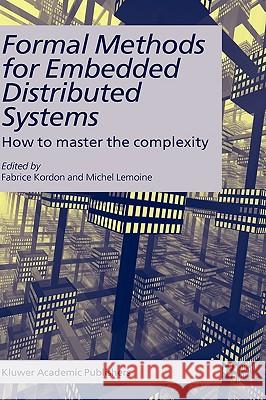
Fabrice Kordon; Fabrice Kordon; Michel Lemoine
Formal Methods for Embedded Distributed Systems: How to Master the Complexity Kordon, Fabrice 9781402079962 Kluwer Academic Publishers - książkaWidoczna okładka, to zdjęcie poglądowe, a rzeczywista szata graficzna może różnić się od prezentowanej.

Formal Methods for Embedded Distributed Systems: How to Master the Complexity

ISBN-13: 9781402079962 / Angielski / Twarda / 1991 / 263 str.

Fabrice Kordon; Fabrice Kordon; Michel Lemoine
cena 403,47
(netto: 384,26 VAT:  5%)

Najniższa cena z 30 dni: 385,52
Termin realizacji zamówienia:
ok. 22 dni roboczych
Bez gwarancji dostawy przed świętami

Darmowa dostawa!

The development of any Software (Industrial) Intensive System, e.g. critical embedded software, requires both different notations, and a strong devel- ment process. Different notations are mandatory because different aspects of the Software System have to be tackled. A strong development process is mandatory as well because without a strong organization we cannot warrantee the system will meet its requirements. Unfortunately, much more is needed The different notations that can be used must all possess at least one property: formality. The development process must also have important properties: a exha- tive coverage of the development phases, and a set of well integrated support tools. In Computer Science it is now widely accepted that only formal notations can guarantee a perfect de?ned meaning. This becomes a more and more important issue since software systems tend to be distributed in large systems (for instance in safe public transportation systems), and in small ones (for instance numerous processors in luxury cars). Distribution increases the complexity of embedded software while safety criteria get harder to be met. On the other hand, during the past decade Software Engineering techniques have been improved a lot, and are now currently used to conduct systematic and rigorous development of large software systems. UML has become the de facto standard notation for documenting Software Engineering projects. UML is supported by many CASE tools that offer graphical means for the UML notation.


Kategorie:
Informatyka, Bazy danych
Kategorie BISAC:
Computers > Software Development & Engineering - General
Computers > Computer Architecture
Computers > Computer Science
Wydawca:
Kluwer Academic Publishers
Język:
Angielski
ISBN-13:
9781402079962
Rok wydania:
1991
Wydanie:
2004
Ilość stron:
263
Waga:
1.29 kg
Wymiary:
23.5 x 15.5
Oprawa:
Twarda
Wolumenów:
01
Dodatkowe informacje:
Bibliografia
Wydanie ilustrowane

Preface Contributing Authors Introduction; F. Kordon, M. Lemoine 1. The 'Traditional' development approach 2. What is covered in this book 3. Organization of chapters Part I: The BART Case Study 1: The BART Case Study; V. Winter, F. Kordon, M. Lemoine 1. Introduction 2. Objective 3. General Background on the BART Train System 4. Informal Specification for the AATC System 5. Inputs and Outputs to the Control Algorithm 6. Physical Performance of the Train in Response to Commands 7. Worst Case Stopping Profile 8. Considerations with Acceleration and Speed Commands 9. Quantitative Quality and Safety Metrics to be Demonstrated 10. Vital Station Computer (VSC) Issues 11. Miscellaneous Questions and Answers Part II: Building and Validating Conceptual Aspects 2: Formal Specification and Refinement of a Safe Train Control Function; V. Winter, D. Kapur, G. Fuehrer 1. Introduction 2. Technical approach and method 3. Inputs taken from the BART case study 4. Applying the approach to the case study 5. Results raised by this technique 6. Conclusion 7. Appendixes 3: From UML to Z; M. Lemoine, G. Gaudière 1. Introduction 2. Technical approach and method 3. Our approach in details 4. Inputs taken from the BART case study 5. Applying the approach to the case study 6. Results raised by this technique 7. Conclusion 4: Environmental Modeling with UML; Adriaan de Groot, Jozef Hooman 1. Introduction 2. Technical approach and method 3. Applying our approach to the case study 4. Designing a Controller 5. Results raised by this technique 6. Conclusion Part III: Building and Validating Operational Aspects 5: Checking BART Test Scenarios with UML’s Object Constraint Language; M. Gogolla, P. Ziemann 1. Introduction 2. Technical approach and method 3. Inputs taken from the BARTcase study 4. Applying the approach to the case study 5. Results raised by this technique 6. Conclusion 6: Modeling and verifying behavioral aspects; F. Bréant, J. -M. Couvreur, F. Gilliers, F. Kordon, I. Mounier, E. Paviot-Adet, D. Poitrenaud, D. Regep, G. Sutre 1. Introduction 2. Technical approach and method 3. Inputs taken from the DART case study 4. Applying the approach to the case study 5. State space computation using DDD 6. Conclusion Part IV: Methodological Aspects 7: AutoFocus - Mastering the Complexity; B. Schätz 1. Introduction 2. Technical Approach and Method 3. Inputs taken from the BART case study 4. Applying the approach to the case study 5. Results raised by this technique 6. Conclusion 8: Conclusions; F. Kordon, M. Lemoine 1. Are Formal Methods an appropriate answer to the Design of Distributed Systems? 2. A process for the Design of Safety Critical Distributed Systems


Udostępnij

Facebook - konto krainaksiazek.pl


Opinie o Krainaksiazek.pl na Opineo.pl

Partner Mybenefit

Krainaksiazek.pl w programie rzetelna firma Krainaksiaze.pl - płatności przez paypal

Czytaj nas na:

Facebook - krainaksiazek.pl
  • książki na zamówienie
  • granty
  • książka na prezent
  • kontakt
  • pomoc
  • opinie
  • regulamin
  • polityka prywatności

Zobacz:

  • Księgarnia czeska

  • Wydawnictwo Książkowe Klimaty

1997-2025 DolnySlask.com Agencja Internetowa

© 1997-2022 krainaksiazek.pl
     
KONTAKT | REGULAMIN | POLITYKA PRYWATNOŚCI | USTAWIENIA PRYWATNOŚCI
Zobacz: Księgarnia Czeska | Wydawnictwo Książkowe Klimaty | Mapa strony | Lista autorów
KrainaKsiazek.PL - Księgarnia Internetowa

Polityka prywatnosci - link
Krainaksiazek.pl - płatnośc Przelewy24
Przechowalnia Przechowalnia





